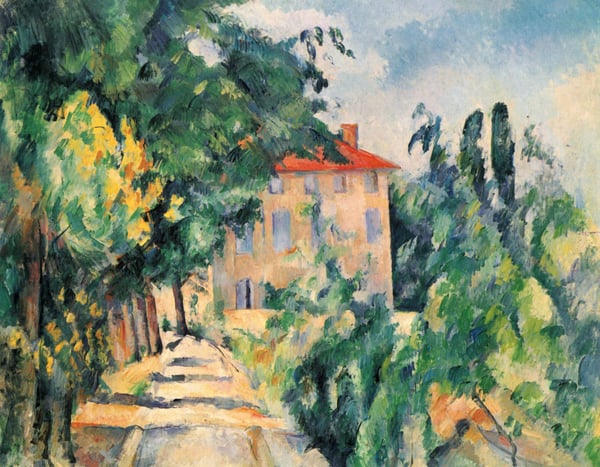
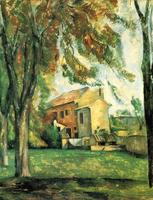
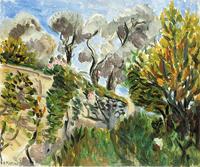
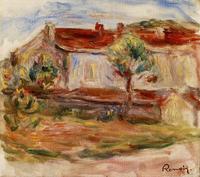
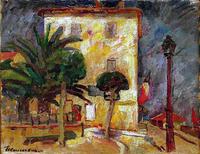
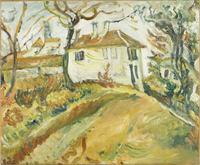
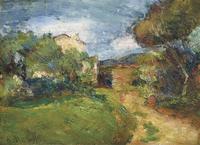
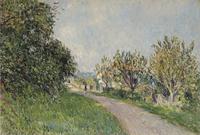
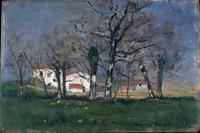
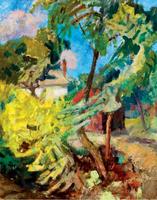
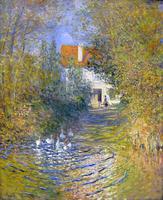
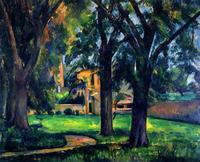
In Paul Cézanne's House with Red Roof, a mature-period landscape from his Post-Impressionist oeuvre, the artist achieves a seminal shift away from the optical naturalism of Impressionism. Instead of capturing a fleeting moment, Cézanne builds the scene through deliberate, parallel brushstrokes and a rigorous, almost architectural structure. The red roof anchors the composition, but each element—the angled planes of the house, the volumetric trees, the shifting patches of green and earth—is simplified into its geometric essence. This analytical approach, where color constructs form rather than merely describing it, directly anticipates Cubism and marks Cézanne as the pivotal bridge between 19th-century Impressionism and 20th-century modernism. The work’s true significance lies in its demonstration that a landscape can be reordered by the painter’s mind, achieving a timeless, monumental stability rather than a literal transcription of nature.