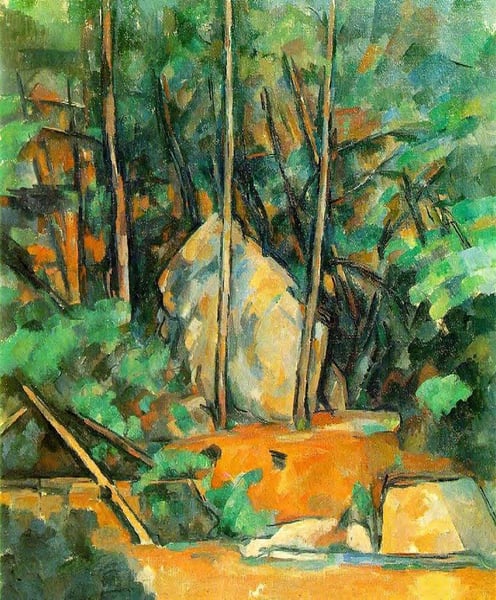
In the Park of Chateau Noir
Ayrıntılar
Paul Cezanne sanatçısının In the Park of Chateau Noir eseri hakkında uzman analizi
Tarz: Cubism · Tür: landscape
Expert Analysis: In the Park of Chateau Noir (c. 1900–1904) by Paul Cézanne
Cézanne’s In the Park of Chateau Noir is a pivotal landscape from the artist’s final period, a phase that directly anticipates the formal language of Cubism. Though Cézanne is often retrospectively linked to Cubism—and this work embodies many of its nascent principles—it remains deeply rooted in direct observation of nature, creating a tense dialogue between perceptual reality and pictorial structure.
Significance within the Final Period and Cubism’s Genesis
-
Faceted, Geometric Brushwork: Cézanne builds the scene with parallel, hatched strokes and block-like planes of color—greens, ochres, and deep blues—that fracture the motif into a mosaic of facets. This technique flattens depth while preserving a sense of mass, a method that Picasso and Braque would later push further into analytical Cubism.
-
Multiple Viewpoints and Distorted Space: The trees, pathways, and rocky formations are rendered from slightly shifting perspectives. The viewer’s eye moves across the canvas without a single vanishing point, collapsing foreground and background. This spatial ambiguity, where forms tilt and overlap, was revolutionary and directly inspired Cubist fragmentation.
-
Color as Structure: Unlike Impressionists who used color for light effects, Cézanne uses color to model volume and organize composition. Warm and cool hues (e.g., orange-browns against blue-greens) create a rhythmic tension that holds the picture together, prefiguring Cubism’s emphasis on pictorial structure over illusion.
-
Subject of Chateau Noir: Cézanne painted this site, a dark, forested estate near Aix-en-Provence, repeatedly in his final years. The dense, tangled park allowed him to explore the interplay of vertical tree trunks, foliage, and rocky ground—a perfect laboratory for reducing nature to its underlying geometry.
Art-Historical Impact
In the Park of Chateau Noir stands as a masterful bridge between late-19th-century Impressionism and early-20th-century avant-garde movements. Its deliberate flattening, emphasis on the picture plane, and articulation of space through colored planes directly informed the Cubist revolution of Picasso and Braque. More than a mere predecessor, this painting exemplifies Cézanne’s dictum to “treat nature by the cylinder, the sphere, the cone”—not as an abstract exercise, but as a profound inquiry into how we see and how we construct meaning from the visible world.
Museum / Gallery
Görsel olarak benzer
İlişkili kompozisyon ve renk paletine sahip 20 eser
In the Forest
Paul Cezanne
Woodland with Boulders
Paul Cezanne
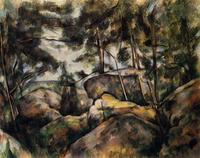
Rocks at Fountainebleau
Paul Cezanne
Forest View near Barbizon
Johan Hendrik Weissenbruch
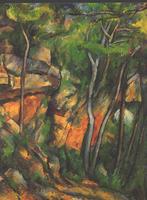
In the Park of the Chateau Noir
Paul Cezanne
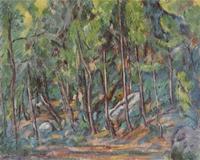
In the Forest of Fontainbleau
Paul Cezanne
Rocks near the Caves below the Chateau Noir
Paul Cezanne
Forest near the rocky caves above the Chateau Noir
Paul Cezanne
Woodland-Stream
John Henry Twachtman
Shadows
Franklin Carmichael
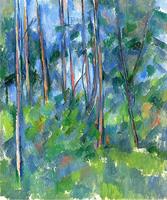
In the Woods
Paul Cezanne
In the Woods
Paul Cezanne
Forest Scene
Kenneth Baker
In the Woods
Paul Cezanne
The forest
Alekos Kontopoulos
Landscape (mountains)
Umberto Boccioni
Trees at Mimizan
Winston Churchill
The Park of the Chateau Noir with Well
Paul Cezanne
Trivaux Pond
Henri Matisse
Monhegan, Maine
Robert Henri