
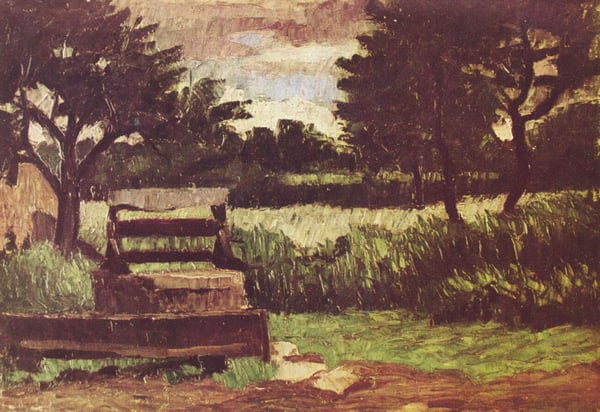
Landscape with fountain
Dettagli
Analisi esperta di Landscape with fountain di Paul Cezanne
Stile: Romanticism · Genere: landscape
Expert Art Historical Analysis
Paul Cézanne’s Landscape with Fountain is a compelling early work from what scholars refer to as his Dark period (c. 1861–1870), a phase steeped in the emotional intensity and dramatic chiaroscuro of Romanticism. Though Cézanne later became a foundational figure of Post‑Impressionism, this painting belongs to a formative moment when he was absorbing the Romantic ideal of nature as a sublime, brooding force.
Significance within Romanticism & the Dark Period
-
Melancholic Palette and Mood
As the “Dark period” implies, Cézanne here employs deep browns, bituminous blacks, and muted greens, with only sparse touches of lighter tones. This somber palette aligns with Romanticism’s fascination with twilight, ruin, and the untamed power of landscape. The fountain—often a symbol of life and clarity—emerges as a pale, almost ghostly focal point, its water rendered in thick, dense brushstrokes that suggest movement but also a weighty, almost geological presence. -
Romantic Sublime in Nature
Unlike the balanced, pastoral landscapes of earlier centuries, Cézanne’s composition is deliberately unbalanced: dark, overhanging foliage crowds the foreground, while the fountain nestles in a recessed, shadowy glade. This asymmetry evokes the Romantic sublime—nature that is both beautiful and threatening. The fountain’s classical motif (a possible nod to Roman or Renaissance gardens) is subsumed by the encroaching wildness, a Romantic trope of human artifice yield to elemental forces. -
Brushwork and Texture
Cézanne’s early style is more turbulent than his later, more structural approach. Here, heavy impasto and visible, almost agitated strokes convey the raw energy of growth and decay. The rough handling of paint itself becomes a Romantic gesture—emotional, tactile, and expressive rather than refined. -
Transitional Significance
While the painting is steeped in Romantic conventions, it also hints at Cézanne’s future innovations. The fountain’s curved, simplified form and the blocky treatment of rocks anticipate his later geometric reduction of nature. Thus, Landscape with Fountain is significant not only as a Romantic landscape but as a document of Cézanne’s struggle to move beyond dramatic emotionalism toward a more disciplined vision of form.
In summary, this work stands as a powerful example of how Cézanne, even in his early, Romantic phase, used landscape to explore profound emotional contrasts—light against darkness, human order against natural chaos—setting the stage for his revolutionary role in modern art.
Visivamente simili
20 opere con composizione e palette affini
Well in summer
Constant Troyon
Na Cisterna
António de Carvalho da Silva Porto
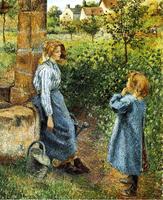
Young Woman and Child at the Well
Camille Pissarro
At the Well
Henry Herbert La Thangue

The water wheel [sketch]
Silvestro Lega
Shmelevka. Windy day
Ivan Shishkin
A well between two properties
Francois-Marie Firmin-Girard
Mother Presle, Montfoucault
Camille Pissarro
The well
John Absolon
Landscape with a Sweep-pole Well
Károly Lotz
Halloween, Monhegan
Jamie Wyeth
Young shepherd at the well
Filippo Indoni
At the Well
Gaston Vuillier
Well at Ruisseauville near Agincourt
John Absolon
The Treasure of Carcassonne
Dorothy Lathrop
The water wheel
Silvestro Lega
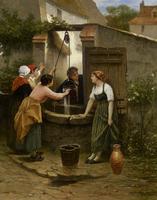
By the Well
Guillaume Seignac
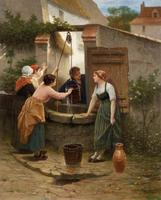
By the Well
Paul Seignac
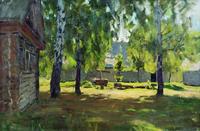
Sunny Day. Near the isba.
Isaac Levitan
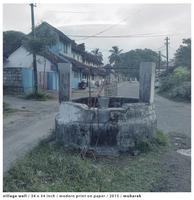
Village well
Mubarak Atmata