
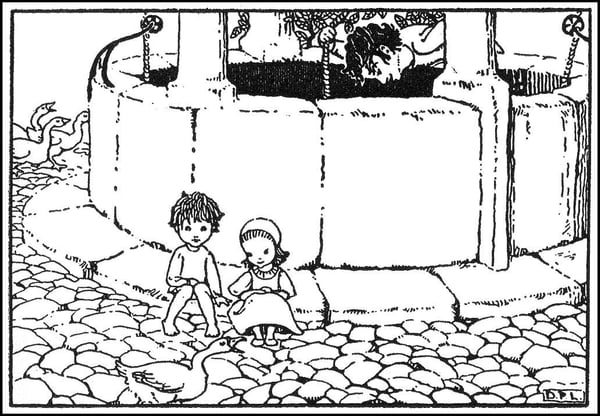
The Treasure of Carcassonne
Dettagli
Analisi esperta di The Treasure of Carcassonne di Dorothy Lathrop
Stile: Art Nouveau (Modern) · Genere: illustration
Expert Analysis: "The Treasure of Carcassonne" by Dorothy Lathrop
Dorothy Lathrop’s "The Treasure of Carcassonne" stands as a notable example of how Art Nouveau’s organic, decorative language was adapted to the intimate scale of book illustration. While the style is often associated with architecture, furniture, and poster art, Lathrop brings its sinuous lines and nature-inspired motifs into the narrative realm, creating a bridge between fine art and children’s literature.
Significance within Art Nouveau
Lathrop’s illustration embodies the Art Nouveau preoccupation with fluid, undulating contours and the fusion of natural forms with man-made objects. In this piece, the medieval setting of Carcassonne—a fortified city of towers and ramparts—is reinterpreted through the style’s characteristic whiplash curves and intertwined foliage. The “treasure” is likely depicted as a nest of jewel-like, botanical or animal forms, echoing the movement’s love for peacock feathers, lilies, and other decorative organic motifs. Lathrop’s linework is precise yet graceful, turning masonry into living, breathing growth. This reflects Art Nouveau’s core belief that art should permeate every aspect of life, even within the pages of a storybook.
Significance as an Illustration
As an illustrator, Lathrop was a pioneer who helped elevate children’s book art to a fine-art standard. Her work is known for its meticulous detail, atmospheric depth, and sensitivity to fantasy themes. "The Treasure of Carcassonne" likely draws on the legend of the city’s hidden wealth—perhaps a mix of historical relics and mythic wonders. Lathrop’s ability to render both the grandeur of the medieval fortress and the delicate intricacies of a hidden treasure (jewels, ancient artifacts, or enchanted flora) demonstrates her skill in balancing narrative clarity with decorative richness. This aligns with the Art Nouveau ethos that form and function, beauty and story, are inseparable.
Legacy and Uniqueness
Lathrop is celebrated for being the first illustrator to win the prestigious Caldecott Medal (in 1938 for Animals of the Bible), yet her earlier works like "The Treasure of Carcassonne" already display the hallmarks that would define her career: a reverence for nature, a love of the fantastic, and a masterful handling of line and pattern. In this piece, she returns Art Nouveau to its roots in illustration—a medium the style’s pioneers (like Aubrey Beardsley and Alphonse Mucha) also cherished—but infuses it with a distinctly American sensibility of romantic medievalism. The artwork is significant as a meeting point between European fin-de-siècle decorativeness and the emerging golden age of American children’s book illustration, proving that Art Nouveau’s elegance could thrive in the service of storytelling.
Genere
Stile
Visivamente simili
20 opere con composizione e palette affini
Emblemata - Well
M.C. Escher
Young Woman and Child at the Well
Camille Pissarro
The Treasure of Carcassonne
Dorothy Lathrop

Village well
Mubarak Atmata
Young shepherd at the well
Filippo Indoni
Well in summer
Constant Troyon
Na Cisterna
António de Carvalho da Silva Porto
Landscape with fountain
Paul Cezanne
A well between two properties
Francois-Marie Firmin-Girard
At the Well
Henry Herbert La Thangue
Spirit of the Well
Alexandre Charles Guillemot
At the Well
Gaston Vuillier
Exlibris T.B. S.
Oleksandr Aksinin
Women at the Well
Paul Signac
By the Well
Paul Seignac
By the Well
Guillaume Seignac
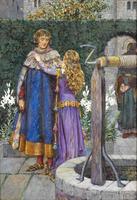
Elaine and Lancelot
Eleanor Fortescue-Brickdale
The water wheel [sketch]
Silvestro Lega
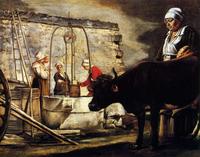
The Well
Le Nain brothers
Tefik's Yard (in Mangalia)
Nicolae Tonitza