
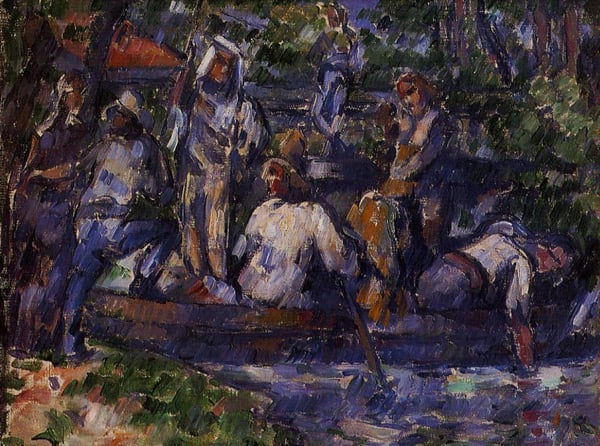
Expertenanalyse zu Paul Cezannes Leaving on the Water
Stil: Post-Impressionism · Genre: genre painting
Expert Analysis: "Leaving on the Water" by Paul Cézanne
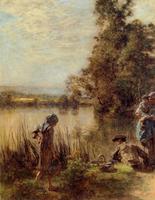
As a quintessential work of Cézanne’s mature period, Leaving on the Water exemplifies the artist’s revolutionary break from Impressionist spontaneity toward a more structured, monumental vision—a defining hallmark of Post-Impressionism. Painted as a genre scene (everyday life), the work transforms a simple moment of embarkation into an exploration of form, color, and spatial tension.
Significance within Post-Impressionism and Cézanne’s Oeuvre:
- Structural Composition: Cézanne abandons atmospheric illusion in favor of a carefully constructed geometry. Figures, boats, and water are rendered as interlocking planes of color, anticipating the Cubist revolution. The composition is balanced yet dynamic, with diagonal lines of the boat and shoreline creating a thrust into depth that is simultaneously flattened by the dense, faceted brushwork.
- Color as Form: True to his mature style, Cézanne uses modulated patches of blue, green, ochre, and white to define volume and light without relying on traditional shading. The water is not a mirror of reality but a mosaic of reflective color patches—each stroke building a solid, almost architectural surface.
- Ambiguity of Space: The boundary between water, sky, and land is deliberately blurred. This ambiguity challenges the viewer’s perception and forces a rethinking of pictorial space—a cornerstone of Post-Impressionist innovation that paved the way for 20th-century abstraction.
- Psychological Weight: Unlike earlier Impressionist scenes of leisure, Leaving on the Water carries a sense of solemnity and permanence. The figures are not narrative agents but formal elements, integrated into the landscape, emphasizing Cézanne’s belief that art should reveal the enduring structure beneath fleeting appearances.
Why It Matters: This painting marks Cézanne’s move from recording visual sensation to constructing a “harmony parallel to nature.” It is a bridge between Impressionism’s light-filled immediacy and Cubism’s fragmented reality. In its quiet, monumental stability, Leaving on the Water demonstrates why Cézanne is often called the “father of modern art.” The work’s significance lies not in its subject, but in how it redefines seeing itself—through color, structure, and an almost geological solidity.
Museum / Gallery
Genre
Visuell ähnlich
20 Werke mit ähnlicher Komposition und Farbpalette
Landscape
Konstantin Korovin
The Ferry at Plougastel
Eugene Boudin
Boating Pleasure at Ada
Ibrahim Calli
Laundresses
Eugene Boudin
In a Boat
Victor Borisov-Musatov
On the dock
Alessandro Milesi
Life in the Fields
Paul Cezanne
Couples Relaxing by a Pond
Paul Cezanne
Berény Róbert, Zebegényi Halászok
Berény Róbert
The skiff
Pierre-Auguste Renoir
Auf Dem Meer
Albert Edelfelt
Two in a Boat
Theodore Robinson
Lake Ilmen
Pyotr Konchalovsky
A Picnic
Konstantin Korovin
The Fountain
Paul Cezanne
On the Water
Mary Cassatt
In the boat
Konstantin Korovin
Mrs. Chase in Prospect Park
William Merritt Chase
Bathers
Paul Cezanne
Fisherman and his family
Léon Augustin Lhermitte