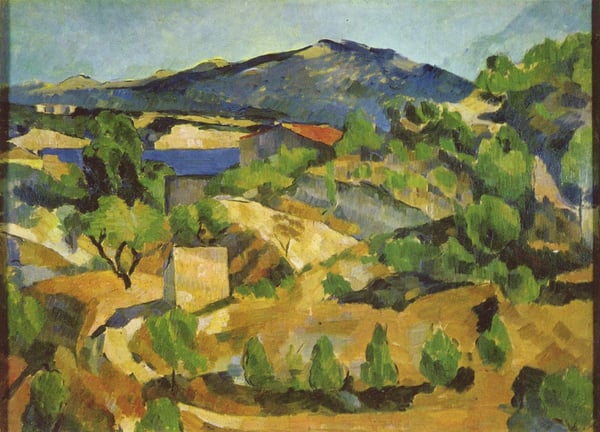
Mountains in Provence. L'Estaque
Détails
Analyse experte de Mountains in Provence. L'Estaque de Paul Cezanne
Style : Post-Impressionism · Genre : landscape
Expert Analysis: "Mountains in Provence. L'Estaque" by Paul Cézanne
Paul Cézanne’s Mountains in Provence. L’Estaque stands as a quintessential work of his mature Post-Impressionist period, a time when the artist radically redefined landscape painting. Painted in the village of L’Estaque near Marseille, this canvas captures the rugged Mont Sainte-Victoire and the bay beyond, but its significance lies far beyond topography.
Formal Innovation: Building with Color and Geometry In this work, Cézanne abandons the atmospheric haze of Impressionism in favor of a structured, analytical approach. He builds the landscape not through line, but through interlocking planes of color. The mountains, trees, and houses are reduced to geometric simplifications—cylinders, spheres, and cones—that anticipate the Cubist revolution of Picasso and Braque. Notice how the warm ochres and greens of the foreground push forward while the cool blues of the distant bay recede, creating a palpable sense of depth without traditional linear perspective. The brushwork is deliberate and faceted, each stroke a small plane of color that constructs form from the canvas outward.
Spatial Tension: Multiple Viewpoints Cézanne famously said that he wanted to “make of Impressionism something solid and durable, like the art of museums.” Here, he achieves that by simultaneously representing the scene from multiple viewpoints. The tabletop-like foreground tilts upward, the middle ground of trees and rooftops shifts, and the mountain seems to slide sideways. This deliberate distortion creates a dynamic, almost tactile sense of space—a visual equivalent of the artist moving his eye across the motif. It is not a passive window onto nature, but an active construction of perception.
Significance: A Bridge Between Centuries Mountains in Provence. L’Estaque is significant because it demonstrates Cézanne’s pivotal role as the father of modern art. His process of reducing nature to essential geometric forms, his modulation of color to model volume, and his activation of the picture plane directly inspired the Cubists. Moreover, his insistence on the painting as a constructed object—rather than a mere representation of reality—influenced nearly every avant-garde movement that followed, from Fauvism to Abstract Expressionism. In this serene Provençal vista, we witness the birth of a new visual language, one that prioritizes the artist’s perception over the natural world’s literal appearance. It is a landscape that thinks as much as it sees.
Visuellement similaire
20 œuvres à la composition et à la palette proches
The Bay of L'Estaque from the East
Paul Cezanne
Antheor Bay
Louis Valtat
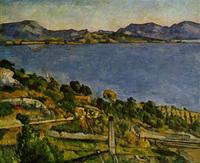
Sea at L'Estaque
Paul Cezanne
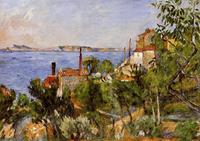
Landscape. Study after Nature
Paul Cezanne
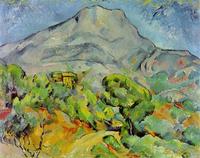
Road near Mont Sainte-Victoire
Paul Cezanne
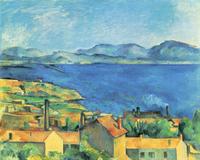
The Gulf of Marseille Seen from L'Estaque
Paul Cezanne
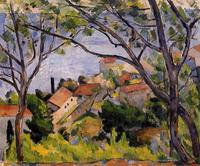
L'Estaque. View through the Trees
Paul Cezanne
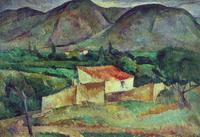
Crimea
Pyotr Konchalovsky
Paysage, St. Tropez
Henri Matisse
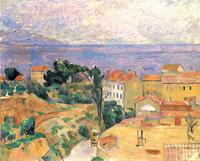
View of L'Estaque
Paul Cezanne
Balchik Landscape
Lucian Grigorescu
Landscape, South of France
Samuel Peploe
Sketch for 'The cypresses (Cassis)'
Rupert Bunny
Landscape in Provence
Paul Cezanne
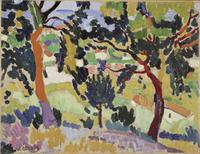
L'Estaque
Andre Derain
Landscape, Sounion
Nikolaos Lytras
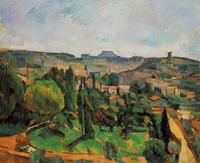
Ile de France Landscape
Paul Cezanne
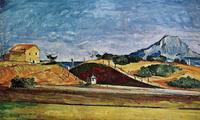
The Railway Cutting
Paul Cezanne
Landscape at Cagnes
Chaim Soutine
The River
Raoul Dufy