Expert analysis of Paul Cezanne’s Pine and Aqueduct
Style: Post-Impressionism · Genre: landscape
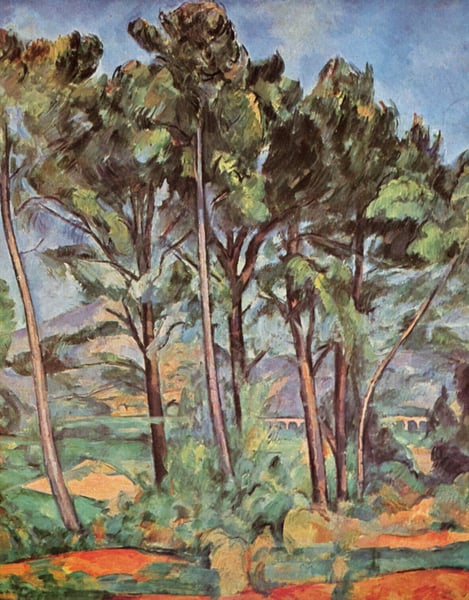
Paul Cézanne’s Pine and Aqueduct (c. 1885–1887) stands as a masterwork of his final period, a time when the artist’s visionary approach to landscape fully crystallized. Executed in the Provençal countryside near his home at Aix-en-Provence, the painting exemplifies Cézanne’s radical rethinking of pictorial space—a hallmark of Post-Impressionism that would profoundly influence the development of Cubism and modern art.
What makes this work significant is its rigorous structural analysis of nature. Cézanne does not merely depict a pine tree beside an ancient aqueduct; he transforms the scene into a system of interlocking geometric planes. The trunk of the pine, rendered in bold, parallel brushstrokes, becomes a vertical axis that anchors the composition, while the foliage is built from patched, faceted blocks of green and ochre. The aqueduct itself is simplified into a series of cylindrical arches, their volumes suggested by subtle shifts in warm earth tones and cool grey-violet shadows. This flattening of depth—where the distance between the near tree and the far hills is compressed—challenges traditional perspective, forcing the eye to read every element on a single, taut pictorial surface.
Cézanne’s late style is characterized by a constructive stroke: each dab of color functions both as a record of light and as a building block of form. In Pine and Aqueduct, the sky is not a passive backdrop but an active mosaic of blue, pink, and white strokes that echo the arcs of the aqueduct. The result is a landscape that feels simultaneously solid and vibrating—a meditation on the underlying order of nature rather than a literal transcription.
Art historically, this work bridges Impressionism’s devotion to transient light and the coming emphasis on structured composition. It demonstrates Cézanne’s famous dictum to “treat nature by means of the cylinder, the sphere, the cone,” yet never loses the sensuousness of the Provençal sun. As a testament to his final period, Pine and Aqueduct reveals an artist at the peak of his powers, distilling landscape into an enduring geometry of vision.
Museum / Gallery
Visually similar
20 works with related composition and palette
Forest
Paul Cezanne
The Great Pine
Paul Cezanne
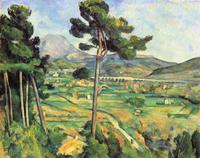
Mont Sainte-Victoire and the Viaduct of the Arc River Valley
Paul Cezanne
Landscape
Pierre-Auguste Renoir
Pines in the Vicinity of Cagnes
Pierre-Auguste Renoir
L'Estaque View Through The Pines
Paul Cezanne
Landscape
Andre Derain
Landscape
Konstantinos Parthenis
Mont Sainte-Victoire
Paul Cezanne
Landscape of Cote d Azur
Pierre Bonnard
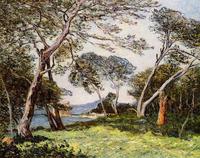
The Pines of the Ile St. Morah
Maxime Maufra
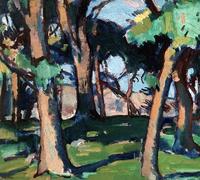
Douglas Hall
Samuel Peploe
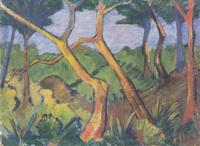
Waldlandschaft
Otto Mueller
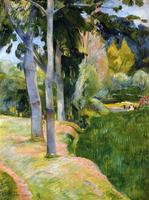
The large tree
Paul Gauguin
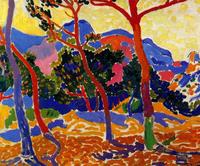
The Trees
Andre Derain
Landscape (mountains)
Umberto Boccioni
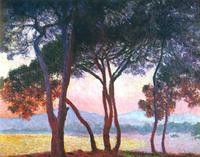
Juan-les-Pins
Claude Monet
Trees
James Yates
A Clearing in the Forest
John Peter Russell
In the Mountains
Gustave Loiseau