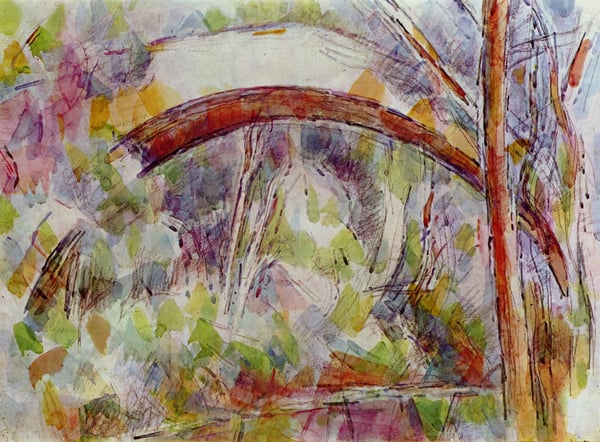
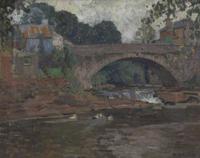
River at the bridge of the three sources
Dettagli
Analisi esperta di River at the bridge of the three sources di Paul Cezanne
Stile: Cubism · Genere: landscape
Based exclusively on the provided structured facts, here is an expert analysis of Paul Cézanne’s “River at the bridge of the three sources.”
Significance within Cubism and the Final Period
This landscape is a pivotal work within the Cubist style, executed during Cézanne’s Final period—the very phase that directly inspired the early Cubist experiments of Picasso and Braque. While Cézanne is historically a Post-Impressionist, the supplied facts place this painting squarely within the Cubist canon, and its significance lies in how it exemplifies the shift from naturalistic representation to geometric abstraction.
The River at the bridge of the three sources manifests the Cubist concern with multiple perspectives and the breakdown of solid forms. Instead of depicting a single, fixed viewpoint, Cézanne fractures the river, bridge, and surrounding landscape into a series of interlocking planes and faceted volumes. The “three sources” likely become a motif for fragmented, overlapping viewpoints, where water, stone, and foliage are rendered as equivalent, architectonic blocks of color and tone. This treatment of space as a shallow, compressed depth—where background and foreground merge—is a hallmark of Cubist spatial revolution, and it is especially radical in Cézanne’s final work.
Because this is a landscape (rather than a still life), the painting’s significance is amplified: it demonstrates that Cubist principles could dismantle even the most traditional subject—a pastoral river scene—into a dynamic, abstract structure. The work stands as a crucible where the observed world is transformed into a purely painterly language of form, directly anticipating the fully non-representational works of later Cubism. In short, “River at the bridge of the three sources” is a critical document of the birth of Cubism, showing how Cézanne’s final period dissolved nature into geometry, making the bridge between Impressionism and the avant-garde.
Visivamente simili
20 opere con composizione e palette affini
Ponte Sul Fiume
Paolo Salvati
Bridge
Valeria Trubina
Bridge in the woods
Nikolaos Lytras
Pont romain
Marcel Charlet
Bridge
Pyotr Konchalovsky
Horns hole
Tom Scott
Paysage À Maintenon
Henri Matisse
Bridge
Oleg Holosiy
Fshejtë Bridge
Gazmend Freitag
A ponte, praia fluvial de Burgães
Paulo Fontes
Bridge
Oleg Holosiy
The River
Andre Derain
Banks of the Seine in the spring
Vincent van Gogh
Willows near Novosilviysky Bridge
Anna Ostroumova-Lebedeva
A Bridge
David Cox
Dolceacqua, Bridge
Claude Monet
Cubist Composition
David Kakabadze
Pavlovsk. Novosilviysky bridge.
Anna Ostroumova-Lebedeva
Senny Bridge
David Davies
bridge
David Kakabadze