Expertenanalyse zu Paul Cezannes Seated Peasant
Stil: Post-Impressionism · Genre: portrait
Expert Analysis of "Seated Peasant" by Paul Cézanne
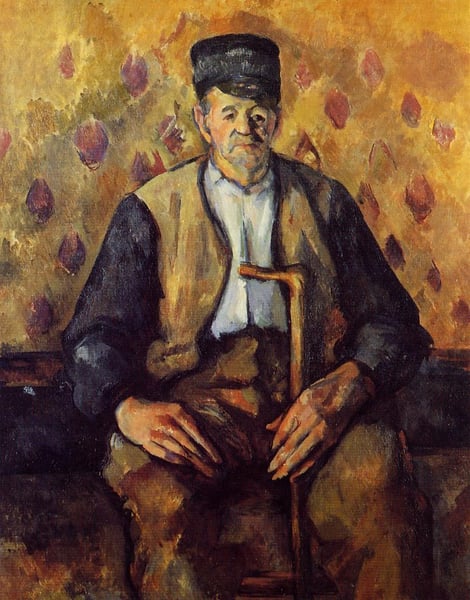
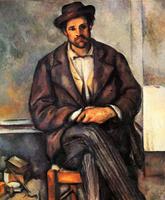
Paul Cézanne’s Seated Peasant belongs to his final period (roughly 1890–1906), a phase widely regarded as the culmination of his artistic vision. Executed in the Post-Impressionist style, this portrait exemplifies Cézanne’s revolutionary approach to form, color, and composition—elements that would later lay the groundwork for Cubism and modern abstraction.
Significance within Post-Impressionism and Cézanne’s Final Period:
-
Monumentality of the Ordinary: Cézanne elevates a humble subject—a peasant—into a timeless, almost architectural presence. Unlike the fleeting, atmospheric impressions of the Impressionists, this portrait is built through deliberate, faceted brushstrokes that give the figure a solid, sculptural weight. The sitter’s pose is stable and frontal, evoking a sense of enduring dignity rather than anecdote or social commentary.
-
Constructive Stroke and Color Modulation: In his late works, Cézanne developed what art historians call the constructive stroke—short, parallel planes of color that build volume and space through their interplay. In Seated Peasant, these strokes do not simply describe the sitter’s clothing or skin; they create an autonomous pictorial structure. Warm ochres, deep blues, and muted greens are carefully calibrated to define the shoulders, torso, and background without relying on traditional chiaroscuro. This method demonstrates Cézanne’s belief that color, not line, should model form.
-
Synthesis of Observation and Structure: Cézanne famously sought to “make of Impressionism something solid and durable, like the art of the museums.” Here, the peasant’s head is subtly tilted, the hands are simplified into abstracted shapes, and the background is flattened into a grid-like pattern of vertical and horizontal strokes. The resulting tension between three-dimensional reality and two-dimensional canvas surface is a hallmark of his final period. The portrait becomes a meditation on perception itself: the sitter is both present and transformed into a kind of structural icon.
-
Bridge to Modernism: This painting is significant as a precursor to the fractured planes of Picasso and Braque. The peasant’s form is reduced to basic geometric volumes—cylinder, sphere, cone—without losing the sense of a living person. Cézanne’s willingness to distort proportions for compositional harmony (the enlarged hands, the compressed torso) anticipates the expressive freedoms of 20th-century art.
-
Emotional and Artistic Resonance: Unlike earlier portraits that might convey social status or psychological depth, Seated Peasant is stripped of narrative. The sitter’s impassive expression and closed-off posture direct attention purely to the painterly act—the way pigment on canvas can evoke mass, light, and the artist’s slow, deliberate search for essential form. This makes the work a quintessential example of Cézanne’s late style, where the subject serves as a vehicle for pure pictorial exploration.
In summary, Seated Peasant is significant because it crystallizes Cézanne’s mature achievements: the marriage of vibrant, modulated color with a rigorous, almost geometric structure; the transformation of a mundane figure into a monumental form; and the decisive step toward a new visual language that would redefine art in the 20th century. It stands as a quiet, powerful testament to the artist’s final, fearless investigation of reality through paint.
Museum / Gallery
Visuell ähnlich
20 Werke mit ähnlicher Komposition und Farbpalette
Old Duff
Samuel Peploe
Two Ukrainians
Vladimir Makovsky
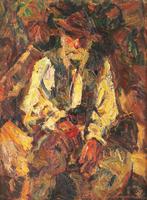
Moş Gheorghe
Rudolf Schweitzer-Cumpana
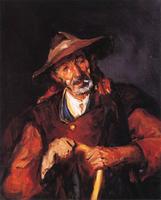
La Jartigo
Robert Henri
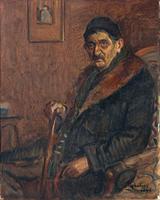
Portrait of Ibnul Emin Mahmut Kemal
Feyhaman Duran
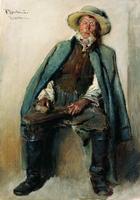
Blind Man
Konstantin Makovsky
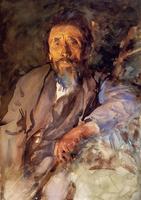
The Tramp
John Singer Sargent
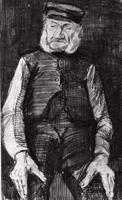
Orphan Man with Cap, Half-Length
Vincent van Gogh
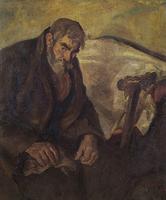
Ancião com muleta
Lasar Segall
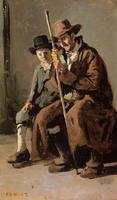
Two Italians, an Old Man and a Young Boy
Camille Corot
Die Dorfpolitiker
Wilhelm Leibl
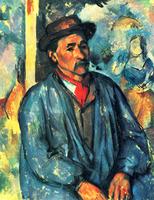
Peasant in a Blue Smock
Paul Cezanne
Untitled
Bela Czobel
Portrait
Konstantin Makovsky
Portrait of a Man
Edgar Degas
Seated Peasant
Paul Cezanne
Portrait of Peasant
Paul Cezanne
A Troubled Soul
Ferdinand Hodler
Portrait of an Older Man
Robert Falk
John
Fred Yates