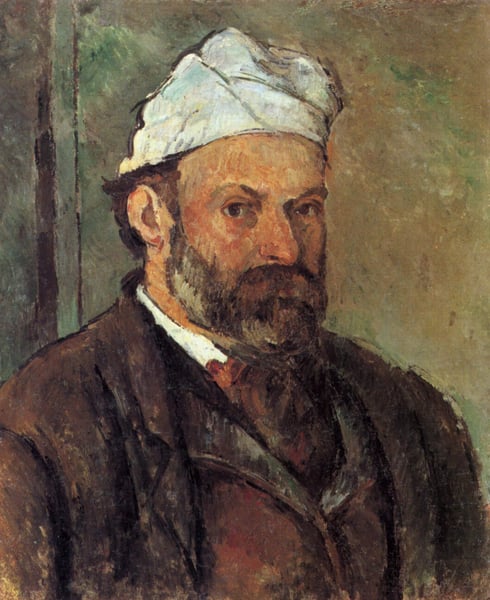
Self-portrait with white turbaned
Detalles
Análisis experto de Self-portrait with white turbaned de Paul Cezanne
Estilo: Post-Impressionism · Género: self-portrait
Expert Analysis: "Self-portrait with white turbaned" by Paul Cézanne
This self-portrait, executed during Cézanne’s mature period, stands as a pivotal example of Post-Impressionism’s shift from the fleeting optical sensations of Impressionism toward a more structural, enduring vision of form. In this work, Cézanne uses the familiar genre of the self-portrait not for mere likeness, but as a laboratory for his revolutionary pictorial logic.
Significance within Post-Impressionism:
The painting exemplifies Cézanne’s core ambition: to "make of Impressionism something solid and durable, like the art of the museums." The white turban—an unusual, almost theatrical accessory—serves a dual purpose. It disrupts the expected naturalism of a self-portrait, emphasizing the artificial construction of the image, while its folded, cylindrical form becomes a geometric anchor. Cézanne builds the face and turban from layered, parallel brushstrokes and modulated planes of color (ochres, blues, greens) rather than from linear outline or chiaroscuro. The result is a fusion of color and drawing: each touch of paint simultaneously describes volume and surface, creating a taut, crystalline structure.
Mature period characteristics:
In contrast to his earlier, more painterly or emotionally charged self-portraits, this work radiates a calm, analytical detachment. The artist gazes outward with a focused, almost stern intensity, but the true subject is the act of seeing itself. Cézanne deliberately flattens the space between figure and background—the turban nearly merges with the wall behind—anticipating the fractured picture plane of Cubism. The psychological depth is replaced by a rigorous formal balance: the tilt of the head, the asymmetry of eyes, and the rhythmic folds of the turban all coexist in a unified, tension-filled harmony.
Legacy:
This self-portrait is significant because it demonstrates how Cézanne transformed a personal image into a universal meditation on perception. His method of constructing form through color relationships and distinct brushstrokes directly influenced Picasso, Braque, and generations of modernists. The white turban, often read as a nod to Rembrandt or Delacroix, is reinterpreted here as a pure compositional element—a bold assertion that painting’s truth lies not in illusion, but in the logic of its own making.
Visualmente similares
20 obras con composición y paleta relacionadas
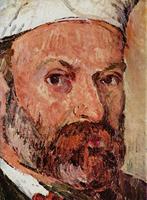
Self-portrait with white turbaned (detail)
Paul Cezanne
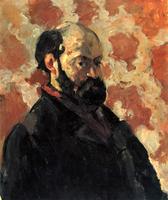
Self-portrait in front of pink background
Paul Cezanne
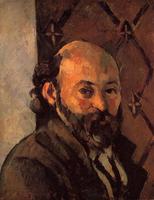
Self-Portrait
Paul Cezanne
Male portrait
Noè Bordignon
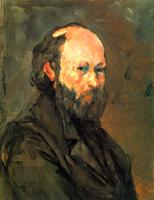
Self-Portrait
Paul Cezanne
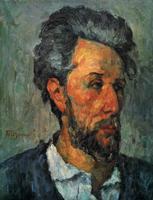
Portrait of Victor Chocquet
Paul Cezanne
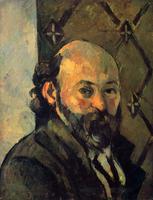
Self-portrait in front of olive wallpaper
Paul Cezanne
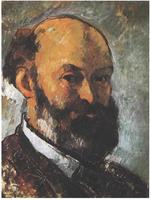
Self-Portrait
Paul Cezanne
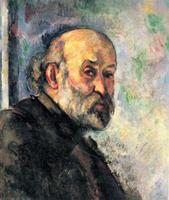
Self-Portrait
Paul Cezanne
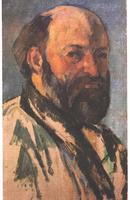
Self-portrait
Paul Cezanne
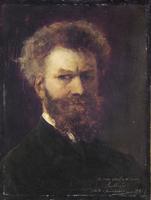
Self-Portrait II
Mihaly Munkacsy
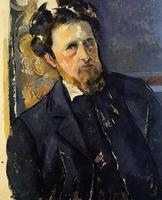
Portrait of Joachim
Paul Cezanne
Автопортрет
Микола Пимоненко
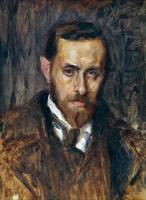
Portrait of the painter Arturo Fittke
Umberto Veruda
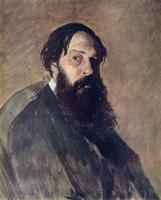
Portrait of the Painter Alexey Savrasov
Vasily Perov
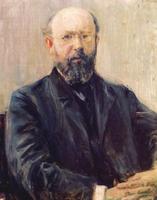
Portrait of Professor Dr. Carl Bernstein
Max Liebermann
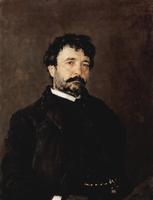
Portrait of the Singer Angelo Mazini
Valentin Serov
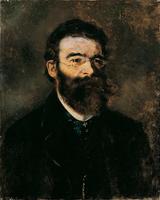
The Internist Professor Samuel Stern
Anton Romako
Self portrait
Isaac Levitan
Portrait of Carl Moll
Oskar Kokoschka