Análisis experto de Smoker de Paul Cezanne
Estilo: Post-Impressionism · Género: portrait
Expert Analysis: "Smoker" by Paul Cézanne (Final Period, Post-Impressionism)
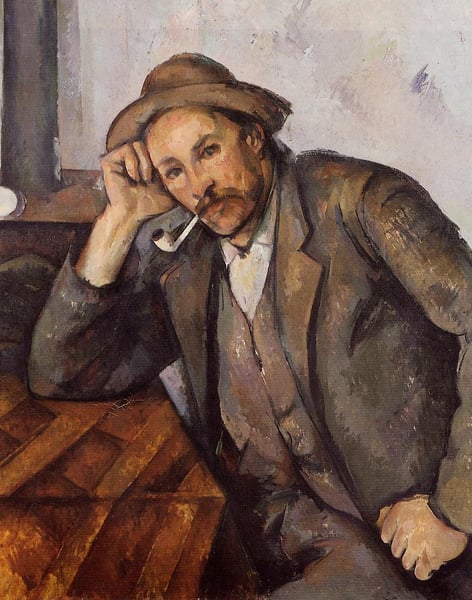
Cézanne’s Smoker, created during his late, or “final,” period, stands as a quintessential example of the artist’s revolutionary approach to portraiture and pictorial structure. Executed within the broader Post-Impressionist movement—which sought to move beyond the naturalism of Impressionism toward subjective expression and formal rigor—this work encapsulates Cézanne’s lifelong pursuit of synthesizing observed reality with the geometric logic of painting.
Significance within Style and Period:
-
Geometry and the “Constructive Stroke”
In his final period (c. 1895–1906), Cézanne increasingly reduced the human figure and surrounding space to simplified, almost architectural planes. In Smoker, the sitter’s head, shoulders, and pipe become a series of interlocking geometric volumes—cylinders, spheres, and cubes—modulated not by line alone but by shifting patches of color. This method, often called the “constructive stroke,” laid the groundwork for the radical formal experiments of Cubism (Picasso later called Cézanne “the father of us all”). -
Color as Structural Element
Unlike the fleeting light effects of Impressionism, Cézanne uses color to define form and depth. The palette in Smoker is subdued yet rich: earthy browns, muted blues, and touches of ochre create a tonal harmony that feels both solid and atmospheric. The smoker’s face is built from warm and cool color contrasts rather than chiaroscuro, giving the portrait a sense of calm monumentality. -
Psychological Ambiguity and Timelessness
The sitter (often identified as a Provençal peasant or a figure from Cézanne’s circle) is depicted without overt narrative or emotion—he stares into space, absorbed in contemplation. This detachment, combined with the simplified forms, elevates the portrait beyond a mere likeness to a timeless meditation on the act of seeing. The pipe becomes a formal motif, a diagonal that anchors the composition. -
Bridge to Modernism
Smoker exemplifies Cézanne’s late style, where he sacrificed conventional perspective and anatomical accuracy for a more abstract, multi-view approach. The slight distortion of the figure’s proportions and the flattening of space anticipate the breakdown of traditional representation that would define 20th-century art.
In summary, Smoker is significant not only as a masterful portrait from Cézanne’s final creative surge but as a crucial pivot point in art history—a work where the tension between observation and abstraction, and between color and form, achieves a profound synthesis that reshaped the course of modern painting.
Museum / Gallery
Género
Estilo
Visualmente similares
20 obras con composición y paleta relacionadas
The Smoker
Paul Cezanne
Man with a Pipe
Paul Cezanne
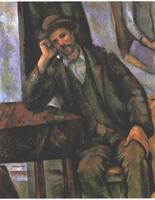
Man Smoking a Pipe
Paul Cezanne
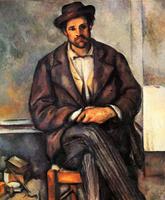
Seated Peasant
Paul Cezanne
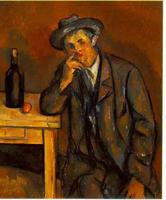
The Drinker
Paul Cezanne
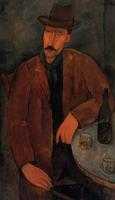
Man with a Glass of Wine
Amedeo Modigliani
Leon Peltier
Claude Monet
The Tramp
John Singer Sargent
Self-Portrait with Pipe and Glass
Vincent van Gogh
Portrait of Edouard Manet
Carolus-Duran
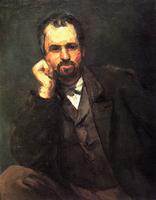
Portrait of a Man
Paul Cezanne
Portrait of the Artist I.S. Ostroukhov
Valentin Serov
Claude Monet Reading
Pierre-Auguste Renoir
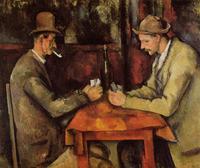
The Card Players
Paul Cezanne
Self-Portrait in a Felt Hat
Paul Cezanne
Portrait of my father
Nina Arbore
The Smoker (Peasant)
Vincent van Gogh
Portrait of a Man
Edgar Degas
Man with Crossed Arms
Paul Cezanne
Portrait of Ambroise Vollard
Paul Cezanne