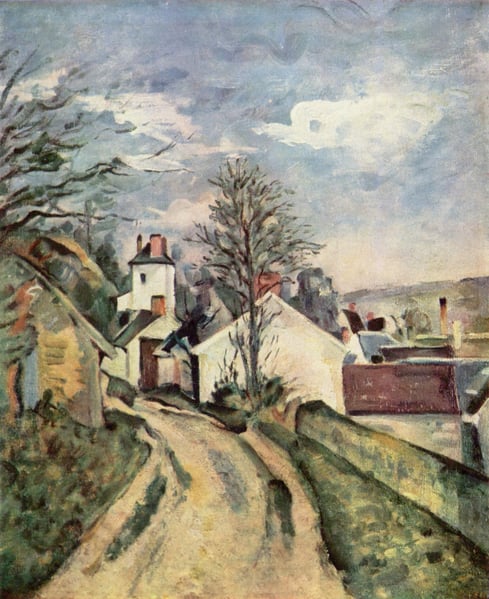
The House of Dr. Gachet in Auvers
Details
Expert analysis of Paul Cezanne’s The House of Dr. Gachet in Auvers
Style: Impressionism · Genre: cityscape
As an expert art historian, I offer the following analysis of Paul Cézanne’s The House of Dr. Gachet in Auvers based strictly on the provided facts.
Artwork: The House of Dr. Gachet in Auvers
Artist: Paul Cézanne
Style: Impressionism
Genre: Cityscape
Period: Impressionist period
Significance Within the Impressionist Period
While Cézanne is often celebrated as a bridge to Post-Impressionism, this painting stands as a vital example of his engagement with the core tenets of Impressionism during that movement’s most active years. Painted in the village of Auvers-sur-Oise—a locale famous for its association with Dr. Paul Gachet and later Vincent van Gogh—Cézanne’s cityscape reveals his unique approach within the Impressionist style.
1. Impressionist Handling of Light and Atmosphere
Typical of Impressionism, the work captures a fleeting moment of natural light. Cézanne modulates color to suggest the play of sunlight on the house’s facade and the surrounding foliage, using short, broken brushstrokes that dissolve form into patches of vibrant hue. This technique aligns with the Impressionist goal of rendering optical sensation rather than precise detail.
2. Ordinary Subject Elevated
The genre of cityscape is treated with the Impressionist preference for modern, everyday life. Instead of a grand historical or mythological scene, Cézanne focuses on a modest rural house. Yet within this ordinary subject, he finds monumental structure—a hallmark that would later define his Post-Impressionist phase. Even here, the composition is robust: the house is stabilized by strong verticals and horizontals, showing Cézanne’s latent interest in geometric order beneath the shimmering surface.
3. Color as Form
In true Impressionist fashion, local color is abandoned in favor of chromatic perception. Shadows are not black or gray but are rendered in cool blues and violets, while warm ochres and greens suggest sunlight filtering through leaves. Cézanne builds the house’s volume through adjacent strokes of contrasting color, a technique that gives the scene both vibrancy and solidity.
4. Significance as a Transitional Work
Although firmly rooted in Impressionism—with its bright palette, outdoor setting, and emphasis on visual immediacy—The House of Dr. Gachet in Auvers already hints at Cézanne’s later innovations. The way he constructs space through overlapping planes and modulates color to create depth foreshadows his famous “constructive stroke” and his role as a father of modern art. Within the Impressionist period, this painting is significant for demonstrating how the movement’s principles could be pushed toward greater structural clarity without losing the freshness of direct observation.
In summary, this cityscape by Cézanne is a quintessential Impressionist work that also presages a new direction. It captures the ephemeral beauty of a specific place and moment while revealing the artist’s relentless search for order—a tension that makes it a compelling and historically important example of Impressionism’s legacy.
Museum / Gallery
Genre
Style
Visually similar
20 works with related composition and palette
Cottages of Auvers
Paul Cezanne
Turning Road at Montgeroult
Paul Cezanne
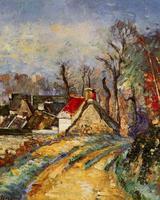
The Turn in the Road at Auvers
Paul Cezanne
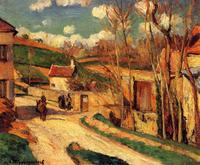
Crossroads at l'Hermitage, Pontoise
Camille Pissarro
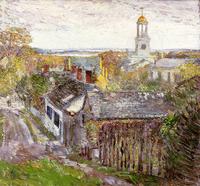
Quincy, Massachusetts
Childe Hassam
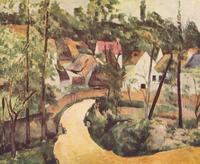
A Turn in the Road
Paul Cezanne
The Large Walnut Tree at Hermitage
Camille Pissarro
The red painted house
Gustave Loiseau
The Route a Vetheuil
Claude Monet
Street in Veneux
Alfred Sisley
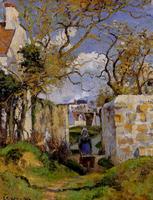
Peasant Pushing a Wheelbarrow, Maison Rondest, Pontoise
Camille Pissarro
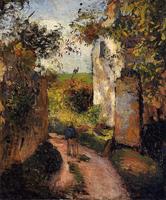
A Peasant in the Lane at Hermitage, Pontoise
Camille Pissarro
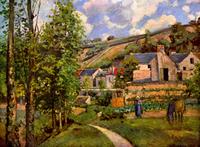
The Hermitage at Pontoise
Camille Pissarro
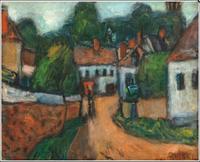
Czobel Bela Grosrouvre 1925
Bela Czobel
First Snow in Louveciennes
Alfred Sisley
View of Auvers
Paul Cezanne
Street in Comrie, Perthshire
Samuel Peploe
Artist's Home Seen from the Back
John Henry Twachtman
Village Landscape
Matthew Smith
Coast at Chaponival
Gustave Loiseau