
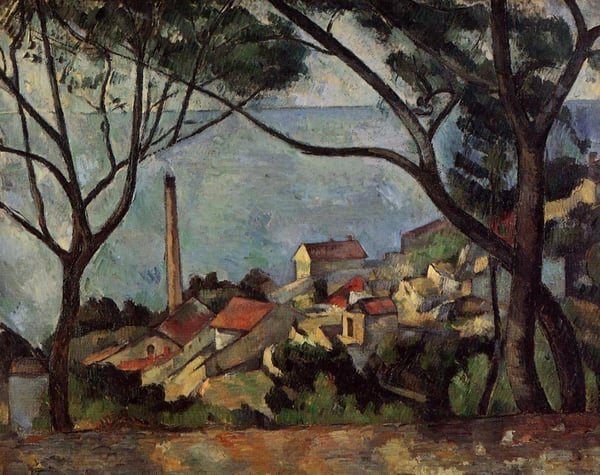
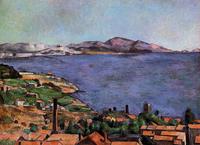
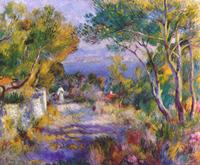
The Sea at l'Estaque
Подробности
Экспертный разбор работы «The Sea at l'Estaque» художника Paul Cezanne
Стиль: Impressionism · Жанр: landscape
Expert Analysis: "The Sea at l'Estaque" by Paul Cézanne
Context and Significance within Impressionism
Painted during Cézanne’s formative Impressionist period, The Sea at l’Estaque exemplifies the movement’s commitment to capturing transient light and atmospheric effects en plein air. Yet even within this framework, Cézanne’s approach distinguishes itself—and the work—as a pivotal bridge between Impressionist spontaneity and the structural rigor that would later define his Post-Impressionist and proto-Cubist experiments.
Composition and Treatment of Landscape
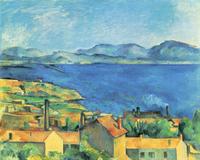
The scene depicts the Bay of Marseille from the village of l’Estaque, a motif Cézanne revisited often. Unlike many Impressionist landscapes that dissolve form into flickering dabs of color, here the artist begins to organize nature into geometric planes. The sea, sky, and hills are rendered with broad, parallel brushstrokes that hint at underlying architectural order. The shimmering blue-green water is not merely a reflection of light but a constructed volume, while the dark green pines and ochre rooftops anchor the composition with a sense of mass.
Color and Light
Cézanne uses a high-keyed palette typical of Impressionism—bright blues, greens, warm earth tones—but applies it with deliberate, almost sculptural strokes. The interplay of warm and cool hues creates a vibrant, breathing surface. Notably, he avoids the atmospheric haze that softens forms in many Impressionist works; instead, each element retains clarity, suggesting that color itself can define structure. This early insistence on color as a constructive force anticipates his later dictum: “Treat nature by means of the cylinder, the sphere, the cone.”
Historical Significance
As a product of the Impressionist period, The Sea at l’Estaque is significant because it captures Cézanne at the moment he began to push impressionism toward something new. While his contemporaries (Monet, Renoir) dissolved form in light, Cézanne sought to solidify it. This tension between optical sensation and underlying order makes the work a crucial document of the transition from Impressionism to the modern movements that followed—especially Cubism, which would explicitly fracture and reconstruct space.
Conclusion
The Sea at l’Estaque is more than a charming coastal view. It is a laboratory for Cézanne’s revolutionary ideas: that permanence can coexist with fleeting light, that color can build form, and that the landscape painter’s task is not merely to record what the eye sees but to reconstruct the logic of vision itself. In this single canvas, the seeds of an entire century of modern art are already planted.
Museum / Gallery
Визуально похожие
20 работ с близкой композицией и палитрой
L'Estaque. View through the Trees
Paul Cezanne
L'Estaque with Red Roofs
Paul Cezanne
Landscape. Study after Nature
Paul Cezanne
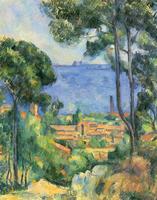
View of L'Estaque and Chateaux d'If
Paul Cezanne
Landscape at Collioure III
Henri Matisse
View of Collioure
Henri Matisse
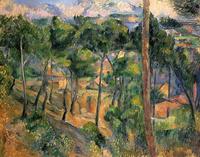
L'Estaque View Through The Pines
Paul Cezanne
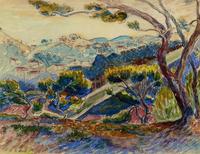
Landscape
Henri-Edmond Cross
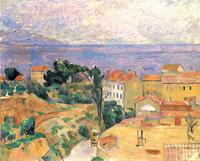
View of L'Estaque
Paul Cezanne
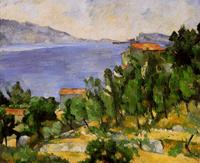
The Bay of L'Estaque from the East
Paul Cezanne
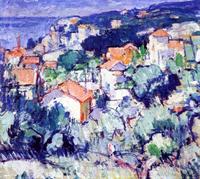
Landscape, South of France
Samuel Peploe
The Gulf of Marseille Seen from L'Estaque
Paul Cezanne
Landscape
Andre Derain
The Coast of Varengeville
Claude Monet
L'Estaque
Andre Derain
View of Collioure
Andre Derain
Bo-Kaap
Gregoire Boonzaier
The Gulf of Marseille Seen from L'Estaque
Paul Cezanne
Saint-Tropez
Francis Picabia
The estaque
Pierre-Auguste Renoir