Expert analysis of Paul Cezanne’s Three Bathers
Style: Impressionism · Genre: genre painting
Expert Analysis: Three Bathers by Paul Cézanne
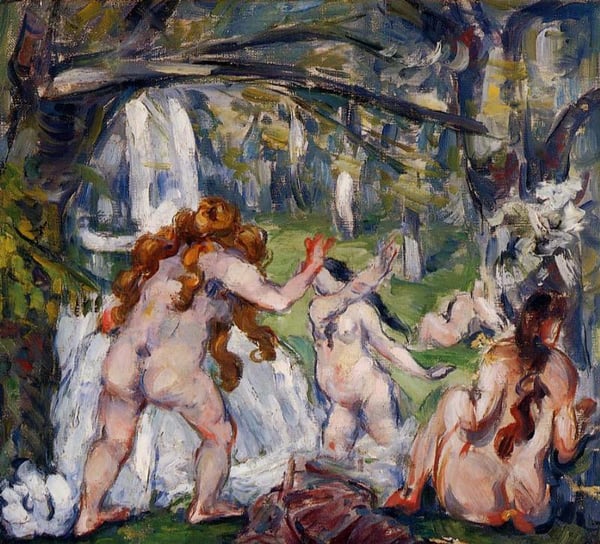
Despite its classification under Impressionism, Three Bathers stands as a pivotal work that subtly challenges the movement’s core tenets while still operating within its stylistic vocabulary. Painted during Cézanne’s Impressionist period (roughly the 1870s–1880s), the canvas presents a genre scene—a group of female figures bathing in a landscape—yet transforms the everyday subject into a rigorous exercise in structure and form.
What makes it significant within Impressionism
While Impressionists typically prioritized fleeting light and atmospheric color over solid forms, Cézanne’s Three Bathers reveals an architectural approach to nature and the human figure. The bathers are not dissolved in shimmering patches of pigment; instead, their bodies are built with deliberate, faceted brushstrokes—a method Cézanne would later push toward proto-Cubism. The composition is balanced yet asymmetrical: the three figures anchor a pyramidal distribution, while trees and foliage arch around them, creating a contained, almost sculptural space.
Break with Impressionist spontaneity
Unlike Monet’s diffuse reflections or Renoir’s soft, tactile flesh, Cézanne’s brushwork here is methodical and constructive. The color palette—earthy greens, ochres, blues, and warm flesh tones—is more subdued than high-Impressionist jolts of pure hue, but it remains luminous, with each stroke defining volume rather than atmosphere. The bathers’ faces are largely anonymous, their poses static and timeless, suggesting an interest in archetypal or classical composition rather than a captured moment.
Legacy and influence
This work anticipates Cézanne’s later Bathers series, which would deeply influence Picasso and Matisse. Within the Impressionist canon, Three Bathers is significant because it demonstrates how a genre scene could retain Impressionist color and plein-air freshness while simultaneously pursuing the monumentality and structure that would herald Post-Impressionism. It is a quiet but radical rethinking of what a “painting of modern life” could be—not just a fleeting impression, but a durable, ordered vision.
Museum / Gallery
Visually similar
20 works with related composition and palette
Four Bathers
Paul Cezanne
Four Bathers
Paul Cezanne
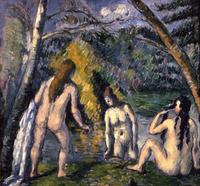
Three Bathers
Paul Cezanne
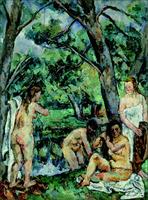
Bathers
Pyotr Konchalovsky
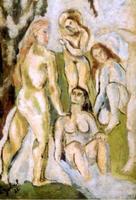
Czobe Bela 1932 Les Baigneuses
Bela Czobel
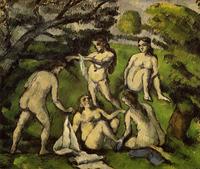
Five Bathers
Paul Cezanne
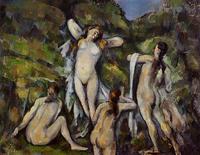
Four Bathers
Paul Cezanne
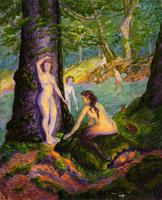
Untitled
Paul Ranson
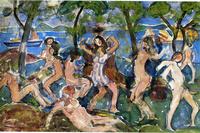
Bathers
Maurice Prendergast
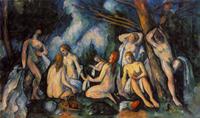
Large Bathers
Paul Cezanne
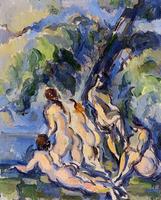
Bathers
Paul Cezanne
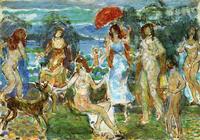
Distance Hills, Maine
Maurice Prendergast
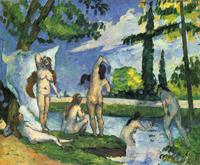
Bathers
Paul Cezanne
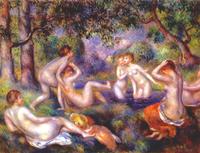
Bathers in the forest
Pierre-Auguste Renoir
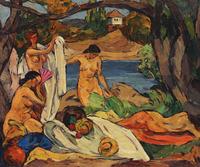
By the Water
Ion Theodorescu-Sion
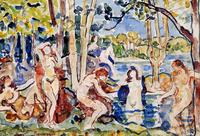
Bathers
Maurice Prendergast
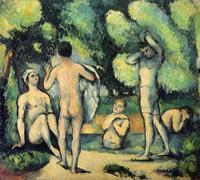
Bathers
Paul Cezanne
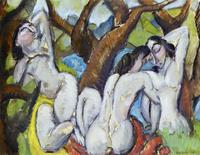
Three Nudes in a Forest
Max Weber
Bathers
Pierre-Auguste Renoir
Diana and Actaeon
Zinaida Serebriakova