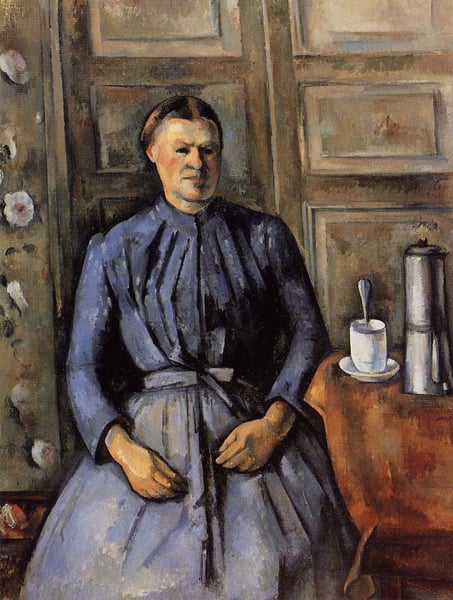
Woman with a Coffee Pot
Details
Expertenanalyse zu Paul Cezannes Woman with a Coffee Pot
Stil: Post-Impressionism · Genre: portrait
Expert Analysis: Woman with a Coffee Pot by Paul Cézanne
This painting, created during Cézanne’s final period, stands as a landmark of Post-Impressionism and a pivotal bridge to 20th-century modernism. Although classified as a portrait, Cézanne subverts traditional portraiture by prioritizing formal structure over psychological narrative. The sitter—an anonymous woman, likely a servant—is rendered with monumental stillness, her body and the coffee pot on the table forming a dense, sculptural composition.
Significance within Post-Impressionism and Cézanne’s Final Phase:
-
Geometry and Spatial Tension: Cézanne’s late work is defined by his pursuit of “parallelism” and the interplay of volumes. Here, the woman’s cylindrical torso, the oval of the coffee pot, and the tilted tabletop create a dynamic equilibrium. He flattens perspective while maintaining depth through color modulations—a hallmark of his final style that directly inspired Cubism.
-
Color as Structure: Rather than using local color, Cézanne builds form with patches of muted blues, ochres, and greens. The background wall, the tablecloth, and the woman’s dress are constructed from faceted brushstrokes that unify figure and environment. This “constructive stroke” technique dissolves the boundary between subject and ground, emphasizing the painting’s flatness.
-
The Inert Figure: Unlike Impressionist portraits that capture fleeting moments, this work freezes its subject in a timeless, almost hieratic pose. The woman’s gaze is averted, her hands folded. This deliberate lack of expression or gesture shifts focus from personality to pictorial structure—a radical departure for portraiture that prefigures abstraction.
-
Final Period Mastery: In his last decade, Cézanne increasingly simplified forms, stripping away anecdote. Woman with a Coffee Pot exemplifies this: every element—the coffee pot, the cup, the folds of fabric—is reduced to its essential geometric nature. The result is a painting that feels both solid and ethereal, a meditation on the architecture of vision itself.
Legacy: This work is a testament to Cézanne’s belief that art should “treat nature by the cylinder, the sphere, the cone.” It is not merely a portrait but a manifesto of Post-Impressionist thought, where perception is rebuilt through color and form, and where the mundane becomes monumental. Its influence reverberates through Picasso, Braque, and the entire trajectory of modern art.
Museum / Gallery
Genre
Visuell ähnlich
20 Werke mit ähnlicher Komposition und Farbpalette
Madame Cezanne with a Yellow Armchair
Paul Cezanne
Madame Cezanne in Blue
Paul Cezanne
Young Girl with a Doll
Paul Cezanne
Portrait of Madame Cezanne
Paul Cezanne
Woman in a Red Striped Dress
Paul Cezanne
Madame Cezanne in a Yellow Chair
Paul Cezanne
Victoria Duborg
Edgar Degas
Portrait of a nurse
Zinaida Serebriakova
Seated Woman
Paul Cezanne
Servant Girl
Amedeo Modigliani
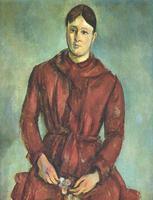
Portrait of Madame Cezanne in a Red Dress
Paul Cezanne
The poor girl
Pellizza da Volpedo
Portrait of N. Lanceray. Mom
Zinaida Serebriakova
Girl with a Blue Scarf
Gwen John
Young servant girl
Amedeo Modigliani
Portrait of Madame Cezanne
Paul Cezanne
Pregnant woman with folded hands
Kathe Kollwitz
Mrs. Vedastine Aubert, B. Moe
Harriet Backer
Portrait of Emilie Amiet-Baer
Cuno Amiet
Madame Cezanne in the garden
Paul Cezanne