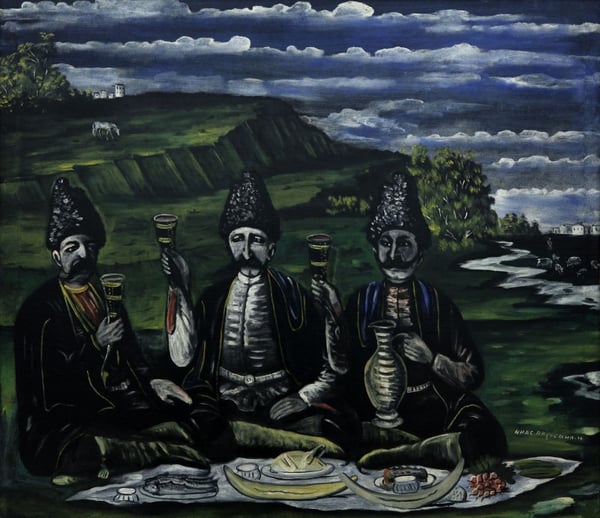
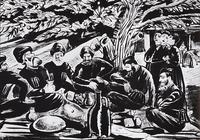
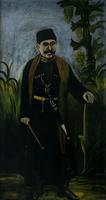
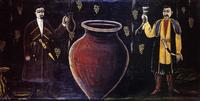
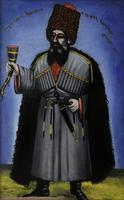
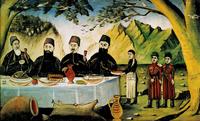
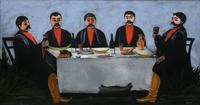
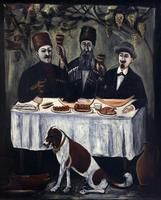
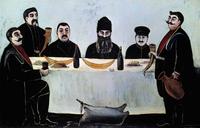
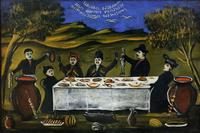
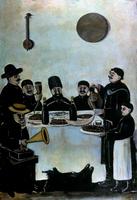
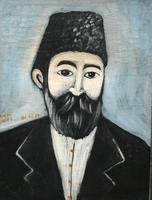
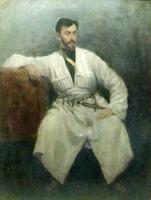
"The Feast of Three Nobles in the Valley" exemplifies Niko Pirosmani’s distinctive contribution to Naïve Art (Primitivism) through its unpretentious yet deeply expressive treatment of a traditional Georgian social scene. As a genre painting, it captures a moment of shared celebration among the nobility, rendered with the flat perspective, bold outlines, and simplified forms characteristic of Pirosmani’s self-taught approach. The work is significant for its fusion of folk-art sincerity with a modern sensibility—Pirosmani reduces the feast to its essential elements: the stark, dark backdrop (often a black oilcloth ground) that pushes the figures and table into sharp relief; the stiff, frontal poses of the three nobles; and the meticulous, almost iconic arrangement of food and wine vessels. This composition transforms a casual gathering into a timeless, emblematic tableau of hospitality and status. Within the context of Primitivism, Pirosmani’s naïveté is not a lack of skill but a deliberate rejection of academic conventions, allowing the painting to communicate raw emotional and cultural authenticity. The work highlights Pirosmani’s ability to elevate everyday life into a symbol of national identity, making it a cornerstone of Georgian naïve art and a precursor to later vernacular modernism.