Expert analysis of Niko Pirosmani’s The Feast of Five Princes
Style: Naïve Art (Primitivism) · Genre: genre painting
Expert Analysis: "The Feast of Five Princes" by Niko Pirosmani
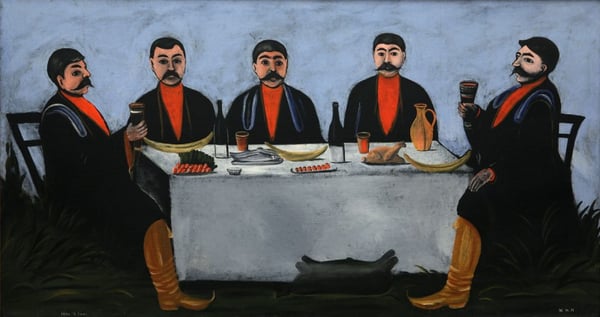
Niko Pirosmani (1862–1918) is a towering figure in the realm of Naïve Art (or Primitivism), and The Feast of Five Princes exemplifies the raw, unpolished power that defines his work. As a genre painting, it depicts a celebratory banquet, likely of Georgian noblemen, but Pirosmani transforms a conventional social scene into a profound statement of his unique artistic vision.
What makes this work significant within Naïve Art and its period:
-
Radical Simplicity and Flatness: True to the Naïve style, Pirosmani rejects Renaissance perspective and chiaroscuro. The figures are arranged in a stark, frontal plane against a deep black background, which is a hallmark of his technique. This void does not represent empty space but rather a symbolic, timeless setting—focusing all attention on the ritual of the feast.
-
Direct, Unidealized Observation: The "five princes" are not idealized nobility. Their faces are rendered with childlike directness: large dark eyes, simple outlines, and almost mask-like expressions. This lack of psychological depth is not a limitation but a deliberate primitivist strategy, emphasizing the universal act of communal dining over individual portraiture.
-
Symbolic Use of Color and Objects: The white tablecloth, the deep reds of wine or meat, and the black background create a bold, almost icon-like contrast. The large, plain wine pitchers and the single lamp or vessel at center become sacred objects—echoing the Orthodox icon tradition that underlies much of Pirosmani’s work. The feast is not merely a party but a ritual celebration of life, abundance, and Georgian hospitality.
-
Cultural Authenticity: Pirosmani worked outside the academic tradition, often painting on oilcloth or tin. His subjects—feasts, tavern scenes, animals—were drawn from his own experiences as a wandering artist in Tiflis (Tbilisi). The Feast of Five Princes captures the ethos of the Georgian supra (traditional feast) without exoticizing it. This authentic, insider perspective is central to the value of Naïve Art: it preserves a folk consciousness that academic art often overlooks.
-
Monumentality in Modesty: Despite its modest scale and naive technique, the painting possesses a gravity and stillness that rivals formal portraiture. The simple arrangement of figures creates a rhythmic, almost musical composition. Each prince is distinct in posture yet united by the shared table, embodying the egalitarian spirit of Pirosmani’s world.
Conclusion: The Feast of Five Princes is significant because it distills the essence of Pirosmani’s primitivism: a total rejection of artifice in favor of direct, emotional truth. It stands as a cultural artifact of early 20th-century Georgia, yet transcends its time through its universal depiction of human connection and celebration. In the context of Naïve Art, Pirosmani’s work—with its stark backgrounds, unsentimental gaze, and folk symbolism—earns him a place alongside Rousseau as a master of the genre, but with a distinctly Caucasian soul that remains unmatched.
Museum / Gallery
Genre
Visually similar
20 works with related composition and palette
The feast of four citizens
Niko Pirosmani
The feast
Niko Pirosmani
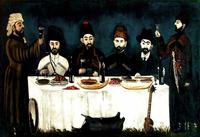
The feast of Kupreishvili family
Niko Pirosmani
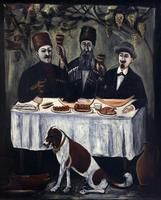
The feast in a grape gazebo
Niko Pirosmani
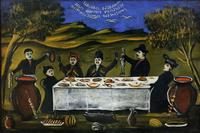
Company Bego
Niko Pirosmani
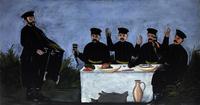
The feast with barrel organist Datiko Zemeli
Niko Pirosmani
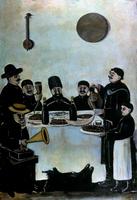
The feast of Tbilisian merchants accompanied by the gramophone
Niko Pirosmani
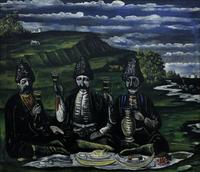
The feast of three Nobles in the valley
Niko Pirosmani
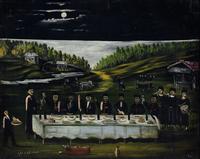
Krtsanisi
Niko Pirosmani
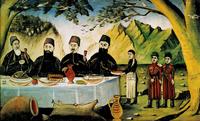
The feast of Gvimradze family
Niko Pirosmani
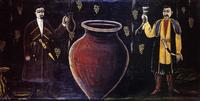
Two Georgians by a Giant Wine Jar (Quevri)
Niko Pirosmani
The blessing of the elderly
Martiros Sarian
Portrait of a wealthy peasant
Niko Pirosmani
Sister and brother (according to the play by V. Gunia)
Niko Pirosmani
Saint George’s Day in Bolnisi (fragment)
Niko Pirosmani
Easter Festival
Niko Pirosmani
Man with a horn for drinking wine (Portrait of Meliton Chkheidze)
Niko Pirosmani
Molokani Carousing
Niko Pirosmani
Armenian dance
Martiros Sarian
The feast of citizens in a forest
Niko Pirosmani