Expertenanalyse zu Niko Pirosmanis Shota Rustaveli
Stil: Naïve Art (Primitivism) · Genre: portrait
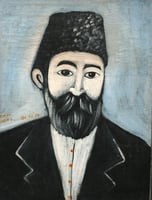
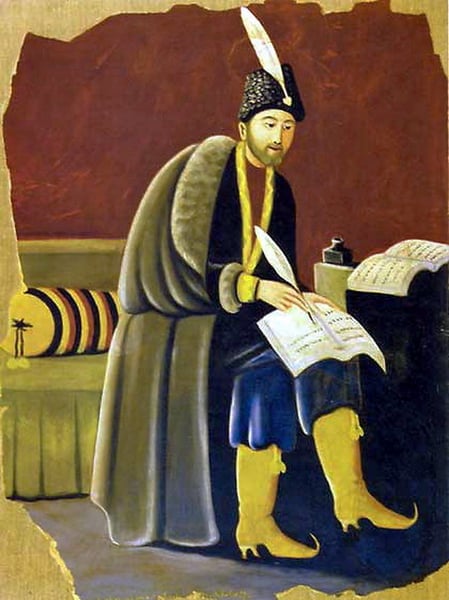
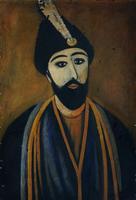
This portrait of Shota Rustaveli by Niko Pirosmani is a powerful example of how Naïve Art (Primitivism) can elevate a national icon through radical simplicity and direct emotional force. Pirosmani, a self-taught Georgian painter who worked as a sign-painter and itinerant artist, created works that are unmistakable for their bold flatness, deep black backgrounds, and almost iconic frontality.
What makes this work significant within its style and period:
-
Naïve Art meets National Identity: Pirosmani depicts Shota Rustaveli—the 12th-century poet laureate of Georgia, author of The Knight in the Panther’s Skin—not as a distant, aristocratic intellectual, but as a monumental, almost folkloric figure. The poet stands rigidly, facing the viewer directly, wearing a dark robe and a traditional fur-trimmed hat. This lack of perspective or shading is not a flaw but a deliberate visual language: Pirosmani strips away all academic convention to present Rustaveli as an eternal, almost saint-like symbol of Georgian culture.
-
Color and Composition as Emotion: The palette is stark—deep earthy browns, blacks, and a faint warm highlight on the face. The large, unmodulated black background is characteristic of Pirosmani’s work (he often mixed paint with soot from his stove). This darkness forces the viewer’s gaze entirely onto the poet’s face and pose, creating a solemn, meditative gravity. The broad, simplified brushstrokes and the slight asymmetry in the eyes give the portrait a raw, human vulnerability that a polished academic portrait would lack.
-
Democratic Modernism: Pirosmani’s work emerged in the late 19th and early 20th centuries, at a time when European avant-garde movements were discovering “primitive” forms. But Pirosmani was not imitating African or Oceanic art; he was channeling an authentic Georgian folk aesthetic. His portraits (often of local tradesmen, friends, or historical heroes) treat every subject with the same earnest grandeur. In Shota Rustaveli, that democratic spirit invests a medieval poet with the same presence as a beloved tavern-keeper—thus breaking down the hierarchy between “high” and “low” culture long before it became a modernist tenet.
In short: Pirosmani’s Shota Rustaveli is a landmark of Naïve Art because it transforms a literary legend into a direct, soulful presence. The work’s significance lies in its ability to express national pride and universal human dignity through the most elementary means—flat shapes, deep shadow, and an unshakeable frontal gaze—proving that primitivism can achieve the same profound monumentality as the most sophisticated portraiture.
Visuell ähnlich
20 Werke mit ähnlicher Komposition und Farbpalette
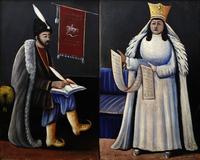
Shota Rustaveli and Queen Tamar
Niko Pirosmani
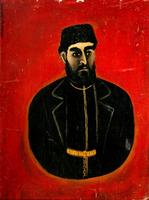
Portrait of wine-pub owner on a red background
Niko Pirosmani
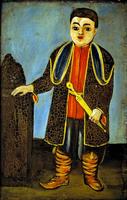
A Boy with national Georgian suit
Niko Pirosmani
Roman
Hossein Behzad
The Ambassadors (after Holbein)
Paul Wunderlich
Persians in Bombay
Émile Bayard
Shota Rustaveli
Niko Pirosmani
Portrait of B. Khmelnitsky
Heorhiy Narbut
Portrait of Ottoman Sultan Mehmed the Conqueror
Gentile Bellini
Alyosha Popovich. Illustration for the book "Russian epic heroes"
Andrei Ryabushkin
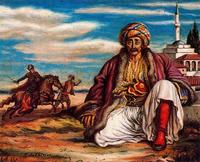
The Turk
Giorgio de Chirico
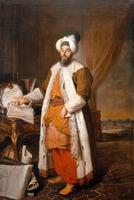
Portrait of Mehemet Said Pacha, Bey of Rumelia, special ambassador of the ottoman Sultan Mahmoud II
Jacques Aved
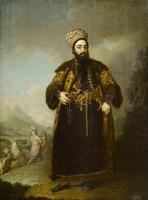
Portrait of Murtaza Kuli Khan, brother of Aga Mahommed, the Persian Shah
Vladimir Borovikovsky
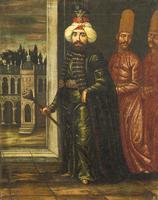
Sultan Ahmed III
Jean Baptiste Vanmour
Portrait of Suleiman Aga
Jean-Bernard Restout
The pipe dealer in the cafe
Ferdinand Georg Waldmüller
Portrait of Sultan Mehmed II (Fatih Sultan Mehmet)
Gentile Bellini
Seated Turk
John Frederick Lewis
Zouave, Half-Figure
Vincent van Gogh
Noble with a horn for drinking wine
Niko Pirosmani