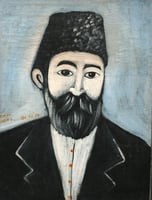
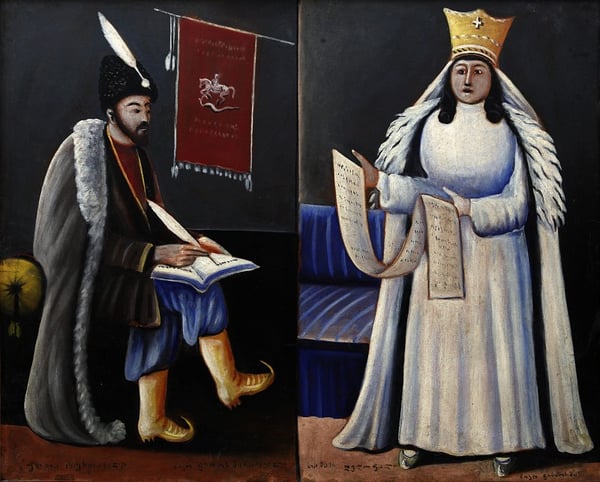
Shota Rustaveli and Queen Tamar
Details
Expert analysis of Niko Pirosmani’s Shota Rustaveli and Queen Tamar
Style: Naïve Art (Primitivism) · Genre: portrait
Expert Analysis of "Shota Rustaveli and Queen Tamar" by Niko Pirosmani
Niko Pirosmani’s "Shota Rustaveli and Queen Tamar" is a masterwork of Naïve Art (Primitivism) that transcends its simple, folk-like execution to become a powerful expression of Georgian national identity. Painted in the early 20th century, this portrait brings together two towering figures of Georgian history and literature: the medieval poet Shota Rustaveli, author of the epic The Knight in the Panther’s Skin, and Queen Tamar, the revered sovereign who presided over Georgia’s Golden Age.
Stylistic Significance Pirosmani’s technique exemplifies the core tenets of Naïve Art: a deliberate rejection of academic perspective, linear precision, and naturalistic shading. The figures are rendered with bold, unmodulated outlines and flat planes of color—black, white, deep blue, and ochre dominate the palette. The composition is stark and frontal, with Rustaveli and Tamar presented as hieratic, almost icon-like presences. There is no attempt at spatial depth; the background is a simple, unadorned dark field that isolates the subjects and imbues them with timeless gravitas. This direct, unschooled approach was not a lack of skill but a conscious artistic choice that allowed Pirosmani to distill his subjects to their symbolic essence.
Cultural and Historical Weight What makes this work particularly significant is how Pirosmani uses the language of Primitivism to elevate folk memory into national myth. Queen Tamar (c. 1160–1213) is depicted not as a remote monarch but as a nurturing, iconic mother of the nation, while Rustaveli is shown as her court poet and spiritual equal. Their pairing reinforces the Georgian cultural ideal of harmony between secular power and literary genius. Pirosmani, a self-taught artist from a humble background, painted not for the elite but for taverns and common people; in doing so, he transformed these historical figures into accessible, intimate symbols of Georgian pride.
Legacy Art historically, "Shota Rustaveli and Queen Tamar" is significant because it demonstrates how Naïve Art can convey profound cultural narratives without relying on the conventions of high art. Pirosmani’s work later influenced the European avant-garde—artists like Pablo Picasso and the Russian Futurists admired his radical simplicity. This painting, in particular, stands as a testament to Pirosmani’s ability to merge folk tradition with personal vision, creating an enduring image of Georgia’s greatest poet and queen that feels both ancient and modern. Its power lies in its directness: a declaration of national identity through the most unpretentious means.
Museum / Gallery
Visually similar
20 works with related composition and palette
Queen Tamar
Niko Pirosmani
Queen Tamar of Georgia
Niko Pirosmani
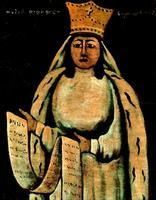
Queen Tamar
Niko Pirosmani
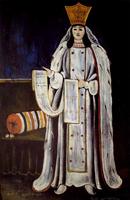
Queen Tamar
Niko Pirosmani
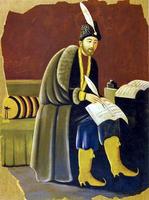
Shota Rustaveli
Niko Pirosmani
Pietro Lando and Francesco Donato
Domenico Tintoretto
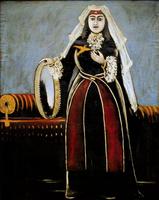
Georgian woman with tambourine
Niko Pirosmani
Portrait of B. Khmelnitsky
Heorhiy Narbut
The Sultana-mother
Jean Baptiste Vanmour
The Ambassadors (after Holbein)
Paul Wunderlich
Doge Pietro Loredano
Tintoretto
The Kislar Aghassi, head of the black eunuchs
Jean Baptiste Vanmour
Clothing of queens. With portraits of queens Evdokia Lukianovny and Natalia Kirilovna
Fyodor Solntsev
Portrait of Doge Pietro Loredan
Tintoretto
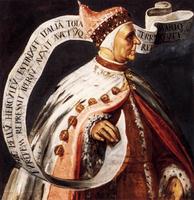
Portrait of Giovanni Mocenigo
Domenico Tintoretto
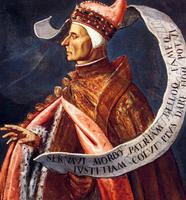
Marco Barbarigo
Domenico Tintoretto
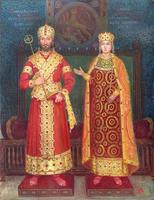
Konstantin and Irina
Anton Mitov
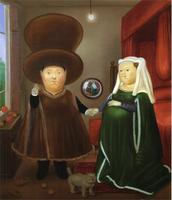
After the Arnolfini Van Eyck (2)
Fernando Botero
Sultan Ahmed III
Jean Baptiste Vanmour
Portrait of King Stephen Bathory
Martin Kober