Expert analysis of Pavel Filonov’s War with Germany
Style: Analytical Realism · Genre: allegorical painting
Expert Art Historical Analysis: War with Germany by Pavel Filonov
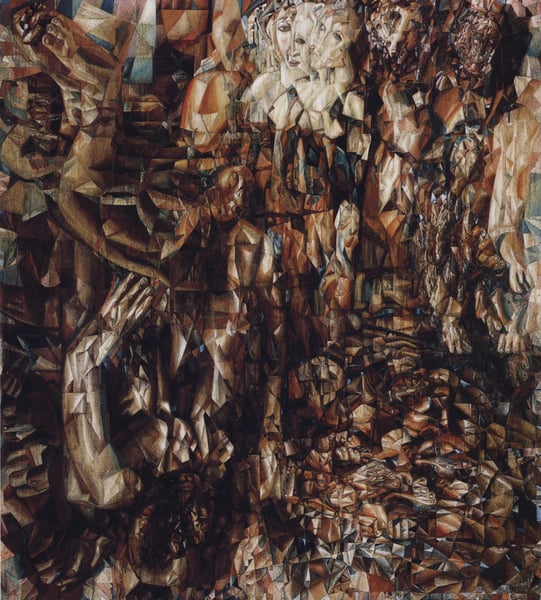
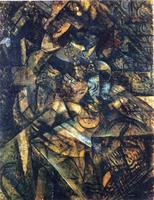
Pavel Filonov’s War with Germany stands as a pivotal exemplar of Analytical Realism, a uniquely rigorous and deeply philosophical avant-garde style that Filonov himself defined. This allegorical painting is significant not only for its thematic confrontation with modern conflict but also for how it embodies the central tenets of Filonov’s method—a systematic, almost scientific approach to painting that he called “making pictures.”
The Significance of Analytical Realism in Context
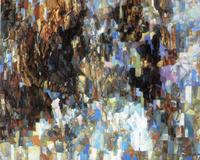
Unlike the geometric abstraction of Suprematism or the functional materialism of Constructivism, Analytical Realism rejected both pure form and utilitarian art. Filonov insisted that a painting must be built from the smallest, most intensely worked unit—what he termed the “atom” of form. In War with Germany, this principle is visible in the densely packed, crystalline facets that compose every figure and landscape element. The surface feels alive, vibrating with microscopic hues and fragmented planes, as if the very molecules of the scene are charged with the trauma and chaos of war.
Allegory as Process
The work’s allegorical genre is not merely a symbolic representation of conflict (e.g., personifications of good vs. evil) but an exploration of historical and cosmic forces. Filonov deliberately blurred the distinction between the human, the organic, and the mechanical. Figures appear to morph into machinery or geological strata, suggesting that war is not a human choice but a natural, elemental catastrophe. This aligns with his belief that art must reveal the underlying “process” of reality—the constant struggle and transformation of matter and spirit.
A Radical Departure from Its Period
Painted during a time of enormous upheaval (likely World War I or the Russian Civil War, though Filonov continued this theme into the 1930s), War with Germany rejects the heroic or propagandistic narratives favored by Socialist Realism. Instead, it offers a dystopian, almost hallucinatory vision—crowded, claustrophobic, and devoid of a central hero. The composition is deliberately anti-perspectival; the viewer is pulled into a sea of interlocking, transparent forms without a clear focal point. This refusal to simplify or idealize conflict made Filonov’s work politically suspect under Stalin, and much of his oeuvre was suppressed or destroyed.
Enduring Significance
War with Germany survives as a testament to Filonov’s relentless commitment to Analytical Realism—a style that prioritized perceptual intensity over legibility. Its significance lies in its challenge to the viewer: to see not just a picture of war, but the very processes of creation and destruction encoded in every brushstroke. In an age of rising totalitarianism, Filonov’s allegory insists that true art must resist easy consumption and instead force a confrontation with the chaotic, irreducible nature of history itself.
Visually similar
20 works with related composition and palette
A Couple
Pavel Filonov
Flowers of the Universal Flowering
Pavel Filonov
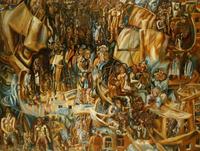
Ships
Pavel Filonov
The Temptation of St. Anthony
Ivan Albright
Invention of a Dream
Richard Oelze
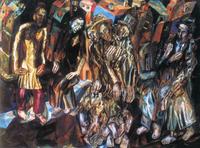
Rebirth of the People
Pavel Filonov
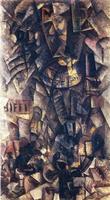
Galleria In Milan
Carlo Carra
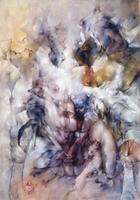
Insomnies (Insomnias)
Dorothea Tanning
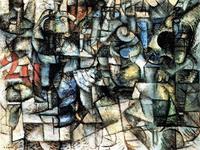
Ritmi di oggetti
Carlo Carra

Nudes in the Forest
Fernand Leger
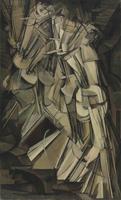
Nude Descending a Staircase, No.2
Marcel Duchamp
Composition VI
Patrick Henry Bruce
La Locomotive
Dado
Tornado Tango
Martin Disler
The Tower of Babel
Endre Rozsda
A White Picture
Pavel Filonov
The Water is a Naked Box
Arnulf Rainer
Mingus in Mexico
David Salle
Last Judgement
William Blake
Quirinal Stables
Carlo Carra