
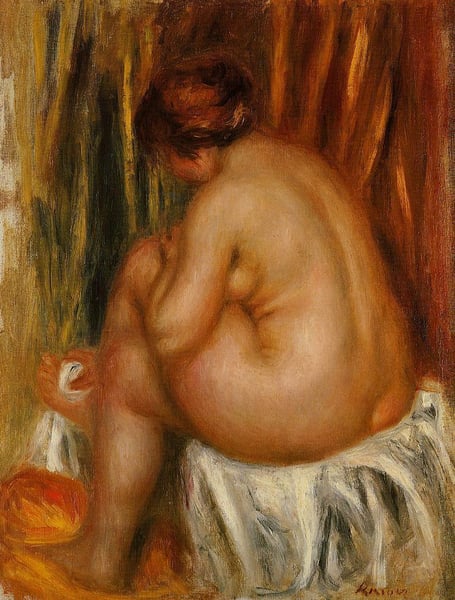
Expert analysis of Pierre-Auguste Renoir’s After Bathing (nude study)
Style: Impressionism · Genre: nude painting (nu)
Expert Analysis of After Bathing (nude study) by Pierre-Auguste Renoir
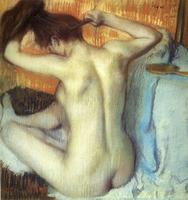
Pierre-Auguste Renoir’s After Bathing (nude study) is a compelling example of his Later Years (c. 1880s–1910s), a period marked by a deliberate shift away from the pure, spontaneous brushwork of early Impressionism toward a more synthetic, classicizing approach. Painted in the Impressionist style but reimagined through the genre of the nude painting (nu), this work embodies Renoir’s lifelong fascination with the female form and his mature quest to merge modern color with timeless monumentality.
Significance within the Period and Style
-
Synthesis of Impressionist Light and Classical Structure
In his later years, Renoir grew dissatisfied with the dissolution of form in pure Impressionism. After Bathing retains the luminous, broken color and soft atmospheric effects of the Impressionist palette—creamy pinks, warm ochres, and cool blue-shadows—but applies them to a figure that is deliberately sculptural and voluptuous. The model’s rounded contours and serene pose recall the bathers of Titian or Ingres, yet the dappled, vibrating surface remains unmistakably modern. This fusion marks a critical moment in Renoir’s evolution: he did not abandon Impressionism, but rather enriched it with a sense of weight and permanence. -
The “Nude Study” as a Genre Statement
The subtitle “nude study” is significant. Unlike a finished mythological or historical scene, this is an intimate, unidealized nu that prioritizes the physicality and warmth of the model. Renoir’s treatment of flesh—glowing, tactile, almost edible in its paint handling—became the hallmark of his late style. He famously said, “The nude should not be painted, but breathed.” In this work, the subject is not merely a body but an embodiment of the Impressionist love for sensory, transient beauty, grounded in the eternal subject of the bather. -
Later Years: A Personal and Aesthetic Reorientation
By the time of this painting, Renoir had traveled to Italy, studied Renaissance frescoes, and developed rheumatoid arthritis (which forced him to adapt his technique, often using a brush strapped to his wrist). The result is a paradoxical mix of fragility and strength. The figure in After Bathing appears robust, almost weightless in her softness, yet the paint is applied with a controlled, sensuous deliberation that differs from the rapid strokes of his earlier Moulin de la Galette. This work demonstrates how Renoir’s physical limitations pushed him toward a more distilled essence of form—a personal, impressionistic classicism.
Conclusion
After Bathing (nude study) is significant as a bridge between Renoir’s Impressionist roots and his late classical period. It captures the artist’s enduring commitment to the nude as the ultimate vehicle for expressing light, color, and human warmth—while also revealing his deep engagement with art history. In this quiet, post-bath moment, Renoir achieves something rare: a painting that feels both exquisitely contemporary and timelessly serene.
Museum / Gallery
Genre
Style
Visually similar
20 works with related composition and palette
After Bathing
Pierre-Auguste Renoir
Seated Nude
Pierre-Auguste Renoir
Seated Female Nude
Pierre-Auguste Renoir
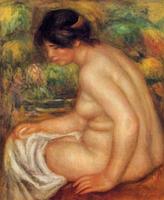
Seated Nude in Profile (Gabrielle)
Pierre-Auguste Renoir
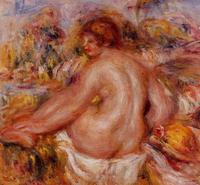
After Bathing, Seated Female Nude
Pierre-Auguste Renoir
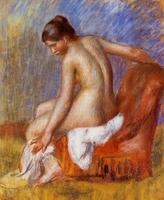
Nude in an Armchair
Pierre-Auguste Renoir
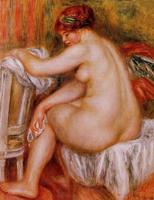
Seated Nude
Pierre-Auguste Renoir
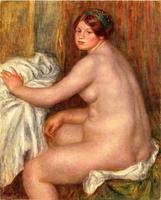
Seated Bather
Pierre-Auguste Renoir
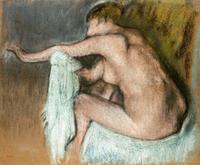
Woman Drying her Arm
Edgar Degas
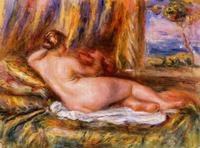
Reclining Nude
Pierre-Auguste Renoir
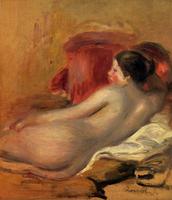
Reclining Model
Pierre-Auguste Renoir
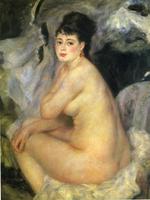
Nude Seated on a Sofa
Pierre-Auguste Renoir
Back of nude
William James Glackens
Seated Bather
Pierre-Auguste Renoir
Female nude from back
Pablo Picasso
Nude Woman on Green Cushions
Pierre-Auguste Renoir
Bather, Seated Nude
Pierre-Auguste Renoir
Study of a Female Nude
Henri Lehmann
Bather with a rock
Pierre-Auguste Renoir
Woman Combing Her Hair
Edgar Degas