
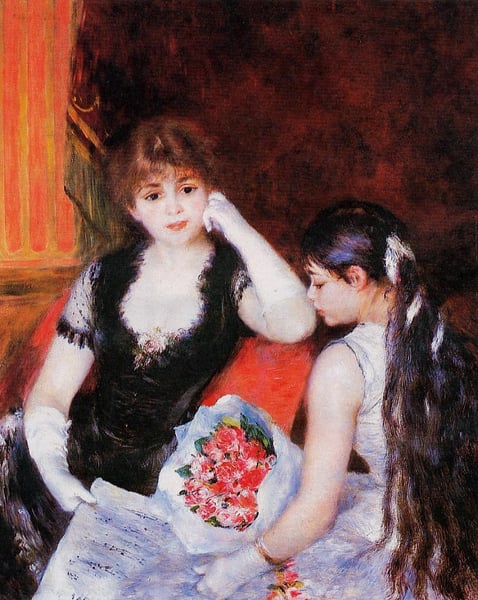
Pierre-Auguste Renoir sanatçısının At the Concert (Box at the Opera) eseri hakkında uzman analizi
Tarz: Impressionism · Tür: genre painting
Expert Analysis: "At the Concert (Box at the Opera)" by Pierre-Auguste Renoir
As a genre painting executed within the Impressionist style, Renoir’s At the Concert (Box at the Opera) exemplifies the movement’s radical shift toward capturing the fleeting, sensual textures of modern urban life. Painted during his association with the Impressionists, the work is significant for its embodiment of two core Impressionist principles: the celebration of contemporary leisure and the revolutionary handling of light and color as autonomous visual elements.
Significance within Impressionism:
-
Modern Life as Subject
The scene—a private opera box—was a quintessentially modern, bourgeois setting. Renoir elevates an everyday social ritual (attending the opera) into a subject worthy of high art. This choice directly opposed academic hierarchies that favored historical or mythological themes. The opera box becomes a microcosm of Parisian society: intimate yet public, performative yet casual. -
Optical Truth and Loose Brushwork
Renoir’s characteristic feathery, broken brushstrokes dissolve solid forms into shimmering patches of color. The fabric of the women’s gowns, the glow of gaslight on skin, and the glittering chandeliers are rendered not as precise details but as sensations of light and atmosphere. The viewer experiences the concert hall’s ambient warmth and the rustle of silk rather than a frozen, photographic record. -
Figure-Ground Ambiguity
The composition blurs the boundary between the figures and their surroundings. The dark clothing of the men in the background merges with the shadowy recesses of the box, while the women’s bright dresses catch and reflect the stage’s glow. This integration of foreground and background—achieved through unified color harmonies and rapid touches of paint—creates a holistic, immersive vision of the moment. -
Psychological Intimacy
Renoir captures the unguarded interactions of a concert intermission: a woman adjusts her bodice, a man leans in to whisper, another gazes out toward the stage. The lack of overt narrative or moralizing allows the viewer to feel like a silent participant. This sense of fleeting, candid social behavior was a hallmark of Impressionist genre painting, aligning Renoir with Degas and Cassatt in their scrutiny of public and private spheres.
In sum, At the Concert (Box at the Opera) is significant not only as a masterful example of Renoir’s radiant palette and tactile brushwork but also as a document of the Impressionist ambition to freeze a single, luminous instant of modern life—a moment at once ordinary and transcendent. It stands as a testament to how the Impressionists redefined artistic value by focusing on the ephemeral, the sensory, and the everyday.
Museum / Gallery
Görsel olarak benzer
İlişkili kompozisyon ve renk paletine sahip 20 eser
Portrait of pianist and professor of Saint Petersburg Conservatory Sophie Menter
Ilya Repin
The Coiffure
Pierre-Auguste Renoir
Spanish Beauty
Charles Hermans

A man with two women in an interior
Umberto Veruda
Misia
Pierre-Auguste Renoir
Madame Leon Clapisson (Marie Henriette Valentine Billet)
Pierre-Auguste Renoir
At the Ball
Berthe Morisot
Young Woman in a Blue Blouse
Berthe Morisot
Young girl in a ball gown
Berthe Morisot

Lillie
Childe Hassam
Portrait of a Lady, Mrs Lionel Phillips
Giovanni Boldini
Portrait of Marguerite Carre (also known as Young Girl in a Ball Gown)
Berthe Morisot

Madame Georges Charpentier and her Children
Pierre-Auguste Renoir
Mrs. Kate A More
John Singer Sargent
The Wyndham Sisters
John Singer Sargent
Party by Lanterns
Joseph Clark

Countess de Rasty Seated in an Armchair
Giovanni Boldini
Portrait of the countess pourtales
Pierre-Auguste Renoir

Portrait of Princess Zinaida Yusupova
Valentin Serov
Portrait of Marthe and Therese Galoppe
Leon Bonnat