
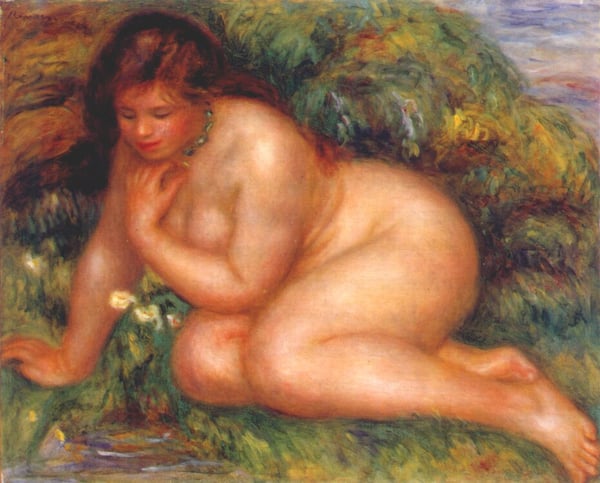
Análisis experto de Bather Admiring Herself in the Water de Pierre-Auguste Renoir
Estilo: Impressionism · Género: nude painting (nu)
Expert Analysis: "Bather Admiring Herself in the Water" by Pierre-Auguste Renoir
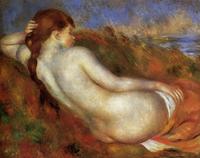
This work belongs to Renoir’s Later Years (roughly the 1890s–1910s), a period in which the artist pivoted from the pure, flickering light of early Impressionism toward a more structured, sensuous classicism. Here, the subject—a lone female bather gazing at her reflection—is a quintessential Impressionist motif (leisure, water, fleeting beauty), but Renoir renders it with a newfound monumentality and sculptural weight.
Significance within Impressionism and Renoir’s Evolution:
-
Synthesis of Tradition and Modernity
Renoir’s later nudes deliberately echo the classical Venus or Diana at her bath—timeless, idealized forms—yet the technique remains unmistakably Impressionist: broken brushstrokes, dappled light filtering through foliage, and a palette of warm pinks, soft blues, and pearly whites. The reflection in the water is not a literal mirror but a shimmering mosaic of color, dissolving the figure’s boundary between surface and depth. -
Mastery of the "Nu" in Impressionism
While earlier Impressionist nudes (e.g., Manet’s Olympia) caused scandal with their confrontational modernity, Renoir’s bathers are intimate and self-absorbed. This painting celebrates the female body as a natural, almost organic part of the landscape. The water’s ripples echo the curves of the woman’s torso; the surrounding brushwork melts flesh into atmosphere. It is a celebration of la douceur de vivre—the sweetness of life—that defined Renoir’s mature vision. -
Technical Distillation of Light and Form
In his later years, Renoir’s touch became broader and more caressing. The flesh is built not through linear contours but through layers of opalescent color—lavender shadows, coral highlights, touches of cerulean where the water meets the skin. This optical mixing, a hallmark of Impressionism, here serves to both define volume and dissolve it into the shimmering air. The bather’s bent pose, one hand lifted to her hair, recalls classical caryatid figures, yet the feathery strokes keep the scene immediate and sensory.
Why It Matters:
This artwork stands at the crossroads of Impressionism’s radical past and Renoir’s personal future. It demonstrates that Impressionism could evolve beyond the sketch-like snapshot into a vehicle for timeless, lyrical beauty. The painting’s significance lies in its ability to reconcile the fleeting (a moment of private admiration) with the eternal (the archetype of the bather). It is Renoir’s final, serene answer to the question that haunted his generation: how to paint modern life without sacrificing poetic grandeur.
Visualmente similares
20 obras con composición y paleta relacionadas
Bather drying her leg
Pierre-Auguste Renoir
Reclining Nude (The Baker's Wife)
Pierre-Auguste Renoir
Nude in a landscape
Pierre-Auguste Renoir
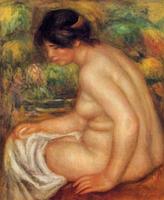
Seated Nude in Profile (Gabrielle)
Pierre-Auguste Renoir
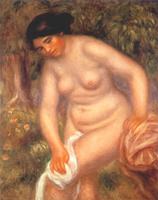
Bather drying herself
Pierre-Auguste Renoir
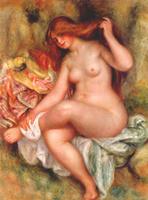
A Seating Bather
Pierre-Auguste Renoir
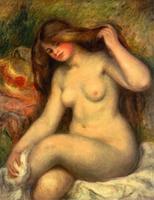
Large Bather with Crossed Legs
Pierre-Auguste Renoir
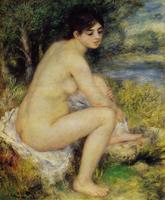
Seated Bather
Pierre-Auguste Renoir
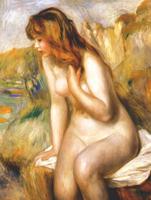
Bather seated on a rock
Pierre-Auguste Renoir
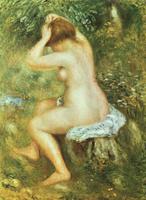
Bather is Styling
Pierre-Auguste Renoir
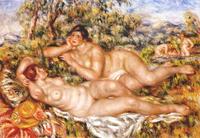
The Great Bathers (The Nymphs)
Pierre-Auguste Renoir
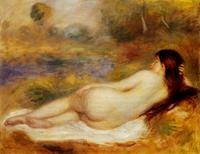
Nude Reclining on the Grass
Pierre-Auguste Renoir
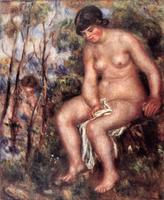
Bather
Pierre-Auguste Renoir
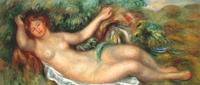
The Spring
Pierre-Auguste Renoir
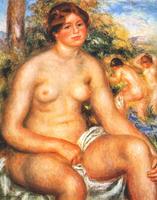
Seated Bather
Pierre-Auguste Renoir
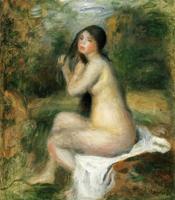
Seated Bather
Pierre-Auguste Renoir
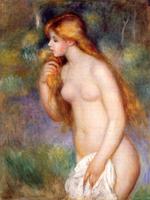
Standing Bather
Pierre-Auguste Renoir
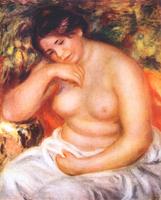
Seated bather
Pierre-Auguste Renoir
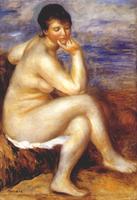
Bather with a rock
Pierre-Auguste Renoir
Reclining Nude
Pierre-Auguste Renoir