
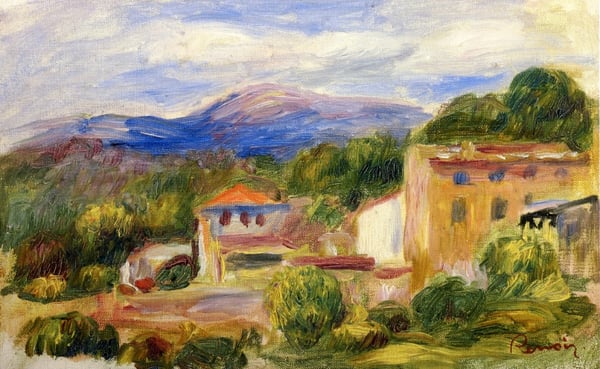
Analisi esperta di Cagnes Landscape di Pierre-Auguste Renoir
Stile: Impressionism · Genere: landscape
Expert Analysis: "Cagnes Landscape" by Pierre-Auguste Renoir
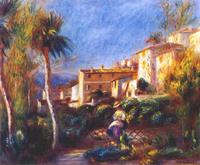
Pierre-Auguste Renoir’s “Cagnes Landscape” belongs to the artist’s later years (c. 1900s–1919), a period defined by a profound stylistic shift away from the high-key, transient light effects of classic Impressionism toward a more voluptuous, decorative, and classically structured mode of painting. Painted while Renoir was living in the sun-drenched village of Cagnes-sur-Mer on the French Riviera—where he settled in 1907 and remained until his death—this landscape exemplifies the artist’s late personal synthesis of Impressionist color with a renewed sense of form, often described as his “pearly” or “mother-of-pearl” phase.
Significance within Renoir’s Oeuvre and Impressionism:
-
Shift from Transience to Permanence
Unlike Renoir’s earlier, more fragmentary Impressionist landscapes (e.g., La Grenouillère, 1869), “Cagnes Landscape” exhibits a denser, more solid handling of form. The brushwork is broad and sweeping, yet the composition is stabilized by strong horizontal bands (sky, hills, terraced fields) and a deep, warm palette dominated by ochres, russets, and golden greens. This reflects Renoir’s late turn toward Renaissance-inspired monumentality, influenced by his travels to Italy (1881) and his admiration for Titian and Rubens. -
Mastery of Light and Atmosphere in a “Difficult” Medium
Renoir’s later years were marked by severe rheumatoid arthritis, which forced him to paint with brushes strapped to his hands. Despite this physical limitation, “Cagnes Landscape” radiates an effortless, luminous serenity. The Mediterranean light is rendered not through broken color patches (as in early Impressionism) but through soft, blended transitions and a unifying golden haze. This demonstrates Renoir’s ability to translate the Impressionist concern for plein air sensation into a more personal, even idyllic vision. -
Cagnes as a Symbol of Renoir’s Late Themes
The locale itself is significant: Cagnes-sur-Mer represented Renoir’s retreat from Parisian modernity. In “Cagnes Landscape,” the scene is devoid of modern industry or figures—instead, it emphasizes timeless nature: rolling hills, olive trees, and distant sea. This aligns with Renoir’s late philosophy that art should bring joy and sensuous delight, a counterpoint to the darker currents of Post-Impressionism and early Modernism. -
Bridging Impressionism and Modern Decoration
The painting’s flattened pictorial space and rhythmic, almost tapestry-like foliage anticipate the decorative landscape panels that Renoir produced for his home in Cagnes. This work thus marks a transition not only within Renoir’s career but also within the broader Impressionist movement—from a scientific analysis of light to a lyrical, decorative art that would influence artists like Pierre Bonnard and Henri Matisse.
Conclusion:
“Cagnes Landscape” is significant because it captures Renoir’s late artistic maturity—a period when he fused Impressionist luminosity with classical composure, creating some of the most emotionally resonant and technically inventive works of his career. It stands as a testament to his resilience and his unwavering belief in painting as an expression of beauty and harmony.
Museum / Gallery
Visivamente simili
20 opere con composizione e palette affini
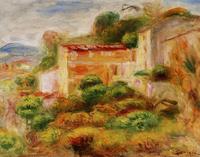
Maison de la Poste
Pierre-Auguste Renoir
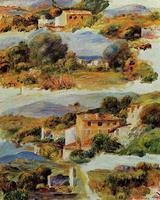
Houses at Cagnes
Pierre-Auguste Renoir
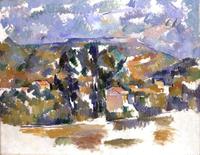
Mont Sainte-Victoire Seen from les Lauves
Paul Cezanne
Balchik Landscape
Lucian Grigorescu
Le Poste at Cagnes (study)
Pierre-Auguste Renoir
Coastal Landscape
Pierre-Auguste Renoir
In the south of France
Konstantin Korovin
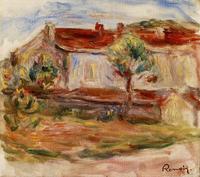
White House
Pierre-Auguste Renoir
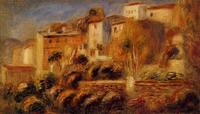
Houses at Cagnes
Pierre-Auguste Renoir
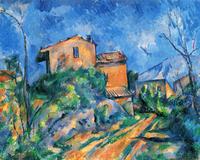
Maison Maria with a View of Chateau Noir
Paul Cezanne
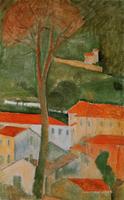
Landscape
Amedeo Modigliani
Sketch for 'Near Toulon'
Rupert Bunny
Ceret Lanscape
Chaim Soutine
Study from the South of France
Anna Katarina Boberg
House in Provence
Paul Cezanne
majorcan House
John Miller
Cassis. The view from the window.
Pyotr Konchalovsky
The farm of Bellevue
Paul Cezanne
Landscape with White House
Pierre-Auguste Renoir
Villa de la poste at cagnes
Pierre-Auguste Renoir