
Expertenanalyse zu Pierre-Auguste Renoirs Camille Monet Reading
Stil: Impressionism · Genre: portrait
Expert Analysis: "Camille Monet Reading" by Pierre-Auguste Renoir
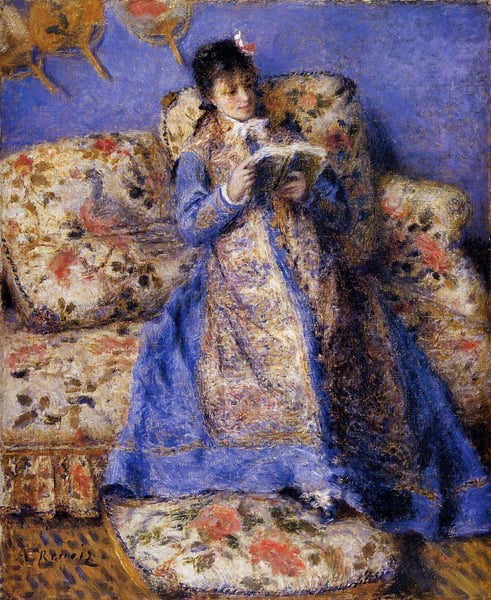
Pierre-Auguste Renoir’s Camille Monet Reading (c. 1872–1873) is a quintessential example of early Impressionist portraiture, distinguished by its intimate, unposed subject and the artist’s pioneering treatment of light and color. Executed during Renoir’s most formative association with the Impressionist circle, the work elevates a quiet, domestic moment into a study of sensory experience and modern life.
Significance within Impressionism
Renoir broke from academic portraiture’s rigid conventions by capturing Camille Monet—wife of fellow Impressionist Claude Monet—in a natural, reflective pose, absorbed in a book. The painting embodies the Impressionist commitment to depicting contemporary leisure and personal, unheroic moments. Instead of a formal commission, this is a snapshot of friendship and shared artistic ideals, offering a glimpse into the private world of the Monet family at their home in Argenteuil—a hub for the movement.
Technical and Aesthetic Innovations
Renoir’s brushwork is loose and feathery, with dabs of vibrant pigment that dissolve form into shimmering patterns of light. The composition is deliberately asymmetrical: Camille is seated at an angle, her face half-shadowed, while the background—a garden or interior—suggests depth through blurred patches of green and gold. Renoir uses color not just to describe but to imply atmosphere. The white of Camille’s dress is rendered with streaks of blue, lavender, and pale yellow, capturing the cool, filtered daylight that falls on her. Her hair and the book’s pages are touched with quick, directional strokes, conveying both texture and the soft diffusion of light.
Humanizing the Subject
Unlike earlier portraitists who idealized sitters, Renoir presents Camille as a living, thinking presence. Her downward gaze and slightly parted lips suggest quiet concentration, making the viewer a respectful observer rather than a direct participant. This psychological depth—achieved through subtle tonal shifts around her eyes and mouth—was revolutionary for its time, prioritizing authentic human experience over formal grandeur.
Legacy and Context
This painting is significant not only as a masterpiece of Renoir’s early career but as a document of the intertwined lives of the Impressionists. Camille Monet was also a frequent model for her husband, and Renoir’s portrayal complements Monet’s own depictions of her, creating a dialogue between two founders of the movement. The work’s spontaneity, emphasis on light, and celebration of ordinary life encapsulate the radical spirit that defined Impressionism and transformed modern art.
Museum / Gallery
Visuell ähnlich
20 Werke mit ähnlicher Komposition und Farbpalette
Madame monet reading
Pierre-Auguste Renoir
Jeanne Reading
Camille Pissarro
Madame Monet
Pierre-Auguste Renoir
Portrait of the Artist's Mother and Sister
Berthe Morisot
Reading girl
Isaac Israels
A Visitor
Sarah Purser
Portrait of a Woman in a pink dress
Berthe Morisot
Portrait of Jeanne Chaine
Odilon Redon
The Cup of Chocolate
Pierre-Auguste Renoir
Woman Reading
Mary Cassatt
Portrait of Sofia Golitsyna
Konstantin Korovin
Portrait of a Lady (Miss My Ellison)
Mary Cassatt
Girl in the mirror
Nicolae Grigorescu
Marguerite
Guy Rose

Hydrangeas
Philip Wilson Steer
Woman with a Cat
Edouard Manet

Woman in red
Umberto Veruda
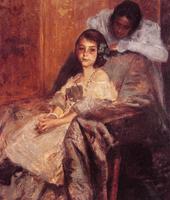
Dorothy and Her Sister
William Merritt Chase
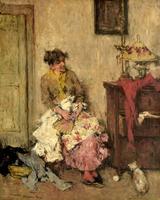
The female mender
Umberto Veruda
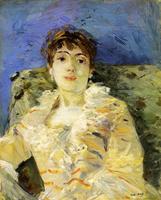
Young Woman on a Couch
Berthe Morisot