
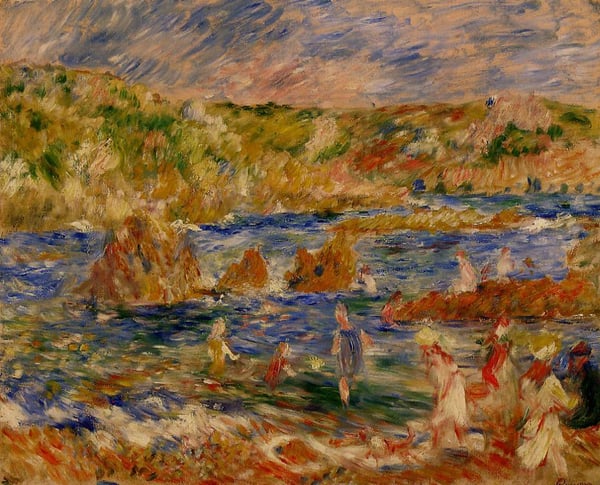
Expert analysis of Pierre-Auguste Renoir’s Children on the Beach at Guernsey
Style: Impressionism · Genre: landscape
Expert Art Historical Analysis: "Children on the Beach at Guernsey" by Pierre-Auguste Renoir
Pierre-Auguste Renoir’s Children on the Beach at Guernsey (c. 1883) is a compelling work that captures a pivotal moment in the artist’s career, often termed his "Rejection of Impressionism." Painted during a period of personal and stylistic crisis, this landscape—featuring two young figures on a sunlit Guernsey shore—embodies Renoir’s deliberate move away from the optical spontaneity of pure Impressionism toward a more structured, classically influenced approach.
Significance within its Period: Renoir’s "Dry Period" and Return to Form
By the early 1880s, Renoir had become dissatisfied with the formlessness and transient nature of Impressionist technique. After a trip to Italy in 1881, he was profoundly influenced by Renaissance masters like Raphael and by the frescoes of Pompeii. Children on the Beach at Guernsey belongs to this transitional "dry period" (sometimes called his "Ingres period"), in which he sought to combine the bright palette and natural light of Impressionism with the disciplined drawing and solid mass of classical art.
In this painting, Renoir retains the luminous, high-key color and broken brushwork typical of Impressionism—the sand sparkles with warm ochres and pinks, the sea vibrates with blues and greens, and the sky is a soft, airy expanse. Yet the children are not dissolved into atmosphere; their forms are more clearly delineated, with firmer contours and a sense of weight and structural stability. The composition is carefully balanced, with the two figures anchoring the foreground against the sweep of beach and sea. This negotiation between fleeting light and enduring form is central to the work’s significance: it documents Renoir’s attempt to rescue Impressionism from its own evanescence.
Stylistic Analysis: Landscape as a Platform for Transition
As a landscape, the painting extends the Impressionist fascination with plein-air observation. The specific location—Guernsey—offered Renoir a coastal setting of brilliant clarity, where the interplay of water, sand, and sky could be studied under changing sunlight. However, unlike his earlier, more fragmented works (e.g., The Swing, 1876), here the beach is rendered with a broader, more unified treatment of mass. The children are not merely color notes; their poses are natural yet composed, suggesting a narrative pause rather than a snapshot. The artist’s brushwork is still visible and energetic, but it is disciplined, serving the overall geometry of the scene.
The painting thus stands as a key document of Renoir’s evolution, bridging the early Impressionist dissolution of form and the later, more voluptuous classicism of his Great Bathers (1884–1887). In this context, Children on the Beach at Guernsey is significant not as a radical break, but as a thoughtful synthesis—a moment when Renoir tried to "make Impressionism into an art that is as solid and lasting as the art of the museums," as he once put it. The beach becomes a liminal space, both literal (the edge of the sea) and metaphorical (the edge of a changing artistic vision).
Museum / Gallery
Genre
Style
Visually similar
20 works with related composition and palette
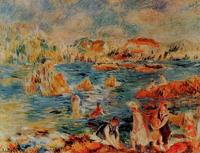
The Beach at Guernsey
Pierre-Auguste Renoir
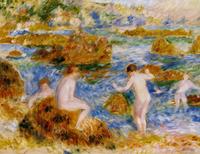
Nude Boys on the Rocks at Guernsey
Pierre-Auguste Renoir
By the Sea
Louis Valtat
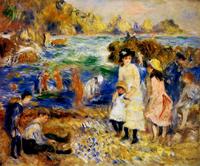
Children by the Sea in Guernsey
Pierre-Auguste Renoir
Near Saint Malo
Henri Martin
Seascape
Maurice Prendergast
The Gorge - Appledore, Isles of Shoals
Childe Hassam
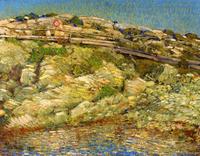
Walk Around the Island
Childe Hassam
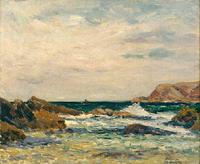
Belle-Ile-en-Mer
Maxime Maufra
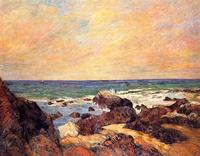
Rocks and sea
Paul Gauguin
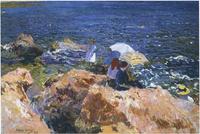
On the Rocks at Javea
Joaquín Sorolla
The Seashore
Maurice Prendergast
Marine Landscape
Michel Simonidy
Duck Island from Appledore
Childe Hassam
Landscape
Salvador Dali
Rocks on the Mediterranean Coast
Claude Monet
Seaside
Henri Martin
View at guernsey
Pierre-Auguste Renoir
Le Ramassage du goémon sur la plage de Trévignon
Henry Moret
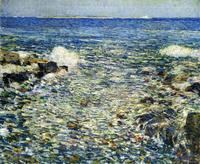
Surf, Isles of Shoals
Childe Hassam