
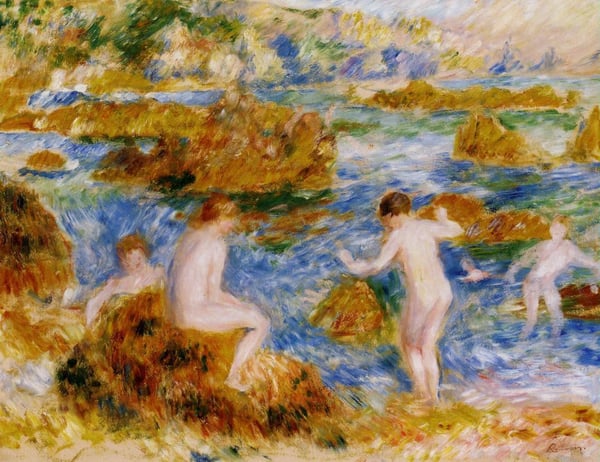
Expert analysis of Pierre-Auguste Renoir’s Nude Boys on the Rocks at Guernsey
Style: Impressionism · Genre: genre painting
Artwork Analysis: "Nude Boys on the Rocks at Guernsey" by Pierre-Auguste Renoir
This painting dates from 1883, a pivotal moment when Renoir was deliberately moving away from the loose brushwork and fleeting light effects of high Impressionism. Though still categorized under the Impressionist style, this work belongs to his "Rejection of Impressionism" period, a conscious turn toward a more structured, classical approach inspired by Renaissance masters he studied in Italy.
Significance within the Artist’s Evolution
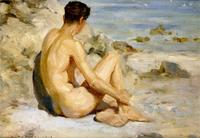
Renoir’s trip to Italy (1881–1882) prompted him to declare that he had "wrung Impressionism dry." In response, he began emphasizing solid form, clear contours, and compositional stability. Nude Boys on the Rocks at Guernsey exemplifies this shift: the figures are delineated with firmer outlines than in his earlier, hazier canvases, and the rocky setting provides a geometric anchor that contrasts with the fleeting atmosphere typical of Impressionist seascapes. Yet he retains Impressionism’s luminous palette and broken color—note the dappled light on the boys’ skin and the shimmering sea—creating a synthesis of spontaneity and order.
Subject and Genre
As a genre painting, it depicts everyday life, but Renoir’s choice of male nudes is unusual. Most of his nudes are female bathers in idyllic settings; here, adolescent boys are shown unselfconsciously playing on the rocks of Guernsey’s coast. This raw, unidealized naturalism reflects Renoir’s interest in the vitality of youth and the human body in harmony with nature—a theme he would later pursue in his monumental The Bathers (1884–1887). The painting thus marks a critical bridge between Impressionism’s sensory immediacy and the classicizing ambitions that would define his mature work.
Museum / Gallery
Genre
Style
Visually similar
20 works with related composition and palette
Marine Landscape
Michel Simonidy
Boy in Sea Foam
Joaquín Sorolla
Children on the Beach at Guernsey
Pierre-Auguste Renoir
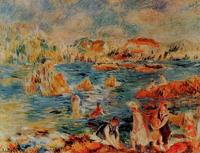
The Beach at Guernsey
Pierre-Auguste Renoir
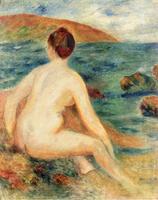
Nude Bather Seated by the Sea
Pierre-Auguste Renoir
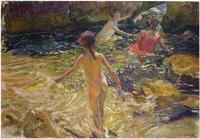
The bath, Javea
Joaquín Sorolla
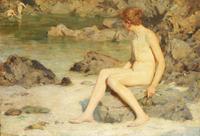
Cupid and Sea Nymphs
Henry Scott Tuke
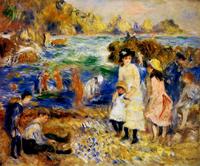
Children by the Sea in Guernsey
Pierre-Auguste Renoir
Sketch for 'Sad Legacy'
Joaquín Sorolla
Bathers
Charles Laval
Bathers
Theo van Rysselberghe
Incoming Tide
Childe Hassam
Baigneuses
Andre Dunoyer de Segonzac
Children in the Sea
Joaquín Sorolla
The Bathers
Henry Scott Tuke
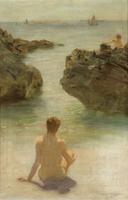
Boy on a Beach
Henry Scott Tuke
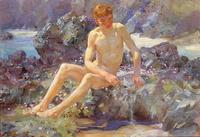
Nude on the rocks
Henry Scott Tuke
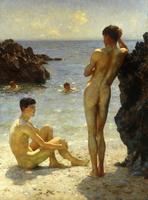
Lovers of the Sun
Henry Scott Tuke
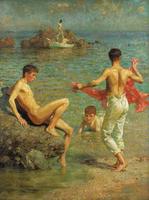
Gleaming Waters
Henry Scott Tuke
Boy on a Beach
Henry Scott Tuke