
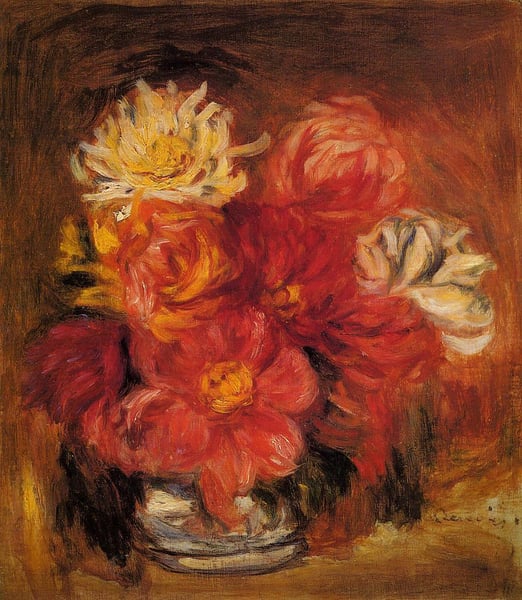
Analisi esperta di Dahlias di Pierre-Auguste Renoir
Stile: Impressionism · Genere: still life
Analysis of "Dahlias" by Pierre-Auguste Renoir
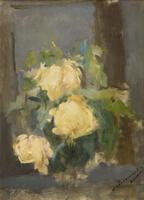
This still life, Dahlias, is a compelling example of Renoir’s stylistic evolution during what is termed his "Rejection of Impressionism" period. Though classified stylistically as Impressionism, the work marks a significant pivot away from the movement’s core tenets of spontaneity and ephemeral light effects. Instead, Renoir reasserts classical structure and durability, signaling his personal crisis with Impressionism’s dissolving forms.
Significance within Style and Period:
-
Impressionist Roots, Classical Turn: The subject—a vibrant bouquet of dahlias—remains quintessentially Impressionist in its celebration of modern, everyday beauty and the artist’s delight in sensuous color. However, Renoir deliberately reins in the loose, sketch-like brushwork of his earlier work. The flowers are rendered with a firmer, more sculptural touch, giving them physical weight and volume. This tension between Impressionist color and solid form defines the work’s significance.
-
Rejection of Impressionist Doctrine: By the 1880s, Renoir grew dissatisfied with Impressionism’s lack of formal discipline and its fragmentation of objects into mere patches of light. In Dahlias, he rejects the ephemeral “impression” in favor of a more anchored composition. The flowers are arranged with a sense of order, the vase is defined by clear contours, and the background is simplified—all moves that distance the painting from the movement’s core aim of capturing fleeting atmospheric effects.
-
A Bridge to Classicism: This painting is a pivotal document of Renoir’s shift toward a cooler, linear style that would later culminate in his so-called “Ingres period.” The depiction of the dahlias demonstrates his new interest in draughtsmanship and balanced composition, even while retaining Impressionism’s luminous palette. It is significant as a transitional work that reconciles two impulses: the freedom of Impressionist color and the permanence of classical form.
In conclusion, Dahlias is not merely a decorative still life but a statement of artistic self-correction. Its significance lies in how Renoir uses an Impressionist language to articulate a critique of Impressionism, making the painting a landmark in the artist’s personal rejection of the movement he helped define.
Museum / Gallery
Visivamente simili
20 opere con composizione e palette affini
Flowers in a Green Vase Dahlilas and Asters
Pierre-Auguste Renoir
Vase of Peonies
Pierre-Auguste Renoir
Bouquets of Flowers
Pierre-Auguste Renoir
Peonies and Irises
T. C. Steele
Bouquet of Flowers in an Earthenware Pitcher
Pierre-Auguste Renoir
Vase of Flowers
Pierre-Auguste Renoir
Bouquet
Pierre-Auguste Renoir
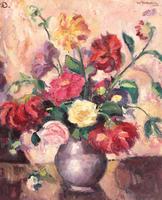
Vase with Peonies
Nicolae Darascu
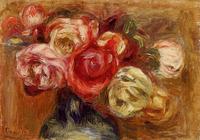
Vase of Roses
Pierre-Auguste Renoir
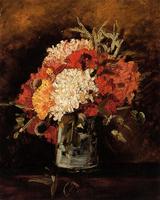
Vase with Carnations
Vincent van Gogh
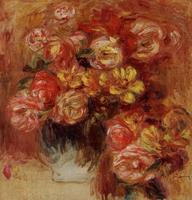
Vase of Roses
Pierre-Auguste Renoir
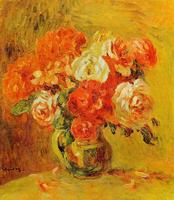
Flowers in a Vase
Pierre-Auguste Renoir
Bela Czobel, Still Life with Peonies, 1936
Bela Czobel
Still Life - Flowers
William Merritt Chase
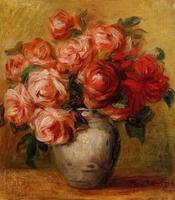
Still Life with Roses
Pierre-Auguste Renoir
Millefiori
Francisc Sirato
Bouquet of Roses in a Green Vase
Pierre-Auguste Renoir
Vase of Flowers
Pierre-Auguste Renoir
Roses in a vase
Pierre-Auguste Renoir
Golden Roses
Olga Boznańska