
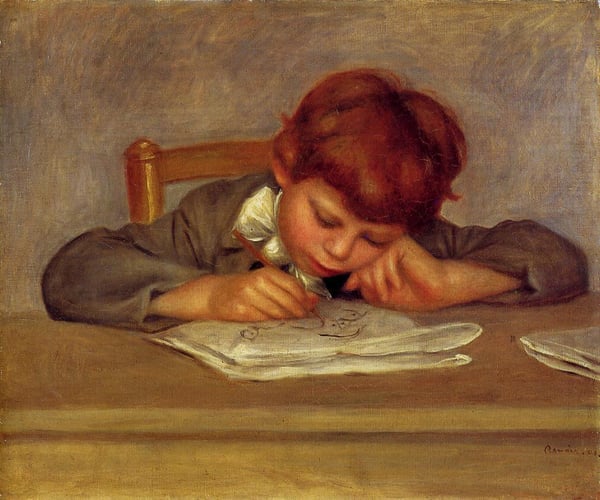
Pierre-Auguste Renoir sanatçısının Jean Drawing eseri hakkında uzman analizi
Tarz: Impressionism · Tür: portrait
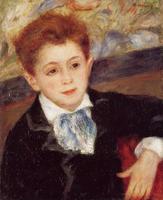
Analysis of "Jean Drawing" by Pierre-Auguste Renoir
This portrait, executed during Renoir’s Later Years, exemplifies the artist’s enduring commitment to Impressionism even as his style matured. The work captures a quiet, intimate moment—likely depicting his son Jean—engaged in an everyday act of drawing. Within the Impressionist tradition, Renoir prioritizes the effects of light and atmosphere over rigid detail, using soft, feathery brushstrokes to suggest form rather than define it. The painting’s significance lies in its fusion of personal subject matter with the core Impressionist goal of rendering transient, sensory impressions. Unlike grand historical subjects, this domestic scene reflects the movement’s turn toward modern, human experience. Renoir’s later palette often grew warmer and more sensual, and here that warmth humanizes the portrait, making the act of drawing feel both casual and monumental. The work stands as a testament to how Impressionism, even in its later phase, continued to find profound beauty in everyday life—and how Renoir, still devoted to the style, used portraiture to explore light, emotion, and familial tenderness.
Museum / Gallery
Tür
Stil
Görsel olarak benzer
İlişkili kompozisyon ve renk paletine sahip 20 eser
Writing boy
Albrecht Anker
Writing lessons
Albrecht Anker
Writing boy with little sister
Albrecht Anker
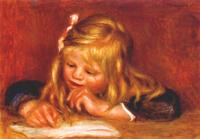
Coco Reading
Pierre-Auguste Renoir
The Loge
Pierre-Auguste Renoir
The Writing Lesson
Pierre-Auguste Renoir
The artist's son (Edmond Dehodencq)
Alfred Dehodencq
The lesson
Pierre-Auguste Renoir
The Letter
Pierre Bonnard
Intimate portraits
Alfred Dehodencq
Portrait of Emile Verhaeren
Willy Schlobach
The Pensive Reader
Mary Cassatt
Leontine and Coco
Pierre-Auguste Renoir
Claude Renoir Playing with Dominos
Pierre-Auguste Renoir
Elena at her desk
Joaquín Sorolla
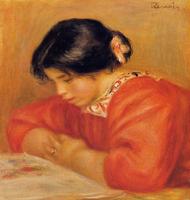
Leontine Reading
Pierre-Auguste Renoir
Portrait of Andreas Amerling (1821-1879), the artist's brother
Friedrich von Amerling
Portrait of Alesha Repin (Age of Pushkin)
Ilya Repin
In the Library (also known as Three School Girls)
Maurice Prendergast
Paul Meunier
Pierre-Auguste Renoir