
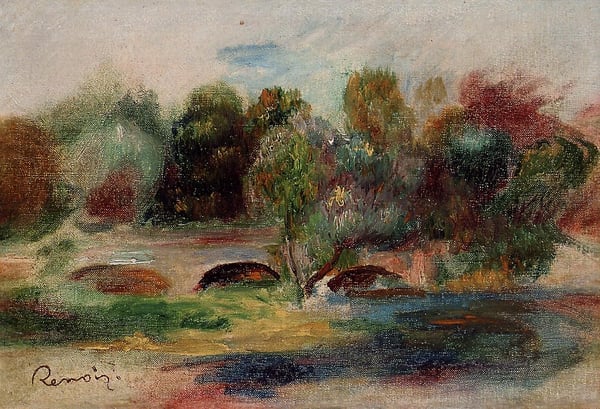
Analisi esperta di Landscape with Bridge di Pierre-Auguste Renoir
Stile: Impressionism · Genere: landscape
As an expert art historian, I will analyze Landscape with Bridge by Pierre-Auguste Renoir based on the provided structured facts: Impressionist style, landscape genre, and creation during his Later Years.
Significance within Impressionism and Renoir's Later Years
Landscape with Bridge exemplifies a pivotal moment in Renoir's career and in Impressionism as a whole. Created during his so-called "Later Years" (roughly the 1880s onward), this work departs from the pure, spontaneous en plein air technique of early Impressionism and embodies Renoir's mature synthesis of that style with a newfound classical formalism.
Key Features of Significance:
-
Evolution of Brushwork and Form: Unlike the fragmented, rapid dabs of paint typical of Monet or early Renoir, this later work reveals a softer, more blended brushstroke. The bridge forms a stable, architectural anchor, while the surrounding landscape—trees, water, sky—is rendered with a looser, almost hazy touch. This tension between structure (the bridge) and atmosphere (the landscape) is a hallmark of Renoir's later period, showing how Impressionism could evolve beyond pure light studies toward a more compositional harmony.
-
The Bridge as a Motif: The bridge itself is significant. In Impressionist painting, bridges often symbolize transition—between the natural and the man-made, between land and water. For Renoir in his later years, this could reflect a stylistic transition: moving from the intense color experiments of the 1870s toward a warmer, more sensuous palette inspired by Rococo and Renaissance masters (especially after his trip to Italy in 1881).
-
Sensuous Palette and Mood: Renoir’s later landscapes are notable for their rich, glowing tones—often more golden, rosy, and verdant than the cooler palettes of fellow Impressionists. Landscape with Bridge likely features dappled light filtering through foliage, with the water reflecting warm hues. This sensuality is part of what makes his late work significant: it prioritizes pleasure, intimacy, and an idealized view of nature, anticipating the decorative quality of 20th-century modernism.
Conclusion: Landscape with Bridge is significant not as a radical break from Impressionism, but as a confident, personal synthesis. It demonstrates that Impressionism was not merely a technical exercise but a flexible language capable of expressing a mature artist’s deepening interest in form, permanence, and emotional warmth. Renoir’s later landscapes, with their blend of immediate sensation and enduring structure, paved the way for artists like Bonnard and Matisse to explore color and composition in new ways.
Museum / Gallery
Visivamente simili
20 opere con composizione e palette affini
Autumn, Pont-de-l'Arche
Clarence Gagnon
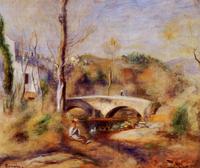
Landscape with Bridge
Pierre-Auguste Renoir
Rolleboise, Bathers Near The Arm Of The Seine
Maximilien Luce
Bridge
Pyotr Konchalovsky

Landscape with river (June 1941)
Vittorio Tessari
Fishermen by a Lake
Pierre-Auguste Renoir
Landscape with River
Pierre-Auguste Renoir
Sunset on the Loire
Maxime Maufra
Autumn
Sergiy Grigoriev
A Bridge. The Vorya River. Abramtsevo.
Pyotr Konchalovsky
The Banks of the River
Pierre-Auguste Renoir
Perthshire Landscape
Samuel Peploe
Landscape
Pierre-Auguste Renoir

Landscape
Pierre-Auguste Renoir
Cagnes Landscape
Pierre-Auguste Renoir
Saint-Cenery, the Church and the Bridge
Eugene Boudin
The Bridge
Henri Martin
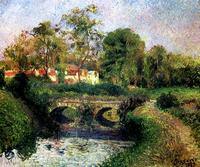
Little Bridge on the Voisne, Osny
Camille Pissarro
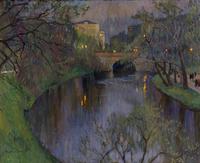
Twighlight in Riga
Nikolay Bogdanov-Belsky
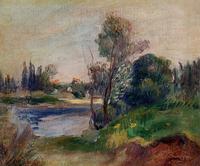
Banks of the River
Pierre-Auguste Renoir