
Expert analysis of Pierre-Auguste Renoir’s Landscape with Fence
Style: Impressionism · Genre: landscape
Expert Analysis: "Landscape with Fence" by Pierre-Auguste Renoir
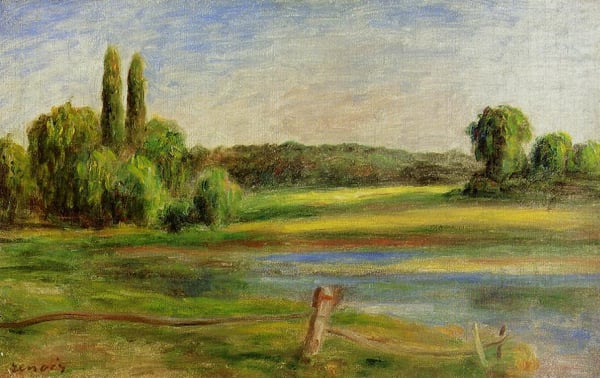
Renoir’s Landscape with Fence exemplifies the artist’s mature period, often referred to as his “Later Years” (roughly the 1890s to early 1900s). During this time, Renoir moved away from the loose, flickering brushwork of high Impressionism toward a more structured, classical approach—while still retaining the luminous color palette and natural light that defined the movement. This painting is significant precisely because it captures that transition.
Composition and Structure:
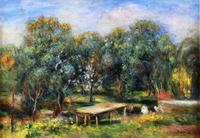
The fence itself acts as a strong horizontal and diagonal anchor, introducing a sense of order rarely seen in earlier Impressionist landscapes. Renoir uses this man-made element to frame the natural world, creating a dialogue between geometry and organic growth. The fence’s rhythmic repetition guides the eye across the canvas, while the soft, dappled foliage beyond it resists rigid outlines—a hallmark of Impressionist optical blending.
Color and Light:
Renoir’s signature sensitivity to warm, glowing hues is on full display. Greens are nuanced with yellow and blue, and the play of sunlight filters through leaves in small, broken touches of paint. Unlike his plein air peers, Renoir often applied thin glazes in his later works, giving the surface a pearly, almost Venetian luminosity. The fence, painted in earth tones and muted ochres, grounds the scene, preventing the color from becoming too ethereal.
Significance within Impressionism:
This work is a testament to Renoir’s ability to evolve without abandoning Impressionist ideals. While Claude Monet pursued ephemeral atmospheric effects, and Degas focused on figure studies, Renoir sought a synthesis of immediate sensory experience and compositional permanence. Landscape with Fence embodies that synthesis: it is at once a fleeting moment of sunshine and a carefully balanced design. The subject—an ordinary countryside view—is elevated through Renoir’s attention to tactile texture (the rough bark of the fence) and atmospheric depth (the hazy treeline in the distance).
Context in Renoir’s Later Years:
By the 1890s, Renoir had already achieved success and was plagued by rheumatoid arthritis, yet his work grew more serene and monumental. This landscape, though modest in scale, hints at the grandeur he would later give to figures in works like The Bathers (1918). The fence acts as a barrier and a threshold—perhaps a metaphor for the artist’s own boundaries between the natural and the structured, the observed and the idealized.
In summary, Landscape with Fence is significant as a key document of Renoir’s later stylistic synthesis: it marries the brilliance of Impressionist color with the stability of classical composition, proving that Impressionism could mature into lasting formal strength without sacrificing its original joy in light and life.
Museum / Gallery
Visually similar
20 works with related composition and palette
The Banks of the River
Pierre-Auguste Renoir
The Clearing
Pierre-Auguste Renoir
Contra Costa Landscape
Xavier Martinez
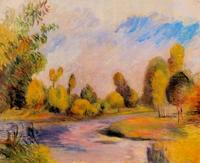
Banks of a River
Pierre-Auguste Renoir
Stormy Day
Edward E. Simmons
The field
Nicolae Tonitza
Landscape with grey sky
Thomas Pollock Anshutz
Fiumetto
Carlo Carra

Winter
Kimon Loghi
Banks of the River
Pierre-Auguste Renoir
Landscape
Pierre-Auguste Renoir
Dunka's Grove. In the estate of Polenovs
Boris Kustodiev
Landscape at Collettes
Pierre-Auguste Renoir
Banks of the River
Pierre-Auguste Renoir
Late Afternoon
Robert Julian Onderdonk
Autumn
Sergiy Grigoriev
Autumn evening. Trail in the forest.
Isaac Levitan
The Village of Vosges
Albert Marquet
Cagnes Landscape
Pierre-Auguste Renoir
Landscape
Pierre-Auguste Renoir