
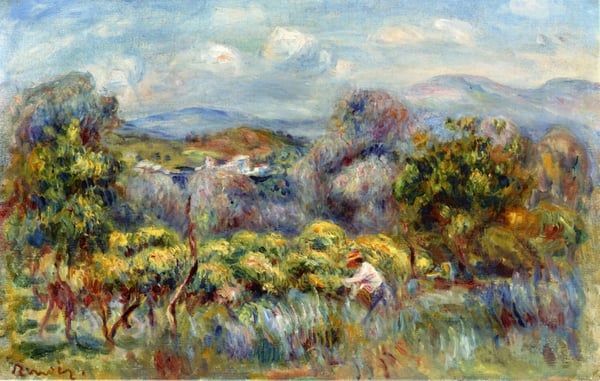
Orange Trees
Expert analysis of Pierre-Auguste Renoir’s Orange Trees
Style: Impressionism · Genre: landscape
Expert Analysis of "Orange Trees" by Pierre-Auguste Renoir
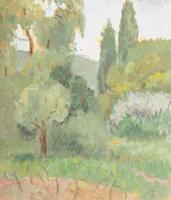
Within the canon of Impressionist landscape painting, Pierre-Auguste Renoir’s Orange Trees exemplifies the movement’s core ambition: to capture the fleeting effects of light and atmosphere through vibrant, unblended color. As an Impressionist landscape, the work departs from the polished, idealized vistas of earlier academic painting, instead embracing spontaneity and sensory immediacy.
Significance in the Impressionist Context
-
Color as Structure: Renoir’s palette in Orange Trees likely relies on broken brushstrokes of pure, unmodulated hues—particularly the oranges, greens, and blues—to model form through light rather than line. The orange grove becomes a shimmering field of reflected sunlight, where the fruit and foliage dissolve into patches of chromatic intensity. This approach was revolutionary: it prioritized optical truth over local color, challenging the viewer to “mix” the tones in their eye.
-
Everyday Subject Elevated: The choice of an orange grove—a humble, domestic landscape—reflects the Impressionist rejection of grand historical or mythological themes. Renoir, like his peers, found the extraordinary in the ordinary: the dappled shade under citrus trees, the heat of the southern sun, the texture of leaves. The work’s significance lies in its insistence that a simple orchard could be as worthy of monumental treatment as a classical ruin.
-
Brushwork and Atmosphere: The rapid, visible brushwork typical of Renoir’s landscape phase creates a sense of air circulation and ephemeral light. In Orange Trees, this technique would dissolve solid forms into a tapestry of strokes, mimicking the way the eye perceives a sunlit grove in constant flux. The painting thus becomes a record of a single moment—a “snapshot” of light on leaves—rather than a permanent, static object.
Renoir’s Role within Impressionism
While Renoir is best known for his figures and social scenes, his pure landscapes, such as Orange Trees, reveal his deep engagement with the theories of Claude Monet and Camille Pissarro. Here, Renoir privileges the sensory experience over narrative: the viewer is invited to feel the warmth of the sun, the rustle of foliage, and the vibrant scent of ripe fruit through pure visual means. This work stands as a testament to Impressionism’s radical belief that paint itself, applied with energy and rhythm, could embody the very act of perception.
In sum, Orange Trees is significant because it distills the Impressionist revolution into a single, luminous scene—demonstrating how a familiar subject, treated with innovative color and brushwork, could redefine the possibilities of landscape painting.
Museum / Gallery
Visually similar
20 works with related composition and palette
Landscape with a View of the Sea
Pierre-Auguste Renoir
Landscape at Collettes
Pierre-Auguste Renoir
Cagnes Landscape
Pierre-Auguste Renoir
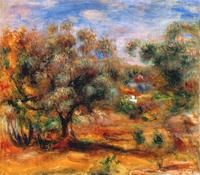
Landscape Near Cagnes
Pierre-Auguste Renoir
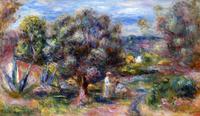
Aloe, Picking at Cagnes
Pierre-Auguste Renoir
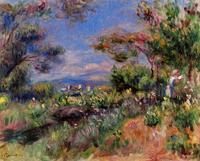
Young Woman in a Landscape, Cagnes
Pierre-Auguste Renoir
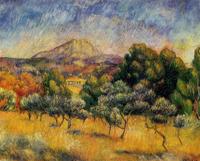
Mount Sainte Victoire
Pierre-Auguste Renoir
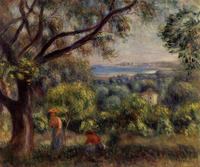
Cagnes Landscape
Pierre-Auguste Renoir
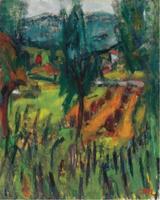
Bela Czobel Szentendrei Taj 1928
Bela Czobel
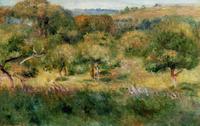
The Edge of the Forest in Brittany
Pierre-Auguste Renoir
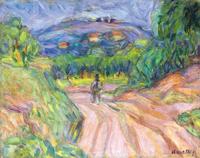
A Painter in the Landscape
Kmetty János
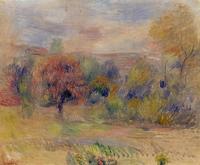
Landscape
Pierre-Auguste Renoir
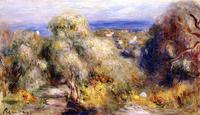
View of Cannet
Pierre-Auguste Renoir
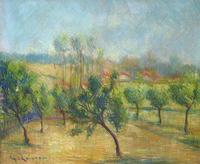
Trees
Gustave Loiseau
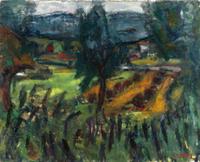
Bela Adalbert Czobel , Passage
Bela Czobel
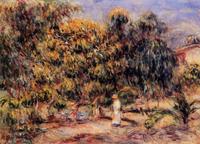
Woman in White in the Garden at Colettes
Pierre-Auguste Renoir
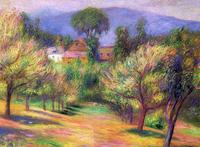
Connecticut landscape
William James Glackens
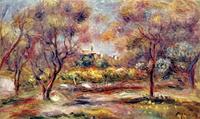
Landscape at Grasse
Pierre-Auguste Renoir
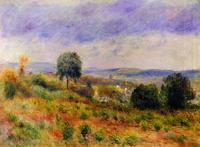
Landscape Auvers sur Oise
Pierre-Auguste Renoir
Juan-les-Pins Landscape
Theodor Pallady