
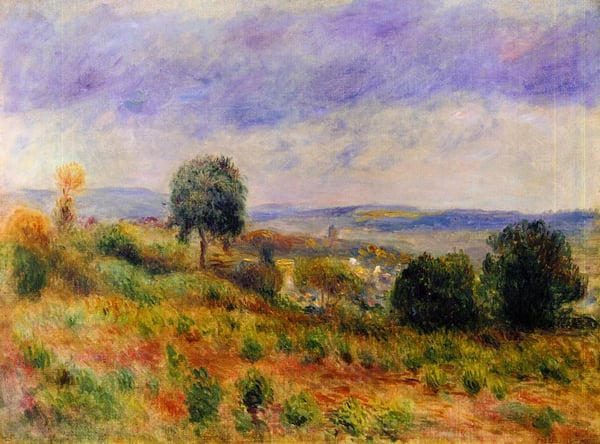
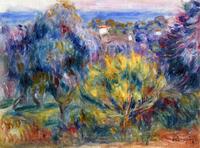
Экспертный разбор работы «Landscape Auvers sur Oise» художника Pierre-Auguste Renoir
Стиль: Impressionism · Жанр: landscape
Expert Analysis of Landscape Auvers sur Oise by Pierre-Auguste Renoir
As an Impressionist landscape from Renoir’s later years, this work holds a distinctive place within the artist’s evolution and the broader movement. While Impressionism is often associated with the 1870s and early 1880s, Renoir’s later period (roughly from the mid-1880s onward) reflects a deliberate shift away from the purely perceptual, sketch-like approach of his earlier works toward a more structured, timeless, and classical sensibility.
Significance within the Later Years Style
In Landscape Auvers sur Oise, Renoir demonstrates his mature synthesis of Impressionist color and light with a renewed interest in form and composition. The village of Auvers-sur-Oise, a favored locale for artists including Cézanne, Pissarro, and later Van Gogh, provided Renoir with a pastoral yet cultivated subject. The painting captures the lush, sun-dappled countryside with the bright, broken brushwork characteristic of Impressionism, but the handling is more deliberate and the palette warmer—often employing rich reds, oranges, and deep greens that hint at a sun-drenched, idyllic atmosphere.
What makes this work particularly significant is how it embodies Renoir’s late-career “anti-modernist” turn. After travels to Italy and a crisis of confidence in pure Impressionism, he began to re‑integrate lessons from Renaissance and Rococo masters—emphasizing volume, contour, and a sense of permanence. Here, the landscape’s gentle undulations, the careful arrangement of trees and fields, and the soft, almost hazy light reveal a search for harmony rather than transient optical sensation. The scene feels both immediate (thanks to the lively brushwork) and timeless (due to the balanced composition).
Impressionist Legacy in a Later Work
Unlike the radical urban or industrial scenes of Monet or the spontaneous suburban views of early Renoir, Landscape Auvers sur Oise represents a contemplative, mature vision. It reminds viewers that Impressionism was not a static style but a living practice that allowed artists to evolve. For Renoir, this later phase produced landscapes that are at once serene, richly colored, and constructed with a classicist’s eye—qualities that elevate this painting beyond a mere record of a place into a personal, poetic meditation on light, nature, and form.
Визуально похожие
20 работ с близкой композицией и палитрой
The Path
Pierre-Auguste Renoir
Landscape near Essoyes
Pierre-Auguste Renoir
The Edge of the Forest in Brittany
Pierre-Auguste Renoir
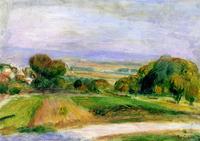
Landscape
Pierre-Auguste Renoir
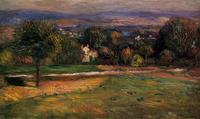
The Clearing
Pierre-Auguste Renoir
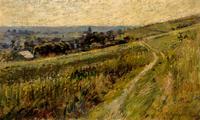
Landscape
Theodore Robinson
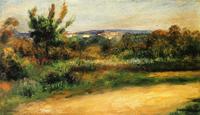
Midday Landscape
Pierre-Auguste Renoir
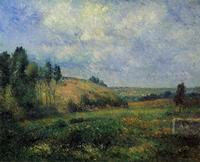
Landscape, near Pontoise
Camille Pissarro
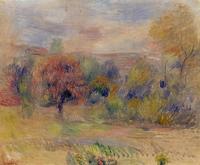
Landscape
Pierre-Auguste Renoir
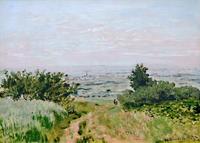
View to the Plain of Argenteuil
Claude Monet
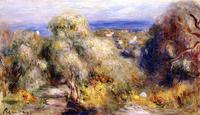
View of Cannet
Pierre-Auguste Renoir
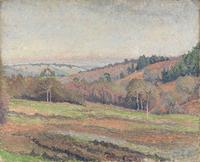
Old Mark's Field, Coldharbour, Surrey
Lucien Pissarro
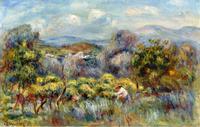
Orange Trees
Pierre-Auguste Renoir
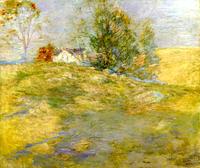
Artist's Home in Autumn, Greenwich, Connecticut
John Henry Twachtman
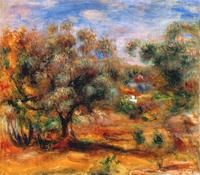
Landscape Near Cagnes
Pierre-Auguste Renoir
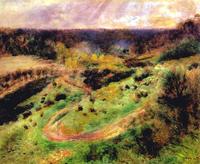
Landscape at Wargemont
Pierre-Auguste Renoir
Dawn in the Hills
Robert Julian Onderdonk
Warm evening, Templestowe
David Davies
Autumn Afternoon, Giverny
Lilla Cabot Perry
Landscape with a View of the Sea
Pierre-Auguste Renoir