
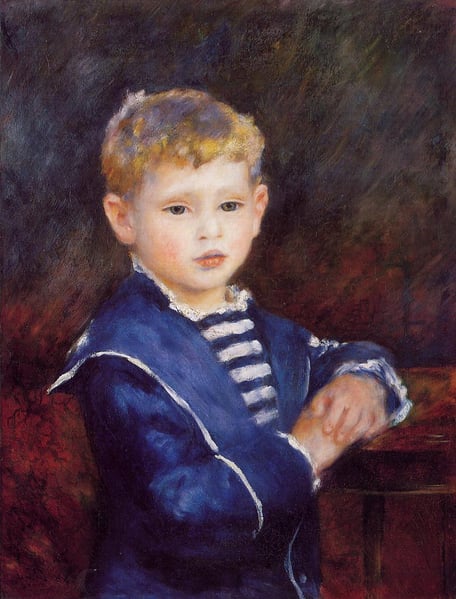
Expertenanalyse zu Pierre-Auguste Renoirs Paul Haviland
Stil: Impressionism · Genre: portrait
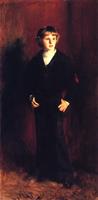
Pierre-Auguste Renoir’s Portrait of Paul Haviland represents a pivotal moment in the artist’s career—the transition away from the loose brushwork and vibrant spontaneity of Impressionism toward a more structured, classical approach. Painted during what is described as his Rejection of Impressionism period, this work signals Renoir’s conscious departure from the movement he helped define.
Significance within Renoir’s evolution:
In the 1880s, Renoir famously declared that he had “wrung Impressionism dry” and began seeking a more disciplined, linear style inspired by the old masters—especially Raphael and Ingres. Paul Haviland embodies this shift: the sitter’s portrait is composed with greater solidity and clarity than the blurred, atmospheric figures of Renoir’s earlier years. The brushwork is still soft and luminous, but the contours are more defined, and the background is treated with a restrained, planar simplicity that focuses attention on the subject’s face and hands.
Stylistic hallmarks:
- Color palette: Muted, warm tones replace the pure, high-key color of high Impressionism, indicating Renoir’s move toward a more tonal, harmonious modeling.
- Form and structure: The sitter’s posture is stable, almost statuesque, with a clear silhouette—a deliberate departure from the fleeting, “snapshot” compositions typical of Impressionist portraits.
- Psychological depth: Unlike many Impressionist portraits that prioritize light and atmosphere, this work uses a calm, direct gaze and subtle shadowing to convey a sense of introspection and dignified presence, aligning with Renaissance portrait traditions.
Contextual importance:
Paul Haviland was a noted collector and patron of the arts, and this portrait reflects the growing acceptance of Impressionist painters—even as they were rejecting their own past—among the intellectual elite. The work thus stands as a document of Renoir mastering a “synthetic” style that would later flower into his monumental late nudes and figure paintings.
In short, Paul Haviland is significant not as a typical Impressionist portrait, but as a clear statement of Renoir’s artistic independence—proof that Impressionism could evolve into something more permanent, structured, and timeless.
Visuell ähnlich
20 Werke mit ähnlicher Komposition und Farbpalette
The Sailor Boy Gardener Cassatt
Mary Cassatt
Scheiber Hugó, Kisfiu Ünneplőben, 1922
Scheiber Hugó
Portrait of Caspar Goodrich
John Singer Sargent
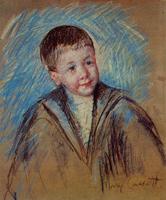
Portrait of Master St. Pierre
Mary Cassatt
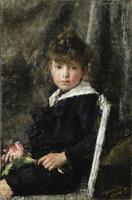
Portrait of Gérome Caccamisi
Antonio Mancini
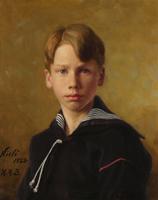
Portrait of the Artist's Nephew Nils
Hans Andersen Brendekilde
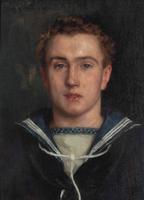
Portrait of Frederick Brewer, Bust-length, in a Sailor's Uniform
Henry Scott Tuke
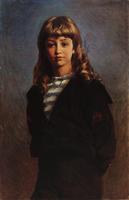
Serezha (Portrait of Son in Sailor Suit)
Konstantin Makovsky
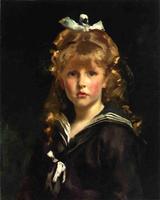
Jacques Barenton
John Singer Sargent
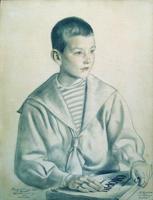
Portrait of Mitya Shostakovich
Boris Kustodiev
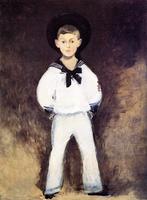
Portrait of Henry Bernstein as a Child
Edouard Manet
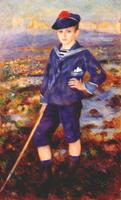
Sailor Boy (Portrait of Robert Nunes)
Pierre-Auguste Renoir
Potrait of Vassilakis Melas
Georgios Jakobides
Gutt i matrosdress
Xan Krohn
Petre Tonitza
Nicolae Tonitza
Irish Boy
Robert Henri
Portrait of Pierre Renoir in a Sailor Suit
Pierre-Auguste Renoir
Portrait of Bruno Veneziani
Umberto Veruda
The two children
Giovanni Boldini
Cecil Harrison
John Singer Sargent