
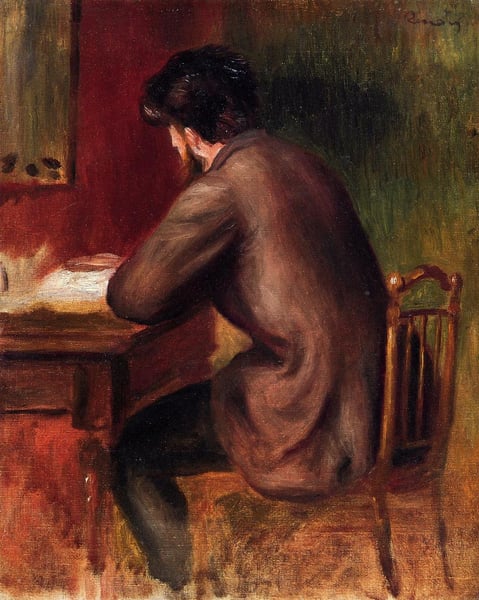
Pierre-Auguste Renoir の Posthumous Portrait of Frederic Bazille の専門的な分析
スタイル:Impressionism · ジャンル:portrait
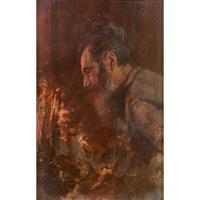
Analysis of "Posthumous Portrait of Frederic Bazille" by Pierre-Auguste Renoir
This portrait holds a unique place in Renoir’s oeuvre, as it was painted after the death of his close friend and fellow Impressionist Frédéric Bazille (killed in 1870). Created during a period often labeled “Rejection of Impressionism,” the work marks a deliberate pivot away from the movement’s ephemeral, optical concerns toward a more structured, timeless, and emotionally resonant approach.
Significance within the Style and Period
-
A shift from Impressionist spontaneity: While Renoir is celebrated as a founding Impressionist, by the late 1870s–1880s he began to feel the style’s limitations—particularly its lack of formal discipline. In this posthumous portrait, the brushwork is notably less fragmented and sketchy than his earlier plein-air works. Instead of dissolving form in light, Renoir models Bazille’s face with careful gradation, conveying both solidity and a quiet, dignified melancholy. The soft, diffused lighting still carries Impressionist warmth, but the composition is more stable, evoking Renaissance portraiture.
-
Commemorative vs. Absence: The portrait is not a direct study from life (as Bazille was long dead) but an idealized recollection. This allowed Renoir to infuse the image with personal grief and a sense of permanence. Unlike the fleeting moments typical of Impressionism, this work aims to preserve memory—a theme that aligns with Renoir’s growing interest in classicism and the “grand tradition” of portraiture.
-
A portrait of transition: The painting stands as a visual manifesto of Renoir’s evolving philosophy. He would later famously say, “I had wrung Impressionism dry and I came to the conclusion that I could neither paint nor draw.” In this portrait, he seeks to reconcile Impressionist color with the structural clarity of Ingres—a synthesis that defines his mature “pearly” style.
Art Historical Context
Painted roughly a decade after Bazille’s death, the work is also a homage to a lost generation. Bazille had been a pivotal early supporter of Impressionism, and Renoir’s choice to depict him in a formal, almost iconic manner—rather than as a casual figure in a landscape—underscores a shift from the movement’s initial revolutionary identity toward a more reflective, self-aware phase. This portrait thus becomes a bridge: honoring Impressionism’s radical roots while signaling its eventual absorption into the broader canon of Western art.
In summary, the “Posthumous Portrait of Frederic Bazille” is significant not only as a touching memorial but as a key document of Renoir’s departure from pure Impressionism. It encapsulates the tension between fleeting sensation and enduring substance, marking a critical juncture in the artist’s career and in the history of modern painting.
Museum / Gallery
ジャンル
スタイル
視覚的に類似
構図やパレットが近い作品 20 件
Untitled
Solomon Joseph Solomon
Portrait of Henri Cordier, teacher at the School of Oriental Languages
Gustave Caillebotte
Berény Róbert, Abszint Ivó
Berény Róbert
Reading Self Portrait
Kmetty János
Portrait of M.V. Dobuzhinsky
Boris Kustodiev
Young Man and Skull
Paul Cezanne
The Card Players
Paul Cezanne
Alden Brooks
Roderic O'Conor
Das Studium
Telemaco Signorini
Portrait of Professor William D. Marks
Thomas Eakins
Chess-Players
Honore Daumier
In the Tavern
Laszlo Mednyanszky
Ambroise Vollard
Pierre-Auguste Renoir
Between Rounds Study for the Timer
Thomas Eakins
Portrait of Elbert Hubbard (The Roycrafter)
William Merritt Chase
Ferenczy Károly, Cipőgombolás
Karoly Ferenczy
Jeantaud, Linet and Laine
Edgar Degas
Seated Young Man in a Jacket with an Umbrella
Edgar Degas
Self Portrait
Boris Kustodiev
Homme de profil Man in profile
Charles Frederic Ulrich