
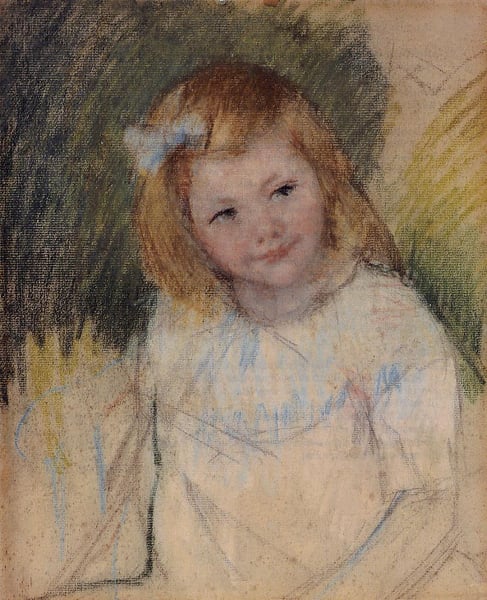
Expert analysis of Pierre-Auguste Renoir’s Sara Looking to the Right
Style: Impressionism · Genre: portrait
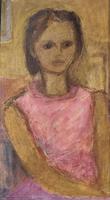
Expert Analysis of "Sara Looking to the Right" by Pierre-Auguste Renoir
This portrait, executed during Renoir’s later years, stands as a compelling testament to the artist’s evolution from the loose, flickering brushwork of high Impressionism toward a more structured, sensuous classicism. While the title suggests a simple, momentary pose—the sitter glancing to the side—Renoir imbues the image with a timeless, almost sculptural weight that marks a significant departure from his earlier, more ephemeral studies.
Significance within the Impressionist and Later Period Context:
-
A Mature Synthesis of Styles
In his later period, Renoir famously declared he had “gone to the end of Impressionism” and sought a new formal clarity. Sara Looking to the Right embodies this synthesis: the skin tones are built with warm, pearly layers (a hallmark of his mature palette), while the contours are softened but more deliberately modelled. The figure feels anchored in space, a quality Renoir admired in Renaissance masters like Raphael. This dialogue between Impressionist luminosity and classical structure makes the work a pivotal example of the artist’s late style. -
Focus on Feminine Grace and Psychological Presence
Renoir’s later portraits often celebrate an idealized, yet deeply human, femininity. Here, the subject’s averted gaze—turning to the right—creates a sense of quiet introspection. The viewer is drawn not into direct engagement but into a privileged observation of a private moment. The brushstrokes remain visible (a nod to Impressionist spontaneity) but are harnessed to define the soft curve of the jaw, the fall of light on the cheek, and the texture of hair. This balance between immediacy and permanence reveals Renoir’s lifelong preoccupation with capturing both the fleeting and the eternal. -
Technical Mastery in the Later Years
Suffering from severe rheumatoid arthritis by this time, Renoir adapted his technique—strapping brushes to his hands—yet produced some of his most confident works. The handling in Sara Looking to the Right is fluid and assured, with subtle modulations of color (pink, ochre, ivory) that generate a warm, atmospheric glow. The background, typically vague, is handled in broad, rhythmic strokes that push the subject forward, focusing all attention on the sitter’s serene expression.
Conclusion
Sara Looking to the Right is significant not merely as a charming portrait, but as a key artifact of Renoir’s late aesthetic—a moment when Impressionism’s shimmering surface gave way to a more monumental, tactile sense of form. It demonstrates that even in his final decades, Renoir continued to innovate, merging the fleeting light of his youth with a timeless reverence for the human figure.
Museum / Gallery
Visually similar
20 works with related composition and palette
Sara Looking towards the Right
Mary Cassatt
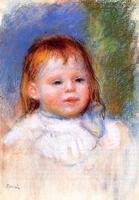
Portrait of Jean Renoir
Pierre-Auguste Renoir
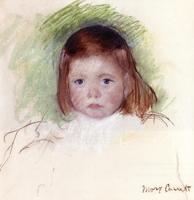
Portrait of Ellen Mary Cassatt
Mary Cassatt
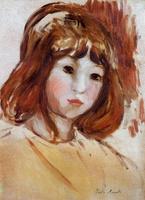
Portrait of a Young Girl
Berthe Morisot
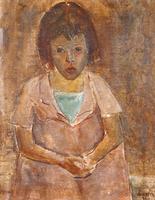
Menina triste e doente
Jose Pancetti
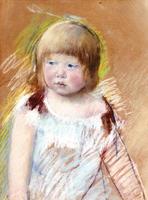
Child with Bangs in a Blue Dress
Mary Cassatt
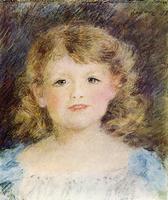
Paul Charpentier
Pierre-Auguste Renoir
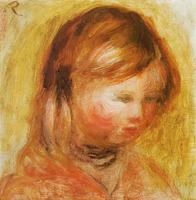
Young Girl
Pierre-Auguste Renoir
Kislány
Bela Czobel
Young Boy in Blue
Mary Cassatt
Ellen with Bows in Her Hair, Looking Right
Mary Cassatt
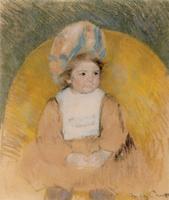
Young Girl Seated in a Yellow Armchair
Mary Cassatt
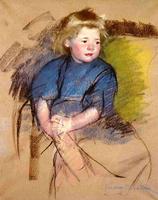
Portrait of a Young Girl (Simone)
Mary Cassatt
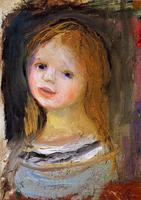
Portrait of a Woman
Pierre-Auguste Renoir
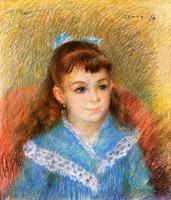
Portrait of a Young Girl (Elizabeth Maitre)
Pierre-Auguste Renoir
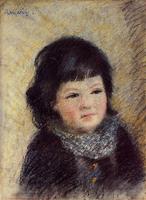
Portrait of a Child
Pierre-Auguste Renoir
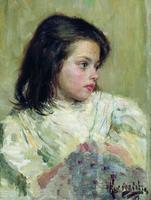
A Girl. Sketch
Boris Kustodiev
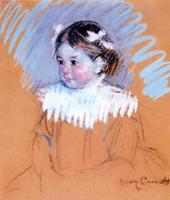
Bust of Ellen with Bows in Her Hair
Mary Cassatt
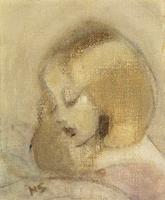
Annuli Reading
Helene Schjerfbeck
Modok Mária, Rózsaszin Bluzos Lány
Modok Mária