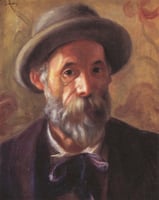
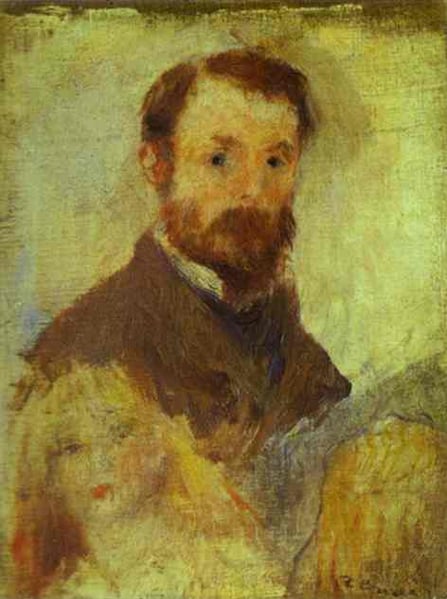
Self-Portrait
Expertenanalyse zu Pierre-Auguste Renoirs Self-Portrait
Stil: Impressionism · Genre: self-portrait
This Self-Portrait by Pierre-Auguste Renoir is a compelling example of how Impressionist principles were applied to the most intimate of genres: the artist's own image. While Impressionism is best known for landscapes and scenes of modern life, Renoir’s approach here demonstrates the movement’s core concern with capturing the ephemeral, subjective nature of vision, even in a static, introspective subject.
Significance within Impressionism:
-
The "Impression" of Personality: Unlike traditional self-portraits that emphasized status, idealized features, or meticulous detail, Renoir’s work prioritizes the feeling of a moment. The loose, broken brushwork and soft edges convey a sense of immediacy—as if we glimpse the artist in a brief moment of self-reflection, not a staged, immortalized persona. This aligns perfectly with Impressionism’s aim to record the fleeting, transient experience.
-
Color and Light over Form: Renoir dissolves the hard contours of his face into patches of warm, luminous color. The skin is built not with smooth modeling but with subtle shifts of rose, ochre, and creamy white, reflecting the Impressionist fascination with how light—and the artist’s perceptual reaction to it—dictates form. The background is treated with equal vibrancy, suggesting that the figure is embedded in the atmosphere, not isolated from it.
-
Subjectivity as Modernity: In this self-portrait, Renoir presents himself not as a master craftsman but as a sensitive observer of his own appearance and mood. The soft focus and slightly informal pose (likely because the artist used a mirror and had to paint quickly before the light changed) underscore the Impressionist belief that the artist’s personal, sensory experience was a valid subject in its own right. This marks a radical departure from the academic tradition.
-
A Counterpoint to Renoir's Later Work: During the period when he painted this self-portrait (a work typical of his earlier, high-Impressionist phase), Renoir was most concerned with capturing the shimmering, fleeting effects of sunlight on surfaces. Applying this technique to his own face transforms the self-portrait from a record of likeness into a study of optical sensation—a hallmark of the Impressionist revolution.
In essence, this Self-Portrait is significant because it pushes Impressionism into the realm of personal introspection. It proves that the movement’s core innovations—broken color, lively brushwork, and a focus on perceptual truth—could be used not just to depict a lily pond or a dance hall, but to articulate the transient nature of the self.
Genre
Stil
Visuell ähnlich
20 Werke mit ähnlicher Komposition und Farbpalette
Portrait of the poet Gaetano Crespi
Cesare Tallone
Self-Portrait
Edouard Vuillard
Portrait of the Painter Charles Sellier
Jean-Baptiste Carpeaux
Self Portrait
Henri Fantin-Latour
Self-Portrait
Edouard Vuillard
Male portrait
Noè Bordignon
Auto-retrato
António de Carvalho da Silva Porto
Portrait of Monsieur Louis Estruc
Camille Pissarro
Self-Portrait
Mstislav Dobuzhinsky
Portrait of Charles Gruet
Carolus-Duran
Self Portrait
Xavier Mellery
Painter George Paul Chalmers
Joseph Farquharson
Self-portrait
Umberto Veruda
Self-portrait
Giacomo Favretto
John William Waterhouse
William Logsdail
Self portrait
Umberto Veruda
Portrait of the painter Arturo Fittke
Umberto Veruda
Self-Portrait
Antonio Mancini
Self portrait
Isaac Levitan
Self-Portrait
Raimundo de Madrazo