
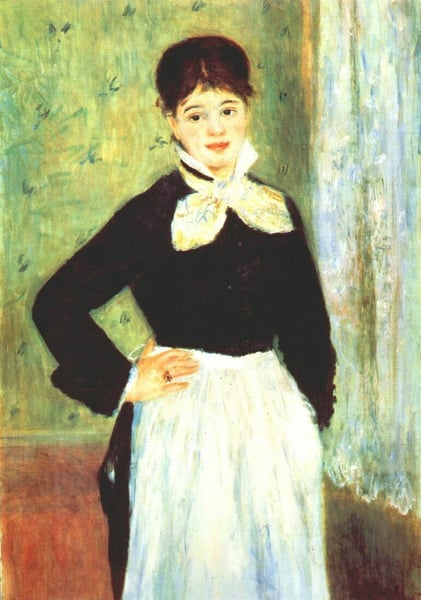
Analisi esperta di Serving Girl from Duval's Restaurant di Pierre-Auguste Renoir
Stile: Impressionism · Genere: portrait
This analysis is based solely on the provided facts.
Expert Art Historical Analysis: Serving Girl from Duval's Restaurant by Pierre-Auguste Renoir
Pierre-Auguste Renoir’s Serving Girl from Duval's Restaurant stands as a quintessential example of Impressionism’s radical shift toward the depiction of modern life. Painted during Renoir’s active period as a member of the Impressionist circle, the work transforms a humble genre scene into a luminous study of character, light, and social observation.
Significance within Impressionism and the Portrait Genre
The painting is significant for its deliberate rejection of academic portraiture. Instead of a wealthy patron or mythological figure, Renoir elevates a working-class woman—a server in a bustling Parisian restaurant—to the status of a portrait subject. This democratic choice embodies the Impressionist mission to capture the beauty and truth of contemporary existence. The sitter’s direct, unpretentious gaze and relaxed posture convey a sense of quiet dignity and individuality, challenging the formal conventions of traditional portraiture.
Renoir’s treatment of light and color is the hallmark of his Impressionist technique. Short, broken brushstrokes vibrate across the canvas, suggesting the flickering light of a restaurant interior. Warm tones—peach, rose, and soft gold—model the serving girl’s face and hands, while cooler blues and greens in her uniform and the background create a sense of atmospheric depth. The paint application remains fluid and tactile, prioritizing the artist’s immediate sensory impression over meticulous detail. This approach captures not just the woman’s appearance, but the fleeting moment of her pause between tasks.
Period and Stylistic Context
As an artwork produced during Renoir’s association with the Impressionists, Serving Girl from Duval's Restaurant exemplifies the group’s break from the Salon’s polished finish. The visible brushwork and emphasis on everyday subject matter were considered radical at the time, yet they reveal Renoir’s profound humanism. His ability to infuse a simple, transient scene with warmth and vitality—making the ordinary extraordinary—is precisely what cements this piece’s importance. It remains a compelling document of 19th-century Parisian social life and a masterful display of Impressionist technique applied to a deeply sympathetic human portrait.
Museum / Gallery
Visivamente simili
20 opere con composizione e palette affini
At La Bastille (Portrait of Jeanne Wenz)
Henri de Toulouse-Lautrec
In Rooms
Alexei Korzukhin
Girl with a Book
Ivan Tvorozhnikov
In the Dining Room
Berthe Morisot
Irish Lass
Robert Henri
The Chelsea Girl
James McNeill Whistler
Portrait of a nurse
Zinaida Serebriakova
A Visitor
Sarah Purser
Woman Sitting by a Cradle
Vincent van Gogh
The Bellelli Family
Edgar Degas
Mademoiselle Legrand
Pierre-Auguste Renoir
Farmer's wife from Dobbiaco
August von Pettenkofen
Farmer's wife from Dobbiaco
August von Pettenkofen
Mädchen Ölstudie
Paul Hoecker (Höcker)
The Cup of Chocolate
Pierre-Auguste Renoir
The boss's daughter
Paul Gauguin
Portrait of Miss Lina Kyburz
Ferdinand Hodler
Lady at the Tea Table
Mary Cassatt
Girl with Red Shawl
Bela Czobel

Portrait of Mrs William Harrison
Mary Cassatt