
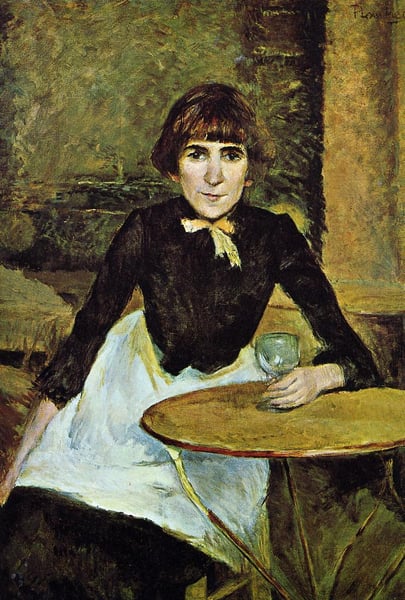
Analisi esperta di At La Bastille (Portrait of Jeanne Wenz) di Henri de Toulouse-Lautrec
Stile: Post-Impressionism · Genere: portrait
Expert Analysis: "At La Bastille (Portrait of Jeanne Wenz)" by Henri de Toulouse-Lautrec
As an art historian, I focus on the intersection of style, subject, and context—the very qualities that make this work a compelling example of Post-Impressionist portraiture.
Significance within Post-Impressionism:
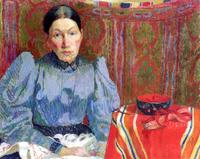
Toulouse-Lautrec’s portrait of Jeanne Wenz stands as a masterful demonstration of Post-Impressionism’s shift away from naturalistic representation toward emotional and psychological truth. The artist employs a deliberately flattened pictorial space, a hallmark of the movement, influenced by Japanese ukiyo-e prints. The composition likely emphasizes strong diagonals and asymmetrical cropping, drawing the viewer’s eye directly to the sitter’s face and hands, while the background—perhaps a café or interior near the Bastille—is rendered with broad, unmodulated strokes of color. This technique prioritizes the feeling of the scene over photographic accuracy.
Portrait as Character Study:
Unlike formal, idealized portraits of the era, Lautrec presents Jeanne Wenz with uncompromising honesty. She is not a remote aristocrat but a real, modern woman—possibly a performer, friend, or denizen of Montmartre’s nightlife. The title “At La Bastille” situates her in the working-class quarter, anchoring the portrait in a specific urban milieu. Lautrec’s use of contour lines, often thick and expressive, outlines her features with a caricature-like directness, yet conveys dignity and individuality. The sitter’s relaxed pose and direct gaze suggest a candid rapport between artist and subject, a signature approach of Lautrec that humanizes figures often marginalized by society.
Compositional and Coloristic Innovation:
In true Post-Impressionist fashion, color is used not to mimic reality but to evoke mood. Likely employing dissonant hues—perhaps a sharp contrast between a greenish complexion and red accents in clothing or background—Lautrec amplifies the psychological intensity. The brushwork is energetic and sketch-like, retaining the immediacy of a charcoal study while building form through color patches. This technique anticipates the expressive freedom of Fauvism and Expressionism.
Cultural and Artistic Legacy:
At a time when portraiture often served as a vehicle for social status, Lautrec democratized the genre by elevating a woman from the margins of Parisian life to the center of a serious artistic inquiry. “At La Bastille” is significant precisely because it refuses to sentimentalize or exoticize its subject. Instead, it captures a fleeting, intimate moment—a raw snapshot of a human being in her environment—and transforms it into a timeless icon of modernist portraiture.
In sum, this work exemplifies how Post-Impressionism, through Lautrec’s lens, used distortion, vivid color, and urban realism to bring the portrait genre into the modern age, making it as much a document of social history as an aesthetic achievement.
Visivamente simili
20 opere con composizione e palette affini
Serving Girl from Duval's Restaurant
Pierre-Auguste Renoir
In Rooms
Alexei Korzukhin
Portrait of a nurse
Zinaida Serebriakova
In the Dining Room
Berthe Morisot
Girl with Red Shawl
Bela Czobel
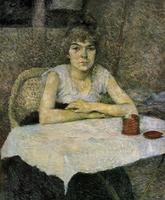
Rice Powder
Henri de Toulouse-Lautrec
Portrait of Mary Cassatt
Edgar Degas
Portrait of Miss Cassatt, holding the cards
Mary Cassatt
Irish Lass
Robert Henri
The Cup of Chocolate
Pierre-Auguste Renoir
At the Milliner's
Edgar Degas
A Visitor
Sarah Purser
Double portrait of Matilda and Gertrude Schonberg
Richard Gerstl
Madame Cezanne Leaning on a Table
Paul Cezanne
Lady at the Tea Table
Mary Cassatt
Portrait of Elizabeth van Rysselberghe, Seated with Her Hands on the Table
Theo van Rysselberghe
The Little Maid Servant
Berthe Morisot
Lotty and a Lady
George Washington Lambert
Portrait of a Woman
Robert Falk
Portrait of Emilie Amiet-Baer
Cuno Amiet