
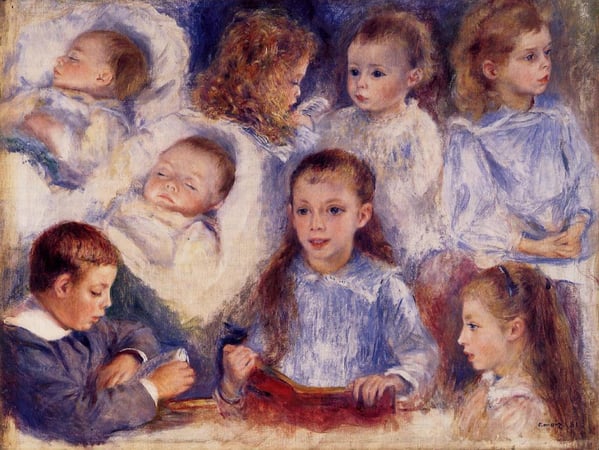
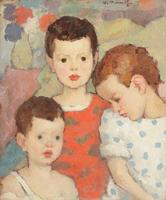
Studies of the Children of Paul Berard
Dettagli
Analisi esperta di Studies of the Children of Paul Berard di Pierre-Auguste Renoir
Stile: Impressionism · Genere: sketch and study
Expert Analysis of "Studies of the Children of Paul Berard" by Pierre-Auguste Renoir
This drawing, classified as a sketch and study within the Impressionist style, holds particular significance because it captures a pivotal moment in Renoir’s career—the so-called "Rejection of Impressionism." The artwork is far more than a casual preparatory drawing; it serves as a visual diary of Renoir’s evolving artistic philosophy.
What Makes It Significant:
-
A Bridge Between Modes: Renoir, after his peak Impressionist years (the 1870s), began to feel constrained by the movement’s emphasis on pure optical sensation, fleeting light, and fragmented brushwork. This study of the children of his patron Paul Berard was created during this transitional "anti-Impressionist" phase. Here, Renoir tempers the characteristic spontaneity of Impressionism—visible in the loose, sketchy lines—with a growing interest in more structured composition and classical form. The drawing’s unfinished nature gives us direct access to Renoir’s process of exploration, showing him shifting toward the smoother, more polished style of his later "pearl and mother-of-pearl" period.
-
Intimacy with the Subject: Paul Berard was a wealthy diplomat and one of Renoir’s most loyal patrons, hosting him at his estate, the Château de Wargemont. Renoir produced numerous portraits of the Berard children. This study is significant for its sheer informality: it is not a commissioned portrait but a personal, fleeting observation—likely a rapid sketch capturing the children at rest or play. This unguarded quality reflects the Impressionist core principle of capturing modern life en instant, but applied to the domestic sphere, signaling Renoir’s deep engagement with the human figure rather than landscape.
-
Mastery of Line Over Light: Whereas pure Impressionist sketches typically prioritize color and light, this study is executed primarily in graphite (or chalk), focusing on contour and mass. The multiple overlapping lines—a hallmark of a working sketch—suggest Renoir was studying the children’s poses, proportions, and the fall of fabric. The significance lies in its demonstration that Renoir, even when "rejecting" Impressionism’s optical effects, remained a virtuoso draftsman. The work anticipates his later, more classical nudes and portraits, showing he never abandoned the discipline of drawing.
-
Document of a Patron Relationship: The Berard commission series (including paintings like Children at Wargemont and The Berard Children) was Renoir’s financial lifeline during this period. This study, therefore, is not just an artwork but a historical document of the patronage system that allowed Renoir to experiment with a new, more structured style while still relying on Impressionist methods of observation.
In summary, this sketch is a key transitional piece. It retains the Impressionist light touch and spontaneity in its rapid execution, yet points toward the firmer, more linear, and classical sensibility that Renoir would fully embrace after 1884. It reveals an artist in the act of questioning his own revolution—a rare and valuable glimpse into creative doubt and renewal.
Museum / Gallery
Visivamente simili
20 opere con composizione e palette affini
Portraits of Marie Sophie Chocquet
Pierre-Auguste Renoir
The Children
Pierre-Auguste Renoir
Mother and Child
Julian Alden Weir
Women and Child
Pierre-Auguste Renoir
Two little girls with a ball and doll and a reading boy
Karl Gussow
Ruth Sears Bacon
John Singer Sargent
My Family
Joaquín Sorolla
Children`s Heads
Pierre-Auguste Renoir
Mother about to Wash her Sleepy Child
Mary Cassatt
Mother and Children
Mary Cassatt
Portraits of Two Children
Pierre-Auguste Renoir
The Family Doctor János Plesch
Max Slevogt
Portrait of the artist's daughter
Joan Brull
The Lesson
Pierre-Auguste Renoir
Jungle Tales
James Jebusa Shannon
Portrait De Fillettes Helena Et Władysława Chmielarczyk
Olga Boznańska
Portrait of a Young Girl (Elizabeth Maitre)
Pierre-Auguste Renoir
Women Admiring a Child
Mary Cassatt
Pattycake
Mary Cassatt
Three Brothers (The Painter's Children)
Nicolae Tonitza