
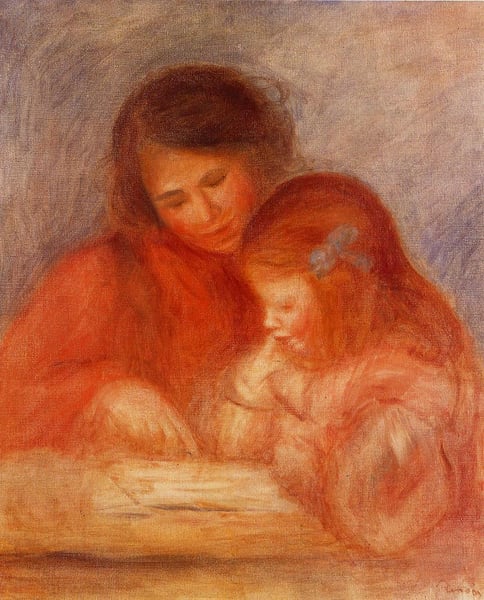
Analisi esperta di The Lesson di Pierre-Auguste Renoir
Stile: Impressionism · Genere: genre painting
Expert Art Historical Analysis: "The Lesson" by Pierre-Auguste Renoir
Significance within Impressionism and Renoir’s Later Years
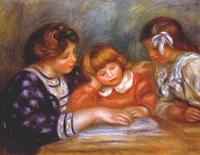
Pierre-Auguste Renoir’s The Lesson (circa 1906–1910) stands as a quintessential example of his mature, late‑Impressionist style—a period when he moved beyond the pure, broken brushwork of the 1870s toward a more tactile, voluptuous handling of paint. Painted in the first decade of the 20th century, this work reflects Renoir’s deepening interest in warmth, human intimacy, and the sensuous pleasures of everyday life, all filtered through a softened, almost hazy application of color and light.
Composition and Subject
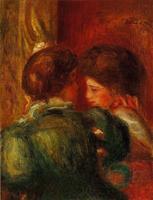
The painting belongs to the genre of genre painting, depicting an ordinary, unglamorous moment: a young girl (likely one of Renoir’s frequent child models, perhaps his son’s nurse or a local girl) sits absorbed in a book or lesson, while an older companion—possibly a mother or tutor—leans in beside her. The scene is intimate, domestic, and devoid of narrative drama. Renoir’s focus is not on the lesson itself but on the quiet connection between the two figures. Their bodies are arranged in a gentle diagonal, their heads nearly touching, creating a secure, enclosing space. The child’s downcast eyes and the adult’s protective presence emphasize tenderness over instruction.
Stylistic Hallmarks of Renoir’s Later Years
By the time Renoir painted The Lesson, he had fully embraced a style characterized by:
- Soft, feathery brushwork: Strokes are loose and fluid, blending into one another rather than remaining separate as in High Impressionism. This gives flesh and fabric a luminous, almost melting quality.
- Warm, earthy palette: Unlike the cool, silvery tones of Monet’s water lilies, Renoir’s later palette leans toward rose, peach, ochre, and burnt sienna. Here, the faces and hands glow with a rosy warmth, while the background dissolves into a rich, undefined amber-brown—a deliberate retreat from sharp detail.
- Suppression of linear definition: Contours are blurred, edges softened. The child’s dress and the adult’s shawl merge with the background, reinforcing the idea that the figures are part of a unified, atmospheric whole rather than isolated forms.
- Emphasis on tactile sensation: Renoir famously said, “I like paintings that make me want to stroke them.” In The Lesson, the paint itself feels creamy and dense, inviting the viewer’s eye to “touch” the surfaces—the sheen of hair, the plumpness of a cheek, the fold of a sleeve.
Contrast to Earlier Impressionism
- High Impressionism (1870s): Works like Luncheon of the Boating Party (1881) are crowded with figures, crisply defined objects, and a lively urban or suburban setting. Brushwork is brisk and energetic.
- Later Years (after 1890): As seen in The Lesson, Renoir retreats from complex social scenes. The backdrop is reduced to a warm, indistinct space; the viewer’s attention is pulled inward to the two faces. This reflects Renoir’s deepening arthritis (which forced him to tie brushes to his hands) and his philosophical pivot toward permanence, comfort, and timeless human bonds.
Why It Matters
The Lesson is significant because it encapsulates Renoir’s final artistic manifesto: that beauty resides not in dramatic events or dazzling light effects, but in the quiet, tender rituals of daily life. The painting rejects the anxious modernity of the early 20th century (Cubism, Fauvism) in favor of a serene, classicizing humanism. It also demonstrates how Impressionism could evolve—from capturing fleeting moments to celebrating enduring states of being. In this sense, The Lesson is both a culmination of Renoir’s lifelong pursuit of pleasure and a gentle farewell to the movement he helped define.
Museum / Gallery
Genere
Stile
Visivamente simili
20 opere con composizione e palette affini
Leontine and Coco
Pierre-Auguste Renoir
The Writing Lesson
Pierre-Auguste Renoir
Claude Renoir Playing with Dominos
Pierre-Auguste Renoir
The lesson
Pierre-Auguste Renoir
Jean Renoir Writing
Pierre-Auguste Renoir
Young gypsy girls
Pierre-Auguste Renoir
Woman Reading
Pierre-Auguste Renoir
Gabrielle and Jean
Pierre-Auguste Renoir
Coco Reading
Pierre-Auguste Renoir
Portrait of coco
Pierre-Auguste Renoir
Leontine Reading
Pierre-Auguste Renoir
Coco
Pierre-Auguste Renoir
Woman in white
Pierre-Auguste Renoir
The reading
Pierre-Auguste Renoir
Portrait of a Young Girl
Pierre-Auguste Renoir
Head of a Little Girl in Profile
Pierre-Auguste Renoir
The Alphabet (Jean and Gabrielle)
Pierre-Auguste Renoir
Lenna Painting (The Artist's Daughter)
William James Glackens
Girl with a Dog
Pierre-Auguste Renoir
Two Women s Heads (The Loge)
Pierre-Auguste Renoir