
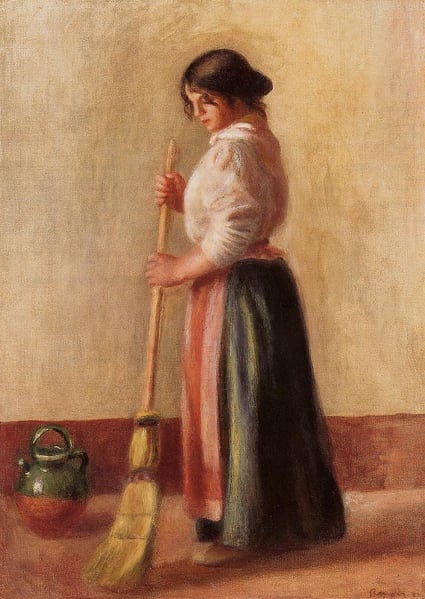
Expertenanalyse zu Pierre-Auguste Renoirs Sweeper
Stil: Impressionism · Genre: genre painting
Expert Analysis of Sweeper by Pierre-Auguste Renoir
Pierre-Auguste Renoir’s Sweeper stands as a compelling testament to a critical turning point in the artist’s career—a moment when he deliberately distanced himself from the purely optical concerns of Impressionism and began to reassert classical draftsmanship and compositional stability. Though painted during his so-called “Rejection of Impressionism” period (roughly the mid-1880s), the work retains the warm, luminous palette and everyday subject matter that define his earlier output, while introducing a new formal discipline.
Stylistic Tension:
The painting is a genre scene—a domestic worker sweeping—a humble, unidealized subject typical of Impressionism. Yet Renoir’s treatment is far from the fleeting, sketchy brushwork of his 1870s masterpieces. Instead, the figure is built with firmer contours, more sculptural modeling, and a controlled sense of space. The floor and background are rendered with broader, looser strokes, but the sweeper’s arms, apron, and broom are delineated with a crispness that recalls the linear tradition of Ingres. This dual approach makes Sweeper a hybrid work: it simultaneously celebrates everyday life (a core Impressionist theme) while rejecting the movement’s emphasis on capturing ephemeral light and color over solid form.
Significance in Renoir’s Oeuvre:
Sweeper is significant because it documents Renoir’s personal crisis of style—a conscious retreat from the “blurry” aesthetic that had defined Impressionism. After a trip to Italy in 1881–82, Renoir declared that he had “gone as far as possible with Impressionism” and began seeking a more timeless, classical structure. In Sweeper, we see that search materialized: the figure is stable, the composition pyramidal, and the brushwork more disciplined, yet the subject remains resolutely modern and prosaic. It is not a mythological allegory but a real person caught in a routine gesture—a nod to Degas’s fondness for working-class themes—but executed with a new clarity that anticipates his later, more monumentally classical nudes.
Art-Historical Context:
Within the broader arc of Impressionism, Sweeper represents a transitional artifact—evidence that the movement was not monolithic. Renoir’s “rejection” was not a denial of his own innovations but a recalibration. By merging the immediacy of modern life with a renewed interest in contour and volume, he paved the way for the Post-Impressionist fascination with structure (think of Cézanne or Seurat) while retaining the warmth and sensuousness that made his work beloved. Sweeper reminds us that artistic progress is rarely linear; sometimes, moving forward means looking backward to move forward again.
Museum / Gallery
Visuell ähnlich
20 Werke mit ähnlicher Komposition und Farbpalette

Young Italian Woman from Papigno with Her Spindle
Camille Corot

Woman with a Broom
Vincent van Gogh

Gleaner
Julien Dupré

Italian Flower Girl
James Taylor Harwood

Young Shepherdess
Charles Victor Thirion

Little shepherd girl
Pericles Pantazis
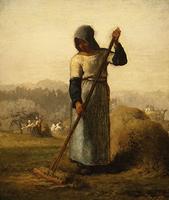
Woman with a rake
Jean-Francois Millet
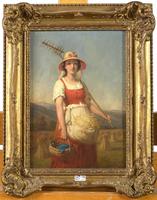
Le retour des moissons
Francois Verheyden

Scheveningen Woman
Vincent van Gogh

Peasant Woman
Camille Pissarro
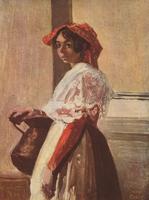
Italian with Mug
Camille Corot

Woman Carrying Firewood and a Pail
Jean-Francois Millet

Charity
Jean-Francois Millet

The belt
Théodore Ralli
Little girl eating cherries
Jules Breton
A Girl Raking
Vincent van Gogh

At the Well
Nicolae Vermont
Fresh Eggs
Winslow Homer

Girl with a Rake
Jules Breton
Servant Returning from the Market
Jean-Baptiste-Simeon Chardin