
Analisi esperta di Two Women s Heads (The Loge) di Pierre-Auguste Renoir
Stile: Impressionism · Genere: genre painting
Expert Analysis: Two Women’s Heads (The Loge) by Pierre-Auguste Renoir
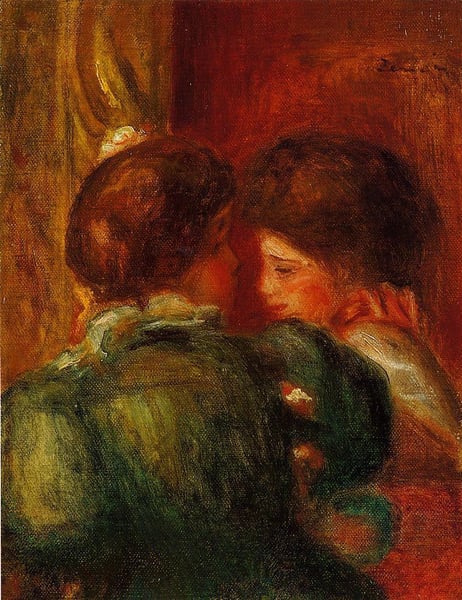
Pierre-Auguste Renoir’s Two Women’s Heads (The Loge) is a quintessential example of his later Impressionist period, executed when the artist had begun to move away from the strict plein-air naturalism of his earlier years toward a more decorative, voluptuous handling of form and color. Painted in the genre of social scene—an intimate glimpse of fashionable Parisian life—the work captures two women seated in a theater box, a motif Renoir explored throughout his career, most famously in The Loge (1874).
Significance within Impressionism and Renoir’s Later Style
This painting is significant for several reasons:
-
Evolution of Brushwork and Color – In his later years, Renoir softened his broken Impressionist touches, allowing his figures to emerge from a haze of warm, creamy tones. Here, the faces are modeled with delicate dabs of pink, peach, and pearl, while the background and clothing dissolve into a shimmer of loose strokes. This technique foreshadows his move toward the “pearly” style of the 1880s and beyond, where flesh becomes luminous and almost porcelain-like.
-
Modernist Subject and Composition – The theater loge was a hallmark subject of Impressionism, symbolizing the modern urban spectacle and the new leisure class. Renoir’s treatment isolates two heads in close proximity, cropping them like a candid photograph—a daring, snapshot-like composition that emphasizes intimacy over narrative. The woman in the foreground, likely a companion or anonymous spectator, gazes outward, while the second figure is partially obscured, creating a sense of fleeting, everyday observation.
-
Sensuous Atmosphere – Unlike many earlier Impressionists who prioritized light over emotion, Renoir’s later work radiates a palpable warmth and sensuality. The loges’ dim, artificial lighting is rendered not as a scientific exercise in color theory, but as a soft, enveloping glow that unites the figures with their surroundings. This tactile quality marks a shift toward a more personal, lyrical Impressionism.
-
Bridge to Symbolism – By the time of this painting, Renoir was moving beyond pure optical realism. The generalized features, the lack of strong individual characterization, and the dreamy, unfocused background all hint at an interest in mood and emotion that aligns with the Symbolist currents of the late 19th century.
In summary, Two Women’s Heads (The Loge) is significant as a transitional work that captures Renoir’s enduring fascination with modern life while showcasing his mature, sensuous technique. It demonstrates how Impressionism could evolve from a radical depiction of light into a refined, almost classical celebration of beauty and intimacy.
Museum / Gallery
Genere
Stile
Visivamente simili
20 opere con composizione e palette affini
Study Two Women s Heads
Pierre-Auguste Renoir
Reader in Green
Pierre-Auguste Renoir
Two girls
Pierre-Auguste Renoir
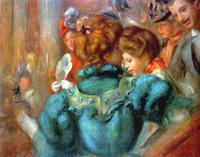
A Box in the Theater des Varietes
Pierre-Auguste Renoir
Bust of a Girl
Pierre-Auguste Renoir
Young Girl Reading
Federico Zandomeneghi
Portrait of a Young Woman
Pierre-Auguste Renoir
Portrait of a Girl in Red
Pierre-Auguste Renoir
Woman`s Head, The Thinker
Pierre-Auguste Renoir
The Little Reader (Little Girl in Blue)
Pierre-Auguste Renoir
Violet Sargent
John Singer Sargent
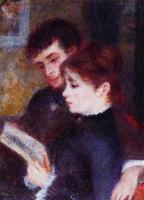
Reading Couple (Edmond Renoir and Marguerite Legrand)
Pierre-Auguste Renoir
Portrait of Coco
Pierre-Auguste Renoir

The Little Reader
Pierre-Auguste Renoir
The Jewels
Edgar Degas
Portrait of a Woman
Pierre-Auguste Renoir
The Reading
Pierre-Auguste Renoir
Melancholy
Edgar Degas
The Writing Lesson
Pierre-Auguste Renoir
Dancer in her dressing room
Edgar Degas