
Pierre-Auguste Renoir sanatçısının The Spring eseri hakkında uzman analizi
Tarz: Impressionism · Tür: allegorical painting
Expert Analysis of The Spring by Pierre-Auguste Renoir
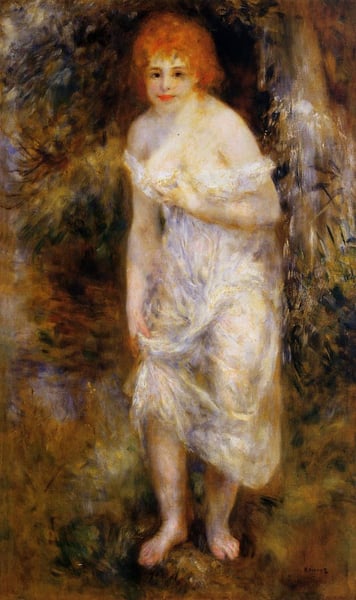
The Spring stands as a pivotal work within Renoir’s later years, showcasing his mature synthesis of Impressionist technique with classical allegorical ambition. While Impressionism is often identified with spontaneous scenes of modern life, this painting asserts the movement’s capacity for timeless, idealized subject matter—here, the personification of the season as a female figure.
Significance within Impressionism and the Later Period
During his later years, Renoir moved away from the strict broken brushwork of early Impressionism toward a more linear, sculptural form influenced by Renaissance masters such as Raphael. The Spring exemplifies this evolution: the figure’s solid, rounded volumes and carefully delineated contours demonstrate a renewed interest in classical composition, yet the vibrant, warm palette and soft, dappled light remain unmistakably Impressionist. This blending of ideals makes the work significant as a testament to how Impressionism could absorb traditional genres—especially the allegorical—without losing its core commitment to capturing transient light and atmosphere.
Allegory as an Impressionist Subject
Allegorical painting had long been the domain of academic art, but Renoir reimagines it through an Impressionist lens. The Spring does not simply depict a mythological figure; it evokes the sensuous, fertile essence of the season through the model’s relaxed pose, the lush greenery that surrounds her, and the glowing, warm tones of her skin. The painting becomes a meditation on nature’s vitality, filtered through Renoir’s personal, intimate vision. This fusion of allegory with the immediate, perceptual focus of Impressionism marks a key moment in the artist’s career—demonstrating that even in his later, more structured phase, he remained committed to the movement’s revolutionary celebration of visual sensation.
Legacy and Artistic Synthesis
Ultimately, The Spring is significant because it encapsulates Renoir’s late style: a deliberate, harmonious balance between the fleeting and the eternal. It affirms that Impressionism was not a rigid doctrine but a flexible approach capable of embracing traditional themes while retaining its radical core of color, light, and human sensuality. For viewers, the work offers a window into Renoir’s personal artistic journey—as he moved from capturing the impression of a moment to shaping that moment into a timeless allegory of renewal.
Museum / Gallery
Görsel olarak benzer
İlişkili kompozisyon ve renk paletine sahip 20 eser
Spring (The Four Seasons)
Pierre-Auguste Renoir
Standing Bather
Pierre-Auguste Renoir
Nude Sitting in the Forest
Pierre-Auguste Renoir
Model with bare breast
Pierre-Auguste Renoir
Bather
Pierre-Auguste Renoir
Standing Bather
Pierre-Auguste Renoir
Nude in the Greenery
Pierre-Auguste Renoir
The Symbol of Spring
Edmund Charles Tarbell
Lady in white dress holding flowers
George Elgar Hicks
Bather drying herself
Pierre-Auguste Renoir
Bathing
Pierre-Auguste Renoir
Young Woman Braiding Her Hair
Pierre-Auguste Renoir
Bust of a Young Woman with Flowered Ear
Pierre-Auguste Renoir
Bather
Pierre-Auguste Renoir
Blonde bather
Pierre-Auguste Renoir
Two Women with Flowered Hat
Pierre-Auguste Renoir
Bather with Long Hair
Pierre-Auguste Renoir
Springtime
Charles-Amable Lenoir
Gabrielle with a Rose (The Sicilian Woman)
Pierre-Auguste Renoir
Ophelia
Konstantin Makovsky