
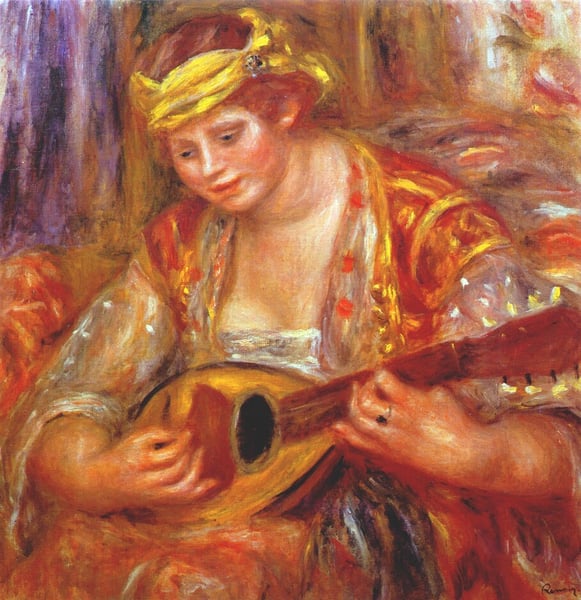
Analisi esperta di Woman with a mandolin di Pierre-Auguste Renoir
Stile: Impressionism · Genere: genre painting
Expert Analysis: "Woman with a Mandolin" by Pierre-Auguste Renoir
Style: Impressionism | Genre: Genre painting | Period: Later Years
In "Woman with a Mandolin," Renoir presents a quiet, intimate scene that exemplifies the evolution of his late-career Impressionism. Painted during his “Later Years” (roughly the 1880s–1910s), this work marks a deliberate shift away from the pure, flickering spontaneity of early Impressionism toward a more structured, classical approach—while still retaining the movement’s signature sensitivity to light and color.
Significance within Impressionism and Renoir’s Oeuvre:
-
Fusion of Impressionist Color with Classical Form
Unlike the looser, sketch-like brushwork of his earlier outdoor scenes, Renoir here models the figure with firmer contours and smoother passages, especially in the woman’s face, hands, and the mandolin’s curved body. Yet the warm, dappled highlights on her skin and the soft, almost hazy background (typical of late Renoir) keep the painting firmly rooted in Impressionist ideals. This balance—structure without sacrificing atmospheric vibrancy—demonstrates Renoir’s mature search for a “timeless” yet modern harmony. -
Genre Painting as a Study of Graceful Domesticity
As a genre painting, “Woman with a Mandolin” does not tell a grand narrative but captures a moment of absorption: the sitter’s gentle focus on her instrument. This reflects Impressionism’s broader interest in everyday life. In Renoir’s later work, such themes become vehicles for idealized femininity and tactile pleasure—the soft shimmer of fabric, the rosy glow of skin, the gleam of wood. The mandolin itself, a recurring motif in Western art, here evokes not only music but a sense of refined leisure, a hallmark of Renoir’s bourgeois subjects. -
Renoir’s Shift Toward Monumentality
By this period, Renoir had traveled to Italy and studied Raphael, prompting a firmer handling of the human figure. In “Woman with a Mandolin,” we see that influence in the solid, rounded form of the woman and the balanced composition—her tilted head echoes classical grace. Yet the blurred edges and broken touches of color in the background (perhaps a curtain or wall) prevent the scene from becoming static. The result is a synthesis: an Impressionist intimacy rendered with a timeless, sculptural coherence. -
Technical Nuance in the Later Years
Renoir’s palette in this work is typical of his late phase: pearly whites, rose, soft blues, and golden ochres. The light appears to originate from within the painting itself, bathing the woman’s face and the instrument in a warm, unified glow. The mandolin’s body is painted with short, horizontal strokes of gold and brown, while the woman’s dress dissolves into delicate, shimmering patches of color—evidence that Renoir never abandoned the broken brushstroke; he simply refined it.
Conclusion:
“Woman with a Mandolin” is significant as a transitional masterpiece within Impressionism. It captures Renoir’s late-career ambition to reconcile the fleeting beauty of modern life with the enduring grace of classical art. The painting embodies Impressionism’s core—light, color, and the celebration of ordinary sensory pleasure—while pointing toward a more controlled, monumental vision that would influence later figurative painting. In this work, Renoir proves that even in his later years, he remained a brilliant orchestrator of color, form, and emotion—turning a simple genre scene into a meditation on harmony, both musical and painterly.
Visivamente simili
20 opere con composizione e palette affini
Girl with a mandolin
Pierre-Auguste Renoir

Christine Nilson, or The Bohemian with a Mandolin
Camille Corot
Dedee in spanish dress
Pierre-Auguste Renoir
Andree in Yellow Turban and Blue Skirt
Pierre-Auguste Renoir
Woman Playing Cards
Pierre-Auguste Renoir
The Entertainer
Carolus-Duran
Portrait Of Guusje Van Dongen Door
Isaac Israels
Morning music
Dante Gabriel Rossetti
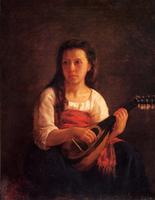
The Mandolin Player
Mary Cassatt

The Beautiful Bandurria Player
Raimundo de Madrazo
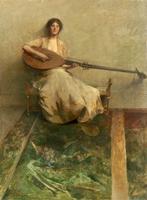
Girl with Lute
Thomas Dewing
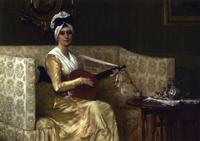
Portrait of Mrs. Millet
Francis Davis Millet
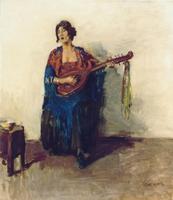
Portret Van Guus Van Dongen Door
Isaac Israels
La joueuse de luth
Edwin Austin Abbey
Profile of Andre Leaning Over
Pierre-Auguste Renoir

Lady with a Lute
Thomas Dewing
Madeleine Leaning on Her Elbow with Flowers in Her Hair
Pierre-Auguste Renoir
Odalisque with Mandoline
Iosif Iser
Woman with a Guitar
Pierre-Auguste Renoir
The music composer
Gustavo Simoni