
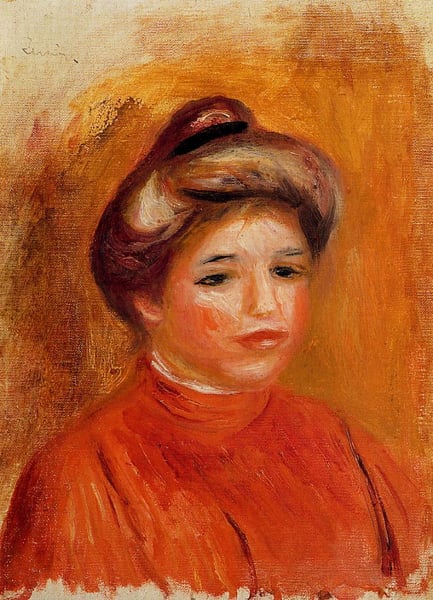
Expert analysis of Pierre-Auguste Renoir’s Woman`s Head
Style: Impressionism · Genre: portrait
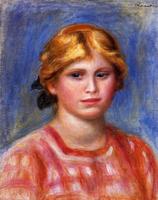
Expert Analysis of "Woman's Head" by Pierre-Auguste Renoir
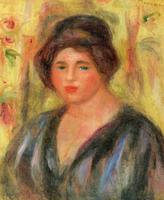
As an Impressionist portrait from Pierre-Auguste Renoir’s Later Years, "Woman's Head" exemplifies the artist’s mature departure from the spontaneous, outdoor scenes of his earlier Impressionist phase toward a more refined, sensuous focus on the female form. Created during a period when Renoir was increasingly influenced by classical Renaissance painting (following a trip to Italy in 1881–82), this work bridges the soft, broken brushwork of Impressionism with a warmer, more sculptural handling of flesh and feature.
Significance of the Work:
-
Mature Impressionist Portraiture: While Impressionism often prioritized atmospheric light over modeling, Renoir in his later years retained the luminous palette but applied it with greater subtlety and contour. Here, the sitter’s visage emerges from a haze of delicate, feathery strokes—typical of the artist’s signature “honeyed” surface—yet the underlying structure of cheekbone, jawline, and brow is more defined than in his earlier, looser portraits. This synthesis of immediacy and permanence marks a key evolution in his style.
-
Emphasis on Feminine Idealism: Renoir famously declared he painted “to decorate the walls of museums with nudes and beautiful women.” In "Woman's Head", the subject is not a specific individual but an archetype of idealized femininity: serene, rosy-cheeked, and softly lit. The lack of a detailed background or narrative context focuses attention entirely on the model’s expression and the painterly texture of skin, hair, and fabric. This reflects Renoir’s lifelong obsession with rendering the warmth and vitality of the female figure.
-
Technical Hallmarks of the Later Period: The painting exhibits the diaphanous, almost “cloud-like” brushwork that Renoir developed as his rheumatoid arthritis worsened—forcing him to adapt his technique by strapping brushes to his hands. Yet the result is anything but labored; the strokes remain fluid and vibrant, particularly in the loose treatment of hair and the subtle gradations of shadow on the neck. The background is typically Impressionist in its lack of clear form, but the face itself is given a heightened, pearlescent glow—evidence of Renoir’s shift toward a more decorative, almost Rococo-inspired elegance.
In summary, "Woman's Head" is significant as a transitional work that captures the synthesis of Impressionist color, classical poise, and Renoir’s deeply personal vision of beauty. It stands as a testament to how the artist, even in his later years, refined his approach without abandoning the core principles of light and atmosphere that defined the Impressionist movement.
Museum / Gallery
Visually similar
20 works with related composition and palette
Gabrielle at Her Window
Pierre-Auguste Renoir
Head of a Young Woman
Pierre-Auguste Renoir
Woman in a Red Blouse
Pierre-Auguste Renoir
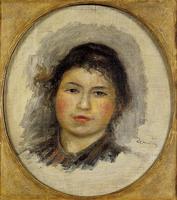
Head of a Young Woman
Pierre-Auguste Renoir
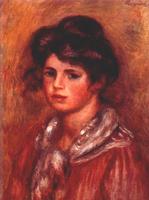
Gabrielle
Pierre-Auguste Renoir
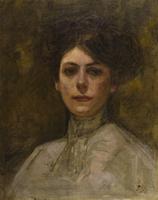
Portrait of An Italian Lady
Fujishima Takeji
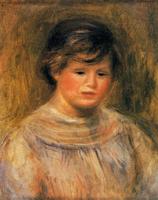
Woman`s Head
Pierre-Auguste Renoir
Self-Portrait
Helene Schjerfbeck
The red carnation
Silvestro Lega
Portrait of a Woman
Grigoriy Goldstein
The red corset
Silvestro Lega
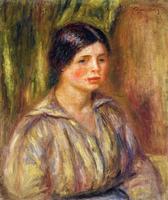
Bust of a Young Woman
Pierre-Auguste Renoir
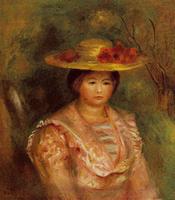
Bust of a Woman (Gabrielle)
Pierre-Auguste Renoir
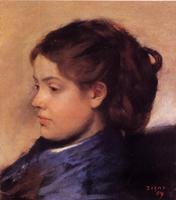
Emma Dobigny
Edgar Degas
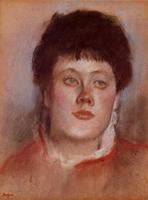
Portrait of a Woman
Edgar Degas
Woman`s Head
Pierre-Auguste Renoir
Woman`s Head
Pierre-Auguste Renoir
Portrait of young woman
Mary Cassatt
Profile of a Woman in a Red Blouse
Pierre-Auguste Renoir
Head of a Young Girl
Pierre-Auguste Renoir