Expert analysis of Kazimir Malevich’s Argentine Polka
Style: Naïve Art (Primitivism) · Genre: genre painting
Expert Analysis: "Argentine Polka" by Kazimir Malevich
Kazimir Malevich is universally celebrated as the pioneer of Suprematism—the radical, non-objective geometric abstraction that reinvented painting in the early 20th century. However, before his leap into pure form, Malevich immersed himself in the visual language of Naïve Art (Primitivism). Argentine Polka (c. 1911) is a crucial example of this earlier phase, revealing the roots of his modernist vision in the vibrant, untutored imagery of folk culture and rural life.
What Makes It Significant
-
A Bridge to Avant-Garde Abstraction
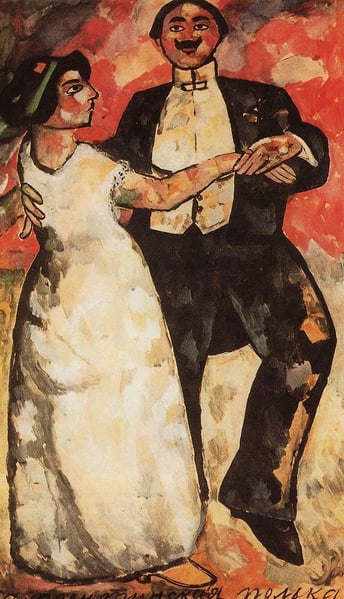
Argentine Polka demonstrates Malevich’s deliberate rejection of academic naturalism in favor of a flattened, simplified visual language. The figures are reduced to bold, almost caricatured silhouettes, their poses stiff and rhythmic—a direct echo of Russian lubok (popular prints) and peasant embroidery. This primitivist reduction was a deliberate strategy to break away from illusionist space, clearing the path toward his later abstract compositions where figures vanish entirely into geometric planes. -
Folk Color and Symbolic Palette
Malevich employs a high-keyed, non-naturalistic color scheme—vivid reds, greens, yellows, and blacks—drawn from traditional Russian folk art. The hues are not descriptive but expressive: the polka dancers are painted as isolated zones of pure pigment, their clothing patterns resembling textile motifs. This approach prefigures his Suprematist use of flat color as an independent, emotional force. -
Genre Painting as Cultural Statement
As a genre painting depicting a social dance (the polka, though titled “Argentine,” is treated as a universal folk celebration), the work aligns with the Primitivist fascination with “authentic” peasant life—a subject that Romanticized the rural as a counter to industrialization. Malevich’s figures, however, are not sentimentalized; their awkward, angular poses and mask-like faces convey a raw, almost ritualistic energy. The dance becomes a metaphor for a pre-modern, unalienated existence, a theme that resonated deeply with the Russian avant-garde’s search for national identity. -
The Argentine Paradox: Global Folk Influence
The title “Argentine Polka” signals the cross-cultural pollination that fascinated early modernists. Malevich merges a Central European dance (the polka) with a geographically distant label, suggesting a universal folk spirit. This reflects the Primitivist belief in a shared, primal human expression that transcends borders—an idea Malevich would later translate into the universal language of Suprematist geometry.
In summary, Argentine Polka is not merely a charming example of early Malevich but a key transition work—one where the artist deliberately unlearns academic conventions by borrowing the directness of naïve art. It stands as a testament to how the “primitive” served as a catalyst for the radical abstraction that would define the 20th century.
Genre
Visually similar
20 works with related composition and palette
English Dance Couple
Ernst Ludwig Kirchner
The Waltz
Anders Zorn
Ballerina in Mauve
Giovanni Boldini
Autumn Tango
Alexander Roitburd
Ginger and Fred 5
Gazmend Freitag
Vaszary János, Párizsi Mulató 1925
Vaszary János
Vaszary János, Virágok 1930
Vaszary János
La Goulue et Valentin
Henri de Toulouse-Lautrec
Dance at Bougival
Pierre-Auguste Renoir
Dancing at the Moulin Galette
Isaac Israels
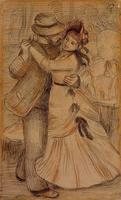
Dance in the Country
Pierre-Auguste Renoir
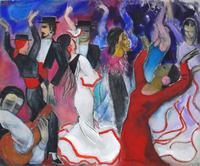
Deja
Biruta Baumane
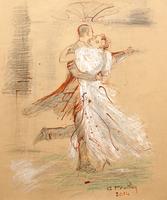
Ginger and Fred 2
Gazmend Freitag
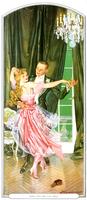
"Suppose Your Hair Came Down" An Advertisement for Palmolive Shampoo
Frank Xavier Leyendecker
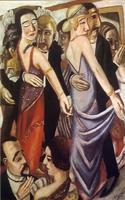
Dancing Bar in Baden-Baden
Max Beckmann
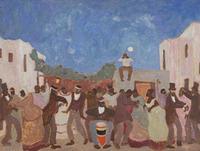
Candombe
Pedro Figari
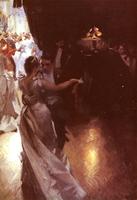
Waltz
Anders Zorn
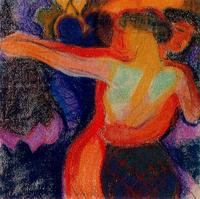
Tango
Frantisek Kupka
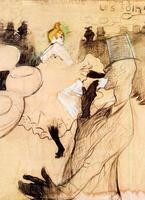
The Goulue and Valentin, The Boneless One
Henri de Toulouse-Lautrec
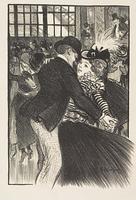
J'ai Voulu Fuir
Theophile Steinlen