Analisi esperta di The Waltz di Anders Zorn
Stile: Realism · Genere: genre painting
Expert Analysis: "The Waltz" by Anders Zorn
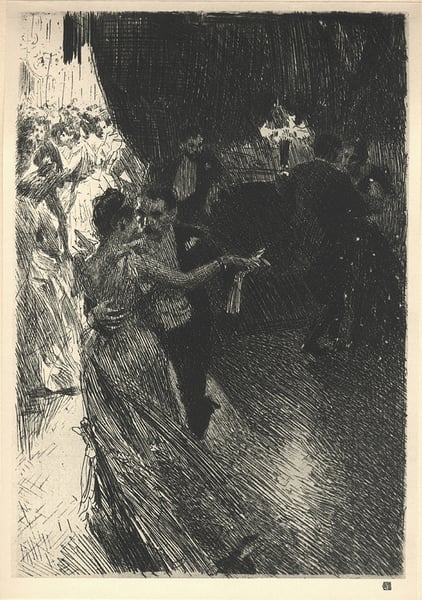
Anders Zorn’s The Waltz stands as a masterful example of Realist genre painting, capturing a fleeting moment of social intimacy with remarkable spontaneity and technical brilliance. Executed in the late 19th century, the work exemplifies the Realist commitment to depicting contemporary life without idealization, focusing instead on the honest, unposed experience of a couple dancing.
Significance within Realism and Genre Painting
- Capturing Motion and Light: Zorn’s signature brushwork—loose, energetic, and seemingly effortless—conveys the swirling movement of the waltz. The dappled light playing across the figures’ clothing and faces is rendered with a naturalistic immediacy that reinforces the Realist goal of portraying the world as it is seen, not as it is staged. The interplay of shadow and highlight gives the scene a transient, snapshot-like quality, as if the viewer has stumbled upon a genuine moment.
- Social Commentary: By choosing the waltz—a dance once considered scandalous for its close embrace—Zorn subtly addresses shifting social mores in late-19th-century Europe. A Realist genre painting often serves as a document of everyday life, and here the intimacy of the dancers reflects contemporary attitudes toward leisure, courtship, and public decorum. The painting neither moralizes nor romanticizes; it simply observes, embodying the Realist ethos of truthful representation.
- Technical Virtuosity: Zorn’s limited palette (typical of his mature style, often centered on white, black, red, and yellow) is used to astonishing effect. The fluid strokes that define the woman’s white gown and the man’s dark coat create a dynamic contrast, while the blurred background suggests the whirl of the dance hall. This technique—prioritizing immediacy over detail—aligns with the Realist interest in capturing the sensory experience of a moment, rather than producing a polished academic composition.
Why It Matters
The Waltz is significant because it exemplifies how Realist genre painting could transcend mere anecdote to become a study in movement, light, and human connection. Zorn’s ability to distill the energy of a dance into a single, vibrant frame places the work at the heart of Realism’s project: to elevate the ordinary into art through acute observation and masterful execution.
Visivamente simili
20 opere con composizione e palette affini
Waltz
Anders Zorn
Dancing at the Moulin Galette
Isaac Israels
Ballerina in Mauve
Giovanni Boldini
In a Ballroom
Mahmoud Saiid
The Ball
Julius LeBlanc Stewart
Stomp
Archibald Motley
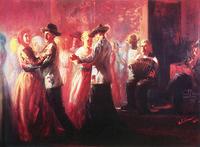
Baile na Roça
Candido Portinari
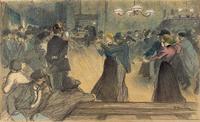
Bal de Barriere drawing
Theophile Steinlen
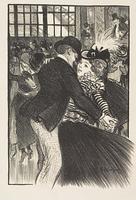
J'ai Voulu Fuir
Theophile Steinlen
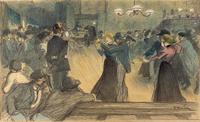
Ball in Paris suburb
Theophile Steinlen
Study for The Spanish Dance
John Singer Sargent
Couple Dancing
Vincent van Gogh
Study of the Bal Tarbarin
Jan Sluyters
El Jaleo
John Singer Sargent
A Hunt Ball
Julius LeBlanc Stewart
Autumn Tango
Alexander Roitburd
Dancers at Monicos
Gino Severini
New Year Ball at Park Otel
Ibrahim Calli
Los 41 maricones
Jose Guadalupe Posada
English Dance Couple
Ernst Ludwig Kirchner