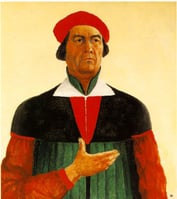
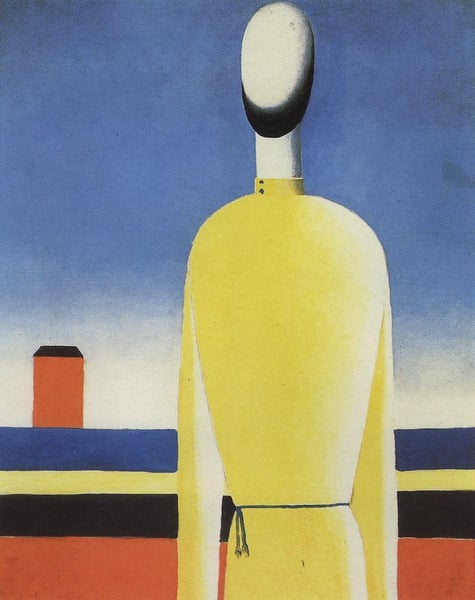
Complex Presentiment: Half-Figure in a Yellow Shirt
Details
Expert analysis of Kazimir Malevich’s Complex Presentiment: Half-Figure in a Yellow Shirt
Style: Neo-Suprematism · Genre: portrait
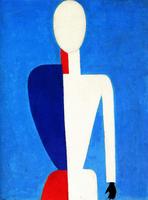
The artwork "Complex Presentiment: Half-Figure in a Yellow Shirt" by Kazimir Malevich is a striking example of Neo-Suprematism applied to the portrait genre—a rare and significant departure from his earlier, fully abstract Suprematist compositions.
Significance within Neo-Suprematism:
Malevich developed Suprematism around 1915, championing pure geometric abstraction as a means to transcend earthly representation. By the mid-1920s, however, his Neo-Suprematism reintroduced figurative elements while retaining the dynamic, non-objective spatial logic of earlier works. This painting exemplifies that shift: the half-length figure is rendered as a carefully balanced arrangement of simplified, almost geometric forms—the yellow shirt becomes a bold, flat plane of color, while the face and body are reduced to archetypal shapes. The “complex presentiment” in the title hints at a psychological or cosmic tension, conveyed through the interplay of warm yellow against cooler tones and the ambiguous, slightly tilted posture of the figure.
Why it matters:
- Genre innovation: Portraiture is rare in Malevich’s Suprematist output. Here, he fuses the human form with the abstract vocabulary of circles, rectangles, and dynamic diagonals, creating a bridge between his earlier radical abstraction and a renewed interest in recognizable subject matter.
- Neo-Suprematist evolution: This work marks a mature phase where Malevich sought to infuse traditional genres with the spiritual and non-representational energy of Suprematism, resisting the Soviet push for Socialist Realism. The half-figure seems suspended in an undefined, timeless space—a hallmark of Neo-Suprematist spatial ambiguity.
- Chromatic power: The yellow shirt is not merely a garment but a compositional anchor. Malevich uses bold, unmodulated color to flatten depth, forcing the viewer to read the figure as a pictorial structure rather than a psychological document.
In essence, this portrait is a pivotal work that demonstrates how Malevich reimagined the human image through a Neo-Suprematist lens, preserving abstraction’s metaphysical ambition while reclaiming the power of recognizable form.
Genre
Style
Visually similar
20 works with related composition and palette
Man in Suprematist Landscape
Kazimir Malevich
Two Male Figures
Kazimir Malevich
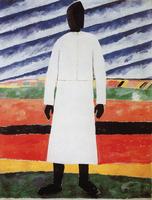
Peasant Woman
Kazimir Malevich
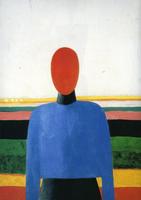
Female Torso
Kazimir Malevich
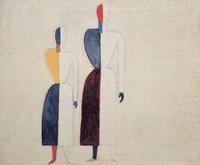
Two Figures
Kazimir Malevich
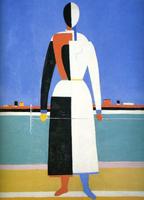
Woman with Rake
Kazimir Malevich
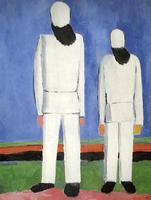
Two Male Figures
Kazimir Malevich
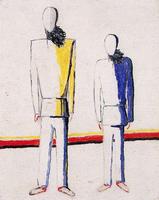
Two peasant
Kazimir Malevich
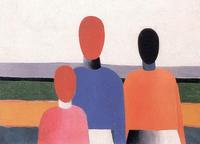
Three Woman Figures
Kazimir Malevich
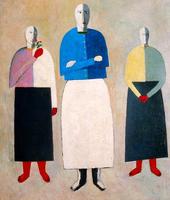
Three Girls
Kazimir Malevich
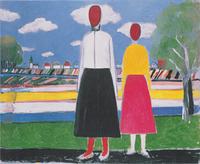
Two Figures in a Landscape
Kazimir Malevich
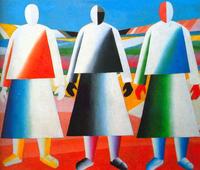
Girls in the Fields
Kazimir Malevich
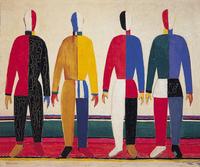
Sportsmen
Kazimir Malevich
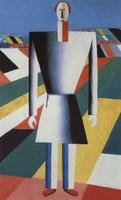
Peasant in the Fields
Kazimir Malevich
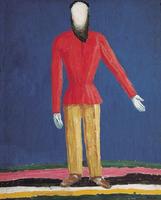
Peasant
Kazimir Malevich
Architect Forbát and his Wife
Sandor Bortnyik
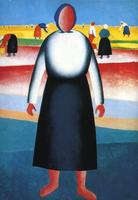
Harvesting
Kazimir Malevich
Julie et l'univers
Jean Paul Lemieux
Torso
Kazimir Malevich
Girl in the Country
Kazimir Malevich