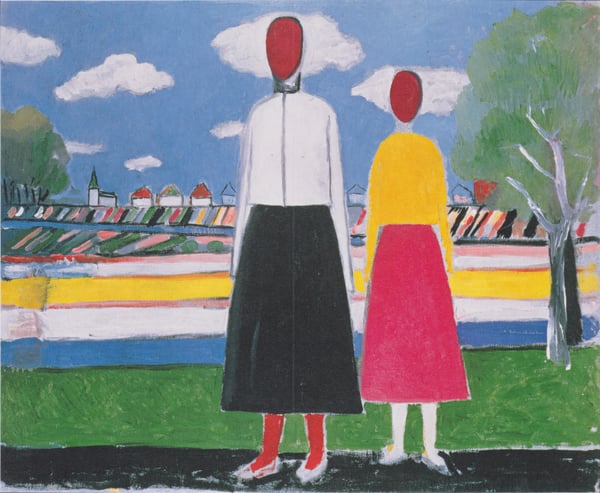
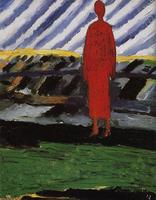
The significance of Kazimir Malevich’s “Two Figures in a Landscape” lies in its paradoxical fusion of the portrait genre with Neo-Suprematism—a style that traditionally rejects representational imagery in favor of pure geometric abstraction. While Malevich’s original Suprematism (c. 1915) eliminated all reference to the natural world, this later Neo-Suprematist iteration re-engages with recognizable subject matter while retaining the movement’s core principles of dynamic composition and elemental shapes. The work is thus a critical document of the artist’s evolution, demonstrating how figuration can be rebuilt through a Suprematist lens rather than simply abandoned. By placing two human figures within a landscape, Malevich asserts that even portraiture can be distilled into a language of colored planes and spatial tension, bridging the gap between radical non-objectivity and the enduring human need for representation.